Dive Brief:
- The U.S. Department of Justice issued a legal memo earlier this month declaring that several of the U.S. Department of Education’s grant programs for minority-serving institutions and students from underrepresented backgrounds are unconstitutional.
- The memo, which was made public Friday, said the DOJ considered the grant programs — some of them decades-old — unlawful because they have racial criteria, such as requiring institutions to have a certain share of students from a particular racial or ethnic group.
- Continuing several of the programs would be unconstitutional, the DOJ said, adding the Education Department could instead redirect the funds. However, the memo concluded that some of them could continue under racially neutral criteria.
Dive Insight:
The Education Department had already canceled grants for MSIs before the DOJ released its memo.
In September, the Education Department said it would end roughly $350 million in discretionary grants for MSIs, arguing the funding was discriminatory because colleges had to enroll certain shares of racial or ethnic minority students to be eligible. However, the Education Department still disbursed $132 million in congressionally mandatory grant funding to MSIs.
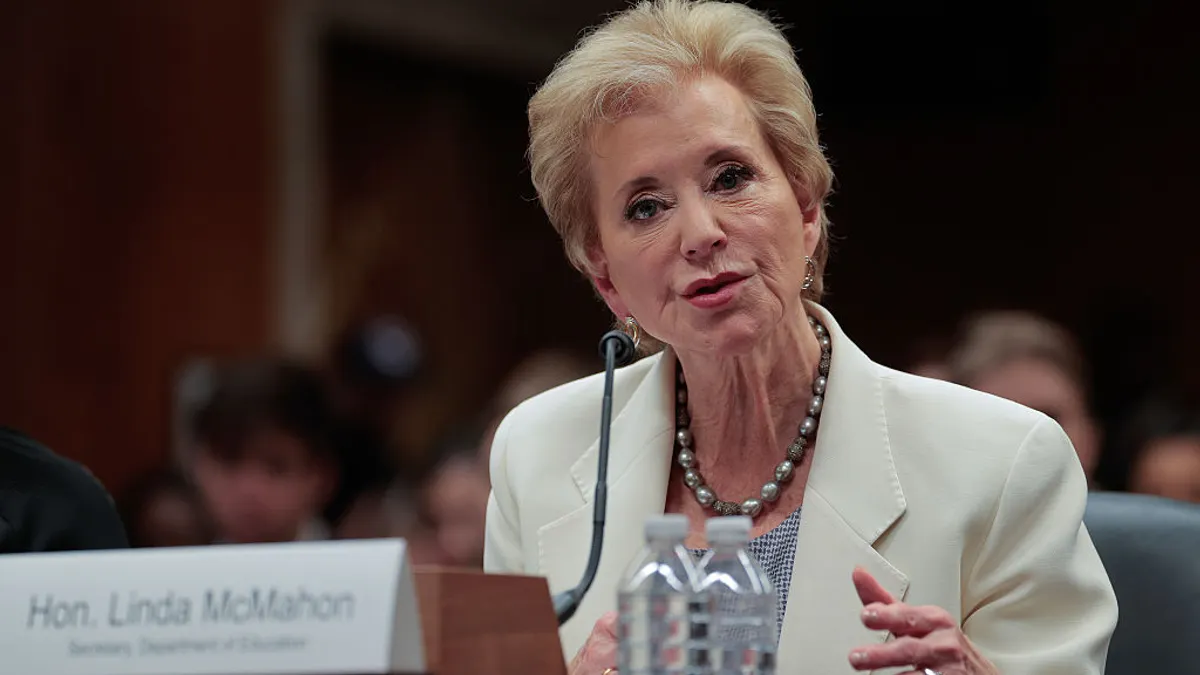
In a statement Friday, U.S. Education Secretary Linda McMahon praised the new memo from the DOJ’s Office of Legal Counsel.
“We cannot, and must not, attach race-based conditions when allocating taxpayer funding,” McMahon said. “This is another concrete step from the Trump Administration to put a stop to DEI in government and ensure taxpayer dollars support programs that advance merit and fairness in all aspects of Americans lives.”
Citing the U.S. Supreme Court decision striking down race-conscious admissions in 2023, the memo found the following grant programs were unconstitutional and said that the Education Department may repurpose their funding:
- Grant programs for Hispanic-serving institutions, including those aimed at improving their academic offerings and increasing the number of Hispanic and low-income students attaining STEM degrees.
- Grants for Alaska Native and Native-Hawaiian-serving institutions.
- Grants for Native American-serving, nontribal institutions.
- Grants for community-based organizations that primarily provide career and technical education for Native-Hawaiian students.
- Formula-based grants for predominantly-Black institutions, which are intended to be used to improve the colleges' ability to serve low- and middle-income Black students.
However, the DOJ said the Education Department could continue the following programs so long as it set aside their race-based eligibility criteria:
- The Minority Science and Engineering Improvement Program, which aims to increase the number of minority students entering science and engineering fields.
- The Ronald E. McNair Postbaccalaureate Achievement Program, which gives colleges funding to support students from disadvantaged backgrounds in research and other scholarly work.
- Competitive grant programs for predominantly-Black institutions, which has included funding for several types of initiatives, including establishing STEM programs and improving educational outcomes of African American men.
- Student Services Support Program, which provides funding to colleges to help them bolster student services.
The Education Department said it is reviewing the memo’s impact on its grant programs.
Virginia Rep. Bobby Scott, the top Democrat on the House’s education committee, slammed the memo in a statement Friday, arguing it was at odds with the Higher Education Act’s purpose of ensuring that students from all backgrounds “can access an affordable, quality degree.”
“A college degree remains the surest path to financial stability,” Scott said. “This is particularly true for low-income students and students of color whose educational and workforce opportunities have historically been limited by intergenerational poverty and systemic racism.”