WASHINGTON — At a time when colleges are facing attacks on their faculty, students and institutional autonomy, public and private stakeholders are pressuring their leaders to make public statements addressing political and social issues.
Such calls have forced college leaders to reevaluate their policy on making statements, potentially balanced against their moral obligations.
These discussions come as colleges have increasingly embraced the practice of institutional neutrality, meaning they won't comment on an issue unless the matter directly impact their interests.
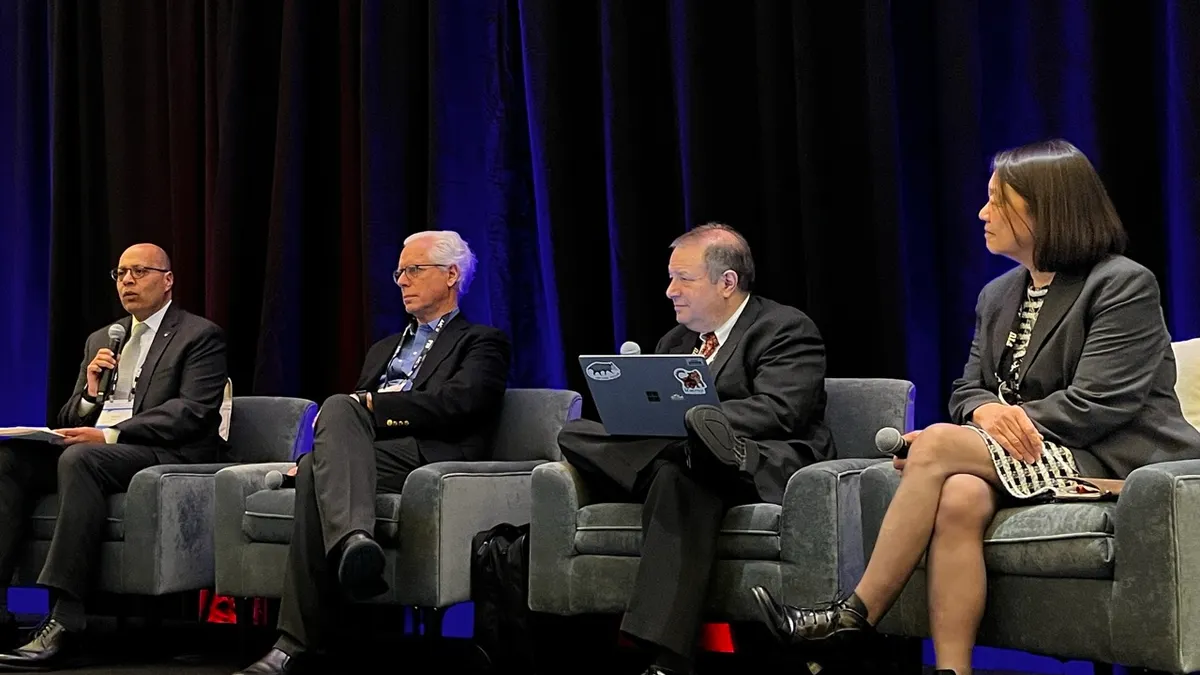
"What we're really asking leaders to do, in my view, is to act in ways that both elevates and reinforces colleges and universities as moral communities with shared values," Karim Ismaili, president of Eastern Connecticut State University, said during a Wednesday panel at the American Association of Colleges and Universities′ annual conference.
But Pam Eddinger, president of Bunker Hill Community College in Massachusetts, warned presidents against viewing courage through a one-dimensional lens or believing that every situation requires the same type of response.
"Sometimes courage is to speak out, or sometimes courage is silent," she said. "Sometimes courage is moderated. Sometimes courage is hiding a student in my office."
Eddinger and Ismaili joined other current and former college presidents in discussing how higher ed leaders can protect their institutional goals in the face of political and financial pressure.
Making public statements
Steven Poskanzer, president emeritus of Carleton College in Minnesota, told AAC&U attendees that public statements should not be restricted to a binary of responding to everything or nothing at all. Instead, he recommended presidents approach such statements with reticence.
"You want to be reticent to speak. But when you do, you need to speak out of principle based on that fidelity to your mission," he said. When that time comes, leaders must be willing to defend their institution "bravely and forthrightly, even if there are going to be consequences," Poskanzer said.
Brian Rosenberg, president emeritus at Macalester College in Minnesota and a visiting professor at Harvard University, evoked the work of Charles Dickens when explaining his decision-making process.
"One of the lessons I took from Dickens is that institutions have a way of dehumanizing people, of robbing them of their basic humanity," he said.
During his almost two decades leading Macalester, he sought to prevent the presidency from erasing his personhood. That often meant taking a stand.
"There were times when I had to keep my mouth shut. I probably didn't do it enough," he said, adding that he learned from Poskanzer in the process.
But he didn't put stock in one argument against presidential statements — that they quash multiplicity of thought.
"I've never been a big believer in the fact that if the president speaks out on an issue and there are differences of opinion, everybody else is going to fall in line," said Rosenberg, adding that very much ran contrary to his experience. Instead, such statements can spark discussion, he said.
Mission statement as North Star
Rosenberg echoed Poskanzer's advice that presidents prioritize their institutional mission when deciding on which issues to speak about openly.
Macalester's mission statement, in part, commits the liberal arts college to maintaining a "special emphasis on internationalism, multiculturalism, and service to society."
Being able to return to that statement, Rosenberg said, makes it clear which moments are important to speak out on.
"When there's a ban on international students coming into the country — or attacks on diversity, equity, inclusion — I took that as a direct challenge to my mission, because it's there in words," he said.
Eddinger likewise said that Bunker Hill's mission is at the forefront of her choices.
"If you're not protecting your mission, you're not really doing anything," Eddinger said, while simultaneously acknowledging that protecting the mission is "getting more and more difficult."
Part of Bunker Hill's mission focuses on diversity and multiculturalism, and it established structures to support its institutional values over the past decade, Eddinger said. That includes student and faculty commissions and a DEI office, Eddinger said.
But Bunker Hill's diversity work had to pivot after the Trump administration began targeting institutions using "diversity, equity and inclusion" language. For example, its Office of Diversity and Inclusion is now called the Office of Access and Opportunity.
"We are forced in some ways to strip away a lot of that language — and I know language is important — but those activities are still being done," she said.
In this type of situation, Eddinger said actions such as continuing to provide services to students can speak louder than words.
Engaging with faculty and students
Faculty and students are often among some of the most vocal groups pressuring college presidents to speak out amid attacks on their institutions.
The panelists advised conference attendees to use these groups as partners in defending their colleges.
Eddinger said she pushes faculty to exercise their academic freedom rights and emphasized to them that "their voice does not always have to be funneled through me."
"There's a learned helplessness sometimes in our faculty that they don't believe that they can speak out," she said. But faculty "are more protected than any other group" and are a vital part of protecting institutional values, Eddinger said.
She also encourages instructors to work closely with students to counteract attacks on specific groups.
"It is really hard to dehumanize … and take agency away when the student is sitting in front of you," Eddinger said.
Rosenberg said that students are looking to college leaders for authenticity. "Students want to see a leader who is also a human being," he said.
Ismaili said he regularly meets with the president of Eastern Connecticut State’s student government association to discuss campus events and policies. During one recent conversation, he said the student came to him with a moral conundrum.
The SGA had received an application to establish a campus chapter of Turning Point USA, a right-wing advocacy group founded by the late Charlie Kirk geared toward young people, and the student president sought advice because she did not feel comfortable having the group on campus.
"So I said, 'What are the rules? What are the procedures? Are you following them the same way as you would for any other group?'" Ismaili told attendees. The same advice applies to administrators, he said.
College leaders must be clear on what their principles are and act on them in consistent, predictable ways, Ismaili said. Those choices serve as a message to students, intentionally or not, he said.
"That resonates for students, because they want to make sure that no particular group of students is being treated differently than others," he said.
Aligning the board with institutional mission
Addressing the ongoing attacks and changes in the higher education sector can't come solely through public messaging, according to Poskanzer.
Presidents must clearly and candidly communicate their vision for their college to stakeholders such as trustees and convince them of its importance, Poskanzer said.
"Some of the greatest dangers come when board members don't feel a genuine loyalty or commitment to the institution," he said. "Instead, they may feel that loyalty or commitment to political powers that are responsible for them being on that job."
For private colleges, Poskanzer said it's not uncommon to see board members driven primarily by ego or a dedication to a specific part of the institution, such as the business school or the football program.
He advised college presidents to work toward "a totally trusting and candid" relationship with their board's chair, something that's crucial for their institution to keep operating properly. For instance, the task of corralling a difficult trustee falls to the chair, not the president, he said.
Poskanzer also recommended presidents to be involved to whatever degree possible in the board selection and training processes at their institutions.