


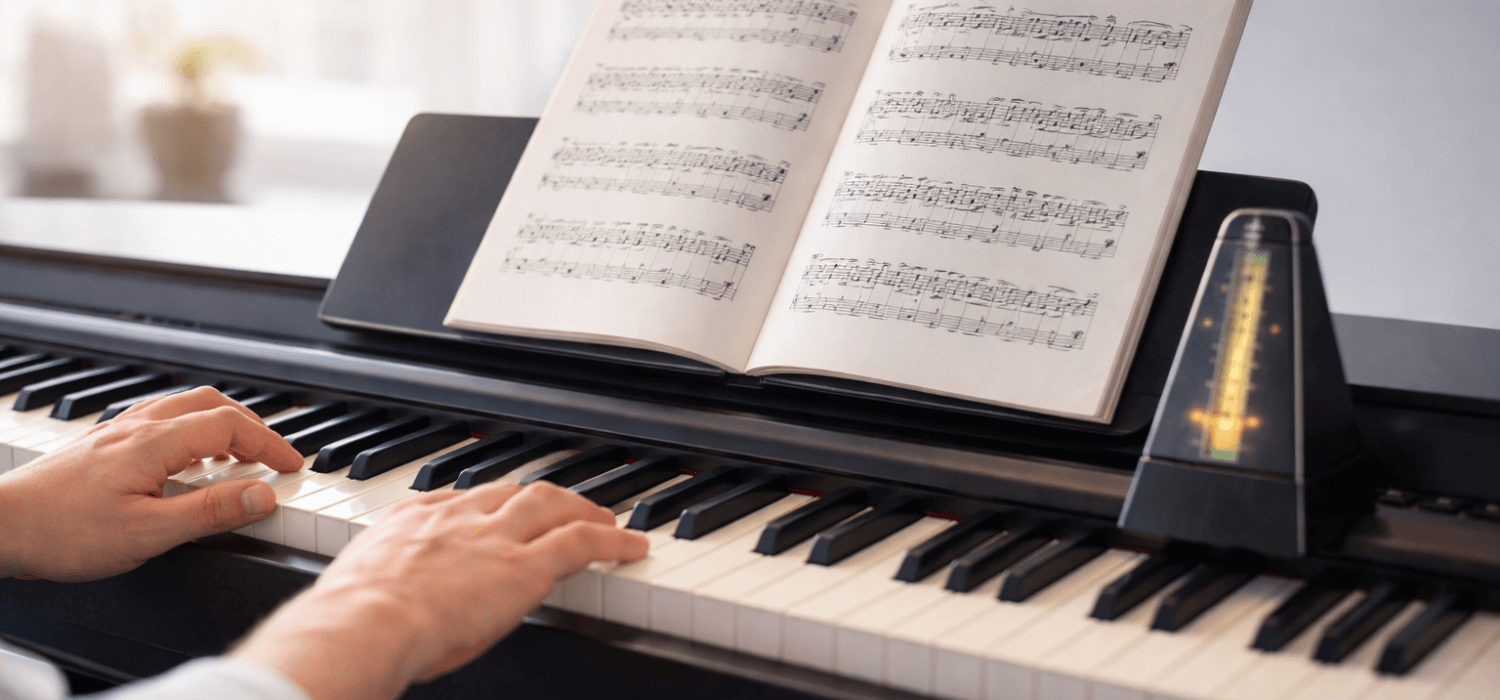
Digital platforms have become a common entry point for piano instruction, particularly in adult learning and continuing education programs. These tools promise flexibility, affordability, and rapid onboarding: qualities that align well with contemporary higher education environments.
Yet educators and program directors frequently observe a disconnect between short-term engagement and long-term musical independence.
The issue is not whether technology belongs in music education. It is whether instructional design choices support the development of skills that transfer beyond the platform itself.
Engagement does not guarantee skill transfer
Many piano learning platforms are designed to minimize friction in the early stages of learning. Visual prompts, guided interfaces, and real-time cues allow students to begin playing quickly, often without prior experience reading music.
These features can be effective for motivation. However, when progress is measured primarily by speed and note accuracy, students may advance through material without developing the conceptual understanding required to interpret unfamiliar music independently.
Educational research has long shown that transfer of learning requires more than repetition. It depends on abstraction, interpretation, feedback on process, and the gradual removal of scaffolding.
In music education, transfer becomes visible when a learner can sit down with unfamiliar material and make sense of it without external cues. If the learning environment never requires interpretation, students never practice that skill.
The role of notation and auditory learning
Traditional piano pedagogy emphasizes notation literacy and ear training alongside technical execution. These elements help students recognize patterns, understand structure, and make expressive decisions.
Many digital platforms, however, deprioritize notation in favor of immediate playability. While this can build early confidence, it may delay the development of interpretive skills essential for ensemble performance, theory coursework, or independent study.
Music education theorist Edwin E. Gordon warned against confusing imitation with understanding, noting that “performance without audiation is imitation, not understanding” (Gordon, 2012). Without opportunities to internalize musical structure, learners may rely on visual cues rather than developing internal musical models.
As Anna Backman Bister, Senior Lecturer at the Royal Academy of Music in Stockholm, has observed, “learning music notation is not a prerequisite for making music, but it opens pathways to deeper understanding and broader musical participation” (Backman Bister, 2022).
Instructional design that supports independence
Technology can meaningfully support music education when it aligns with established pedagogical principles. Digital instruction that promotes independence typically includes:
- Gradual removal of external prompts as learners progress
- Evaluation of timing, dynamics, and phrasing, not just correct notes
- Incorporation of ear training, as well as other adjacent skills like sight-reading
- Integration of theory, scales, and harmony within repertoire
Cognitive load research helps explain why this matters. Excessive guidance can create short-term success while undermining long-term transfer. As Sweller and colleagues note, learners may perform well during instruction but fail to apply knowledge independently when guidance is removed.
Platforms such as Chordzy are designed around these principles, structuring practice to resemble traditional instruction: isolating hands, slowing difficult passages, and reinforcing musical context alongside technique. The goal behind the adult beginner piano series is not to replace instructors, but to extend sound pedagogy into daily practice… particularly for students with limited access to one-on-one instruction.
Implications for higher education and continuing education programs
As institutions evaluate digital tools for music instruction, distinguishing between engagement metrics and learning outcomes becomes increasingly important.
Platforms that generate high participation but fail to produce independent learners may not align with academic goals related to assessment, progression, and long-term skill development. For higher education programs, the most effective technologies are those that complement existing curricula and prepare students to operate without constant guidance.
Technology is not the variable
Digital tools have expanded access to piano instruction and lowered barriers for adult learners. Their educational impact, however, depends on how closely they adhere to principles that support interpretation, transfer, and independence.
When technology treats music as a language to be learned rather than a sequence of actions to be followed, it becomes a meaningful extension of instruction rather than a shortcut around it.
In music education, as in higher education more broadly, technology does not determine outcomes. Instructional design does.
References
- Gordon, E. E. (2012). Learning Sequences in Music. GIA Publications.
- Backman Bister, A. (2022). Musical Literacy and the Relevance of Music Notation. NAfME.
- Sweller, J., Ayres, P., & Kalyuga, S. (2011). Cognitive Load Theory. Springer.
Chordzy is a digital piano learning platform focused on musical literacy and independent skill development.