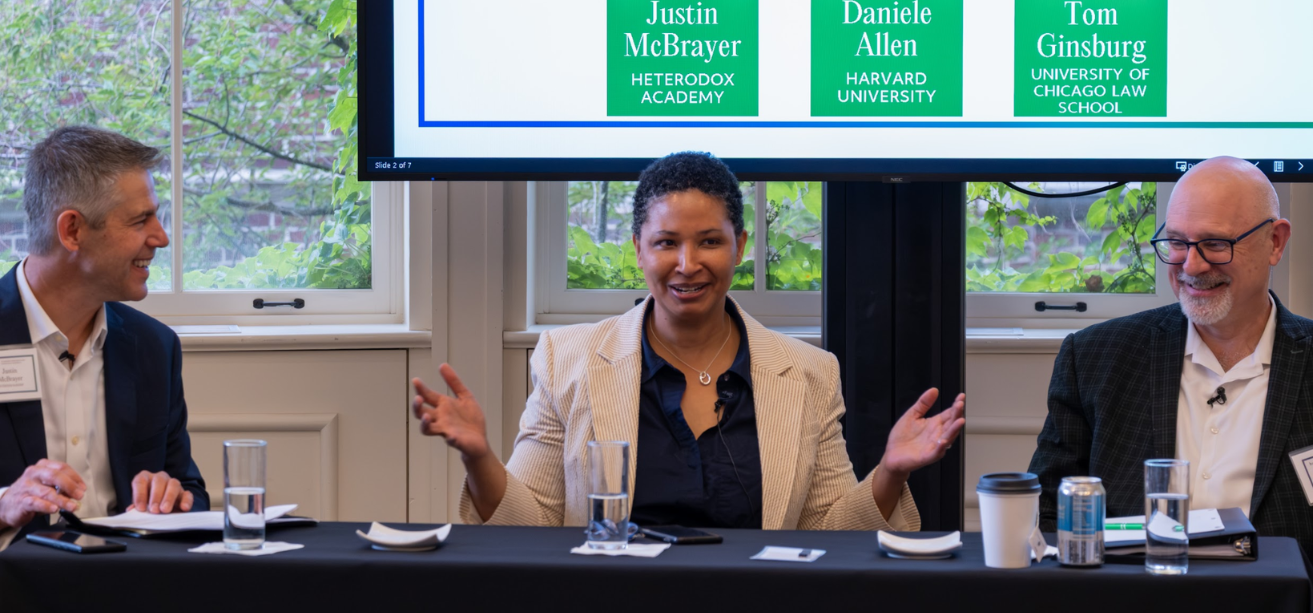
Heterodox Academy (HxA), a nonpartisan, nonprofit working to build cultures of open inquiry on campus, announced the completion of its inaugural Summit on Academic Freedom and Viewpoint Diversity, held June 17–18 at Columbia University's Faculty House in New York City. The invitational gathering brought together dozens of senior academic leaders from 13 institutions to work through practical strategies for building cultures of open inquiry on their campuses while respecting the boundaries of academic freedom.
The summit opened with remarks from HxA President John Tomasi on the relationship between viewpoint diversity and academic freedom, followed by a panel discussion with Danielle Allen of Harvard and Tom Ginsburg of the University of Chicago Law School — two of the country's leading scholars on academic freedom and university reform. Their conversation grounded the day's work in the theoretical stakes before the summit turned to practice.
“The HxA summit was a fantastic opportunity to discuss what strategies are working and not working to foster open inquiry and create campuses where people can work effectively across differences,” said Phoebe Sengers, Special Advisor to the Provost and Professor of Information Science at Cornell University. “It was a refreshing chance for open, frank, and productive discussion about how to navigate this work effectively.”
Three working sessions moved from theory to practice, each pairing an expert interview with hands-on workshops built around HxA's tools and reports. Ashley Rubin drew on her co-authorship of the recent Vanderbilt/Washington University State of the Scholarship in the Humanities report to guide participants through evaluating their own academic units; Ilana Redstone tackled curriculum reform without personnel changes; and William Howell, Dean of the School of Government and Policy at Johns Hopkins, brought his experience as both department chair and dean to the challenge of viewpoint diversity in faculty hiring. Every session was designed to send participants home with strategies they could use immediately.
“I gained valuable insights from both the speakers and fellow participants on fostering rigorous debate around contentious public policy issues,” said Lael Keiser, Director of Truman School of Government and Public Affairs at The University of Missouri. “The workshop strongly aligned with the University of Missouri’s Discovery mission that we challenge assumptions, broaden perspectives, and excel in our pursuit of knowledge.”
Each session across the two-day summit paired expert HxA members with senior leaders at institutions committed to practical reform with tools designed for use by HxA. The result: senior leaders leaving with concrete resources, peer connections, and a clear path forward. “The summit underscored that viewpoint diversity is not peripheral to the academic mission, but integral to the vitality of teaching, research, and democratic higher education,” noted Santiago Schnell, Provost at Dartmouth College.
The summit reflects HxA's deepening investment and impact in working directly with the academic leaders who set institutional policy. HxA's University Partnerships program, which organized the summit, supports colleges and universities in building and sustaining cultures of open inquiry through research-based tools, peer networks, and programming designed for administrators.
"The administrators in this room are the ones who can lead lasting change in how these institutions function," said HxA President John Tomasi. "Our goal was to give them rigorous frameworks, honest peer exchange, and practical resources — not just inspiration, but infrastructure."
A follow-on convening is planned for the next academic year. University leaders interested in working with Heterodox Academy on internal reforms to build cultures of open inquiry on their campus should reach out to HxA’s Director of University Partnerships Justin McBrayer, [email protected].
Heterodox Academy (HxA) is a nonpartisan, nonprofit membership organization of faculty, staff, and graduate students committed to fostering a culture of open inquiry on college and university campuses. Through a combination of grassroots membership efforts and direct engagement with institutional leaders, HxA equips campus stakeholders to advance viewpoint diversity, constructive disagreement, and the free exchange of ideas — values essential to higher education's role as a truth-seeking, knowledge-generating enterprise.