

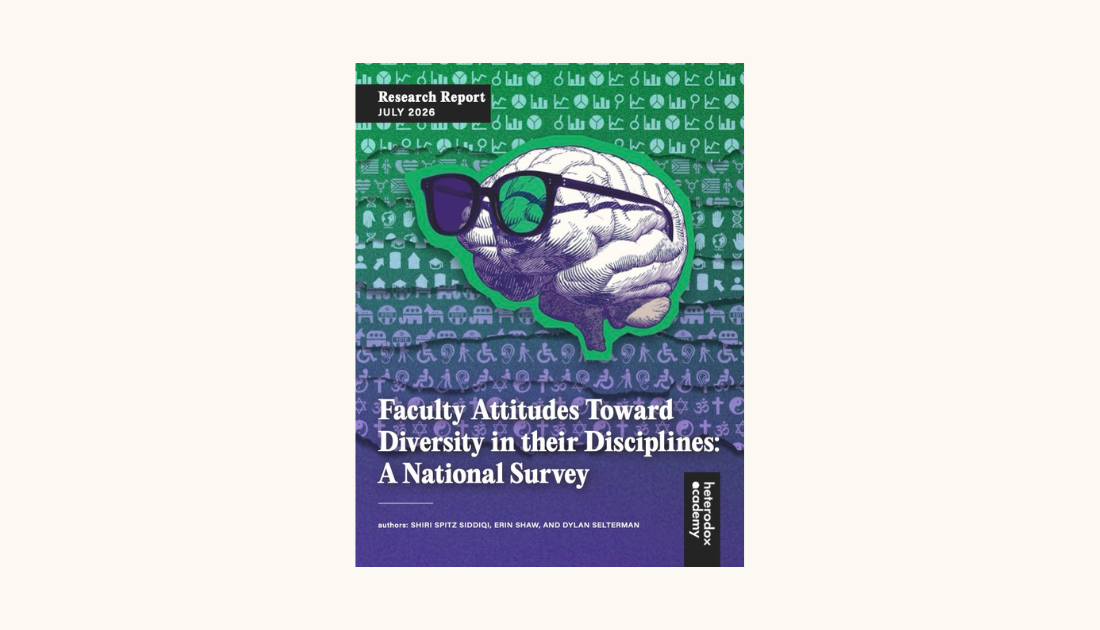
Heterodox Academy (HxA), a non-partisan, non-profit organization that advocates for open inquiry in higher education, announced today the release of a new report, Faculty Attitudes Toward Diversity in their Disciplines: A National Survey, one of the first national studies to assess how faculty value different dimensions of diversity within their discipline.
The report draws on responses from 3,563 faculty across 80 institutions, surveyed in partnership with NORC at the University of Chicago between November and December 2025. The survey asked faculty whether teaching and research in their disciplines is improved by eight different dimensions of diversity — political perspectives, socioeconomic background, racial or ethnic identity, gender identity, religious views, theoretical or methodological views, sexual orientation, and disability status — and what they believed their colleagues thought.
The HxA team finds that support for viewpoint diversity, or the range of ideological, personal, and academic perspectives that characterize an intellectually vibrant community of scholars to ensure scholarly inquiry proceeds in an open and lively way, is the norm among faculty, not the exception.
The report includes several key takeaways on the value of viewpoint diversity across a range of disciplines:
- Every form of diversity measured — eight dimensions in total, including political perspectives, religious views, and theoretical and methodological diversity — won majority support from faculty. Methodological and theoretical diversity was the single most valued dimension of all, endorsed by 84% of respondents.
- Sixty-nine percent of social science faculty, where political diversity can be especially highly valuable, said that it improves their discipline.
- Viewpoint diversity is not only a “conservative cause.” Left-leaning faculty valued political diversity more than their right-leaning colleagues, 62% to 46%, a gap that held within disciplines — not just across them — in every field except STEM.
- A silent majority is hiding in plain sight. On average, faculty personally saw political and religious diversity as good for scholarship, but assumed their typical colleague saw considerably less value in it. This perception gap was widest among social scientists, who underestimated peers’ support for political diversity by 15%. More than one in four personally valued political (29%) and religious (28%) diversity more than they assumed their colleagues did.
- Despite the majority of faculty supporting all dimensions of diversity asked about, nearly 30% of faculty report not regularly engaging with anyone who disagrees with them on substantive issues in their discipline. Adjunct professors were nearly twice as likely as tenured faculty to report this (41% vs. 22%). STEM faculty were 1.5 times as likely as their counterparts in the social sciences (36% vs. 23%) to report so.
“These results should be encouraging to open inquiry advocates: faculty are not opposed to viewpoint diversity in principle, even though the polarized discourse around the topic can make it seem that way, ” said Shiri Spitz Siddiqi, Senior Researcher at Heterodox Academy. “The real challenge is twofold: helping faculty see there’s broader support for viewpoint diversity than they might think, and leveraging this support toward principled, positive-sum reform.”
The report builds on HxA's foundational research on viewpoint diversity, including another recent report, How Politically Diverse Are University Faculty?, and arrives as national conversations about viewpoint diversity and internal reform are dominating discussions among university leadership and faculty. The findings suggest that there is a wellspring of support for viewpoint diversity on campus, but its potential may be hindered by other incentives to self-censor. Efforts to broaden viewpoint diversity on campus can be more successful by first helping faculty see that support for viewpoint diversity is greater than they previously assumed; and making such principles normative through on campus-programming where viewpoint diversity among faculty and disciplines is platformed rather than sidelined.
Heterodox Academy (HxA) is a nonpartisan, nonprofit membership organization of faculty, staff, and graduate students committed to fostering a culture of open inquiry on college and university campuses. Through a combination of grassroots membership efforts and direct engagement with institutional leaders, HxA equips campus stakeholders to advance viewpoint diversity, constructive disagreement, and the free exchange of ideas — values essential to higher education's role as a truth-seeking, knowledge-generating enterprise.