Dive Brief:
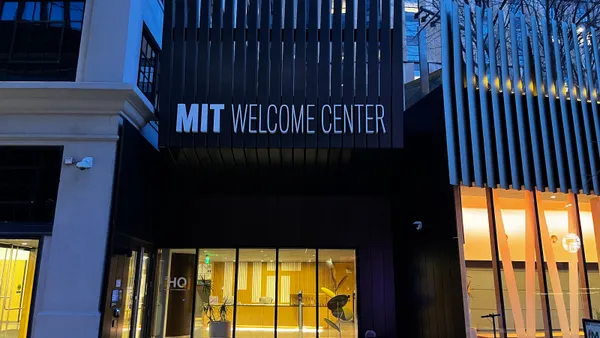
- The Massachusetts Institute of Technology must revise its governance processes to allow for more rapid changes to its curriculum in response to the evolving capabilities of artificial intelligence, a university committee recommended in a report released Tuesday.
- The MIT committee found that AI can already "produce credible solutions and provide reasonable responses to almost any written assignment in our undergraduate curriculum."
- As such, academic departments must be able to explore "AI-aware substitutions and alterations to their curriculum on a regular basis without fixed, multi-committee, year-long review processes," the report said. If they can't, MIT will be left behind, it said.
Dive Insight:
MIT President Sally Kornbluth said in a campus letter Tuesday that instructors would receive guidance later that day on creating AI policies for their fall classes. Her message described this as a “watershed moment for MIT," and she echoed the committee's view that keeping up with AI is not optional for the university.
In its report, the committee — which includes MIT faculty, staff, and undergraduate and graduate students — advised instructors against relying on AI detection software to determine if students are using AI to cheat.
The technology is imperfect and can discriminate against neurodivergent students and non-native English speakers, the committee said in the report. It can also result in a technological "arms race" between AI detection software and AI tools meant to evade it, wasting "a lot of effort on both sides that in the end serves no one," it said.
Instead, faculty should have students write by hand in class during the early stages of projects and create regular deadlines throughout those projects to track their progression. Instructors should also give feedback at each stage rather than waiting until the final project, according to the report.
Drawing a connection between AI use and grades, the committee advised against capping the number of top marks instructors can give out. MIT's neighbor Harvard University recently announced it will begin capping As for undergraduate students in fall 2027 amid broader concerns about grade inflation at the Ivy League institution.
"Rationing top grades would intensify the temptation to cut corners on actual learning by increasing reliance on AI," it said. Instead, "MIT should take this opportunity to consider what role grades play in our overall system, and if the current approach could be improved."
Instructors who plan to teach with "content substantially generated by AI, or to use AI for some aspect of evaluation, grading, or feedback" should be transparent about how they’re using the technology, the report said.
"Students notice when instructors are clearly using AI for slides, feedback, or grading while imposing restrictions on student use, and they perceive it as a double standard," it said. "By modeling responsible use of AI, instructors can help reinforce the new social contract our community will need to adapt to an AI-infused world."
AI is also changing the culture on MIT's campus, the report found.
Over the past three years, it has driven a decrease in students attending office hours and reduced their participation in online discussions. The report also cited anecdotes of fewer in-person groups meeting in the campus's study spaces.
MIT students used AI "frequently and pervasively" but expressed mixed emotions about the technology. Instructors were more divided on AI use, with some reporting a growing reliance on it while others practiced "AI refusal," the committee found.
The committee also disclosed how it used AI when creating its report. Some of its members used AI to present data during committee discussions, and they ran early drafts through ChatGPT to identify redundancies. While they created some of the report's appendix materials with OpenAI's coding tool, the group said none of the final report's text was AI-generated.