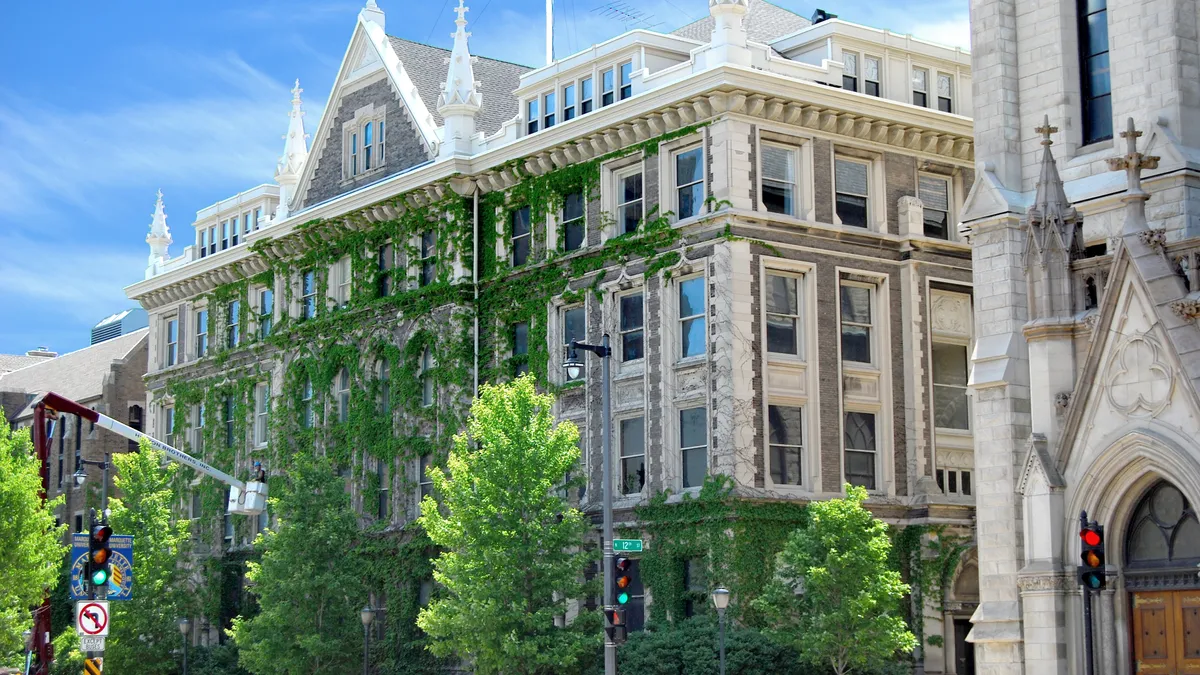
As some institutions try to root out discussions about contentious topics from the classroom, Marquette University is actively teaching its students how to debate their fellow classmates.
The private Milwaukee-based university recently began requiring a civil discourse class as part of its core curriculum for many of its first-year students, said Amelia Zurcher, director of Marquette's University Honors Program, who helped launch the course.
“Part of our goal was that this wouldn't just be students who had selected" the course because they were interested in it specifically, said Zurcher. “It would be a skill that everyone would be expected to learn at Marquette.”
Some state lawmakers and leaders at institutions, such as Texas A&M University and the Texas Tech University system, have recently tried to limit classroom discussions about what some consider to be contentious topics like gender identity and diversity, equity and inclusion. Administrators, as well as government officials, student groups and activists, have also often tried to ban speakers or performers from holding lectures, events or discussions on campuses.
In the face of those trends, a growing number of colleges are working to educate students on how to lean into and engage with challenging conversations. That means finding ways to allay well-founded fears that students have about the possible repercussions of speaking their minds.
When students can’t wrestle with hard questions aloud, higher education loses much of its value, said Connor Murnane, campus advocacy chief of staff at the Foundation for Individual Rights and Expression.
Students need those skills for work and civic life, as democracy depends on one’s ability to argue, listen, reconsider and live in communities with people who disagree with one another, Murnane said in an email.
“This is all about learning how to challenge, be challenged, and stay engaged in tough conversations,” said Murnane. “Things break down fast when dissent gets treated like hostility or folks avoid conflict entirely.”
How Marquette teaches students to hold civil debates
At Marquette, course instructors provide background information and questions about discussion topics, such as freedom of expression, artificial intelligence or different forms of democracy, said Zurcher.
Each week, Marquette students meet in groups of six to seven and hold structured debates or conversations about those topics, she said. Some 32 peer facilitators — students who previously took the course — have also been trained to help with these discussions, she said.
Students “need to learn to think on their feet, to work in teams, to understand each other,” said Zurcher. “It's definitely about a really healthy democratic society, but I think it's also a great professional skill.”
Marquette’s efforts have seen measurable success.
The university piloted the course to students in a single section of its honors program in 2024. But after receiving a three-year, nearly $150,000 grant from the Arthur Vining Davis Foundations that year, it integrated the course into its core curriculum for all first-year honors students and an equivalent number of non-honors students — about 600 students total, said Zurcher.
Overall, Marquette enrolled 1,913 first-time, first-year undergraduates this past fall, according to a university spokesperson. The undergraduate student body numbered 8,206 for the academic year, the spokesperson said.
In total, the course is offered to students in eight sections and co-taught by Marquette faculty in disciplines ranging from nursing and business to philosophy and political science, said Zurcher.
To determine outcomes, Zurcher is conducting a research project reviewing transcripts from last year's participants to look for qualities of good deliberation, such as balanced participation and disagreeing constructively. Preliminary findings show measurable growth in students’ willingness to disagree, see perspectives beyond their own, and engage with others, she said.
After taking the class, some first-year students have told facilitators and professors that they feel they can be more open about what they think, Zurcher said.
“They feel like it's not such a dangerous thing to engage with people, because if someone disagrees with them, they know what to do,” she said.
How colleges can help alleviate student concerns
The Massachusetts Institute of Technology’s Concourse Program — a first-year learning community that connects science subjects with the humanities — launched the private university’s civil discourse program in 2023 with the help of a grant from the Arthur Vining Davis Foundations.
The program holds four to five events for undergraduate students per year in which speakers with contrasting views discuss topics considered timely, culturally important and difficult, said Brad Skow, an MIT philosophy professor who helped launch the program.
The events are intended to model how people who disagree articulate and explain their viewpoints to each other — covering contentious issues such as COVID-19 policies, climate change, capitalism versus socialism, and the Israel-Hamas war, he said.
Then, during class time, students hold debates about the topics discussed at the events, taking turns defending their stances, said Skow. That allows them to practice such discussions without getting angry or trying to shut the other person down, he said.
Engaging in these kinds of conversations can be scary for college students. Disagreeing with friends or people in their social groups — who are often in their classes — can cause personal problems, said Noreen Lape, an educational studies professor at Dickinson College, in Pennsylvania.
“The threat of losing social capital is huge,” said Lape, who is writing a book about holding difficult conversations in classrooms.
"Things break down fast when dissent gets treated like hostility or folks avoid conflict entirely."

Connor Murnane
Campus advocacy chief of staff at the Foundation for Individual Rights and Expression
Instructors need to work intentionally to create a classroom environment in which students don’t fear negative consequences to their grades or reputations when they share their views on contentious topics, April Bleske-Rechek, a psychology professor at the University of Wisconsin-Eau Claire, said in an email.
Bleske-Rechek surveyed students who participated in the Unify Challenge — a virtual event held three times a year in which college students engage in one-on-one conversations with peers who have different political views and attend other four-year institutions.
In her 2025 report analyzing the results of a pilot study with 47 students, she found that students who chose to engage in dialogue with politically different peers were nervous before the conversation but optimistic after. Further research she worked on has shown that, while many students have fears about how a dialogue could go wrong — that they would look stupid, it would be awkward, or the other person would be disagreeable and not listen to them — the conversations are productive and civil, she said.
For faculty, facilitating difficult discussions in the classroom can take some “scaffolding” to help ease students' fears that they could get in trouble for stating their views, said Skow.
Sparking those discussions requires finding a way to create a room where people trust each other — while simultaneously creating a room where people feel distanced enough that they don't censor themselves out of fear about what their peers will think, Skow said.
That can require some stage setting by faculty at the beginning of the semester to talk about the importance of free speech and make clear that what’s discussed in the classroom stays in the classroom, he said.
The goal of the conversations isn’t necessarily to change others’ views, said Skow. Rather, it’s to understand each other by allowing people to articulate their viewpoints — an expectation that can lower the temperature in the classroom, he said.
How to make civil discussion programs successful
Universities should make protecting speech, both in policy and in practice, their top priority, considering that this sets the foundation for all expressive activity, said Murnane.
Colleges can’t expect students to arrive on campus with a full grasp of the importance of speech and expression or how to interact in the classroom — institutions must teach them the expectations about speech on campus, he said.
Many initiatives aimed at promoting civil discourse have emerged in political science, communications or public affairs departments in recent years, according to Lape.
This includes the University of New Hampshire’s Civil Discourse Lab, which holds lectures and extracurricular trainings for students in all majors aimed at improving their ability to hold respectful conversations around difficult conversations on topics like climate change, addiction and immigration.
Similarly, the University of Virginia’s Think Again program provides free resources about expressive rights — such as best practices and templates for holding campus civil discourse events, as well as tips for funding such efforts.
Kristen Shahverdian, PEN America’s director of campus free speech program, questioned the value of one-off programs, saying that short-term investments into civil discourse, dialogue training and skill-building will have a limited impact.
And programs that teach civic skills and practices such as problem solving, collaboration, principled disagreement, inquiry, dialogue and deliberation shouldn’t be limited to specialized government or political science programs, said Shahverdian in an email. Instead, she said, they should be infused into existing curricula in ways that align with the institution’s educational mission.
Investing in training for faculty members to incorporate civil dialogue into daily teaching practices can help foster those difficult discussions in courses throughout campus, Shahverdian said.
Effective university programs also tend to be voluntary and viewpoint neutral, said Murnane, who echoed Shahverdian’s comments about tying those initiatives to the university’s mission. These programs don’t try to manage controversy but rather ensure that students actually face it, he said.
And effective initiatives treat students like adults — trusting them to hear tough ideas, speak plainly and disagree in good faith, Murnane said.
What’s the broader free speech environment like for classrooms?
College leaders trying to foster difficult dialogues on campus are often challenged by pressure from state governments that are targeting speech in higher ed, Lape said.
At least 21 states have enacted at least one bill or policy to censor classroom teaching at higher education institutions since 2021, according to PEN America. Last year alone, 22 laws and policies censoring higher education were passed in 16 states.
Indiana University disciplined at least two professors last year for discussing controversial topics, as administrators tried to abide by SB 202. The two-year-old state law on intellectual diversity requires lecturers to expose students to different viewpoints — and bans them from giving opinions on topics unrelated to their academic disciplines.
And in January, Texas A&M officials instructed a philosophy professor to remove certain Plato readings from his class for violating new university policies that barred professors from teaching courses that advocate “race or gender ideology” without approval from a campus president.
Free speech is not a partisan issue — rather, people on both ends of the political spectrum have a tendency to suppress speech they don’t like, said MIT philosophy professor Alex Byrne.
Byrne helped launch MIT’s civil discourse project following a high-profile canceled lecture on his campus in 2021. MIT’s earth, atmospheric and planetary sciences department canceled a lecture by Dorian Abbot, a University of Chicago geophysics professor, following outcry from students over statements he made that were critical of diversity, equity, and inclusion initiatives.
Faculty members are essentially under surveillance, as students record their lectures without their consent and post them online, said Lape. Holding conversations about certain topics in the classroom can lead to a barrage of hate mail and a loss of funding, jobs — and peace of mind, she said.
“It's very important that students learn" these civil discourse skills, said Lape. “It not only serves the core mission of the university when it comes to teaching and learning and knowledge making, but it also fulfills that idea of the university as serving the common good, in this case, democratic discourse.”
Correction: A previous version of this article inaccurately described portions of the research that Bleske-Rechek worked on. The article has been updated.