Dive Brief:
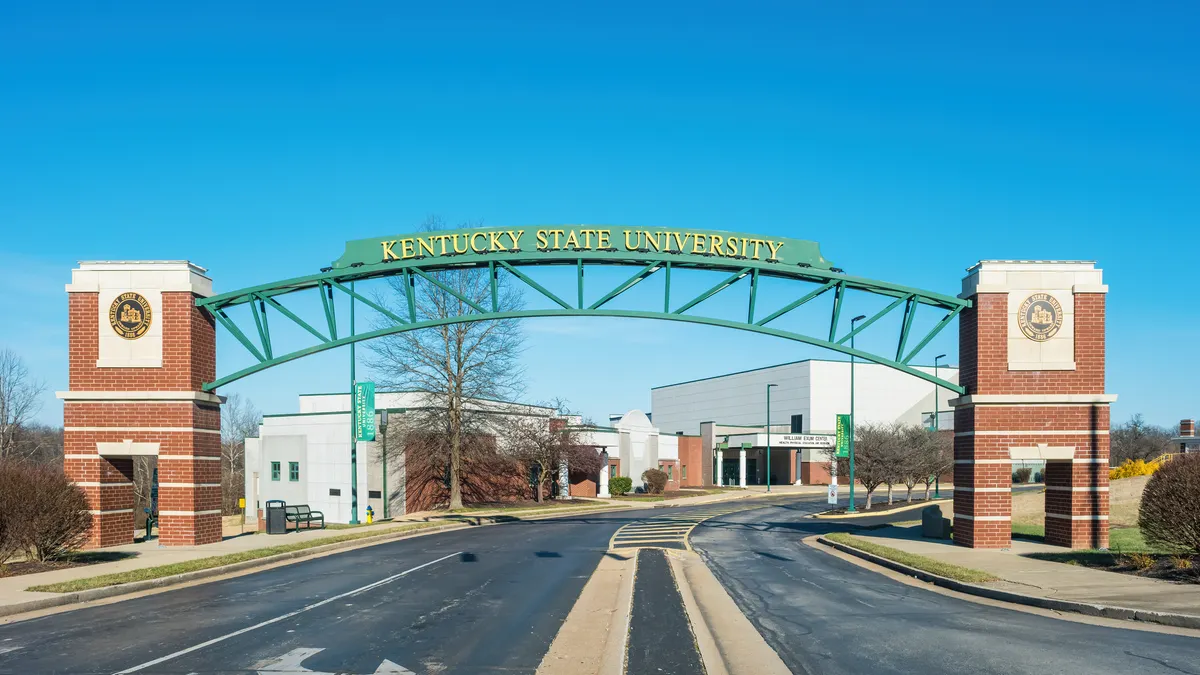
- Kentucky lawmakers are eyeing a dramatic overhaul of the state’s only public historically Black college, with a legislative proposal that would revamp the Kentucky State University’s mission, academics and operations.
- Under SB 185, lawmakers would declare financial exigency at Kentucky State for up to five years as part of a broader plan to transform the university into a polytechnic institution. During that time, it would give Kentucky State’s president the ability to fire any university employee, including tenured professors, with only 30 days notice.
- A state Senate committee advanced the bill Wednesday. The bill’s sponsor, Republican Sen. Chris McDaniel, said lawmakers had initially considered closing Kentucky State but changed course following discussions with the university’s president, Koffi Akakpo, about its future, according to local media reports.
Dive Insight:
Akakpo praised the bill in a university statement Wednesday, casting it as “legislation that positions Kentucky State University for long-term strength, sustainability, and growth.”
According to Akakpo’s release, new legislation would also provide $50 million for a new health sciences building and up to $50 million for campus infrastructure upgrades.
Although the bill’s text doesn’t include that money for Kentucky State, McDaniel said such funding for the university could come through a separate one-time spending bill, according to the Kentucky Lantern.
The measure's mandated changes at Kentucky State would range from overhauling the university’s academics to giving the state tighter control over its finances.
Under the bill, for instance, Kentucky State would have to seek approval from the state’s Council on Postsecondary Education for any purchase above $5,000. It would also have to provide monthly financial updates to the council, which would then give quarterly reports to the state’s governor and the state’s Legislative Research Commission.
This monitoring would continue the entire time Kentucky State is under financial exigency, which would last either five years or until lawmakers declare the university’s finances to be stable.
The bill would also charge Kentucky State with reviewing all of its academic programs to align with becoming a polytechnic institution. By this June, the university would have to submit lists of programs it wishes to keep or shed to the state’s higher education council.
If the legislation passes, the list of program closures could stretch long.
That’s because the proposal would also mandate that Kentucky State offer no more than 10 academic areas of study for the next five years, with exceptions for education and exclusively online programs. The bill would, however, give the higher education council the power to carve out other exceptions.
Faculty in programs slated for closure would lose their jobs, according to the bill. Moreover, Kentucky State would be allowed to keep no more faculty and staff than necessary to support the enrollment of 1,000 in-person students.
As of fall 2024, Kentucky State enrolled 2,020 students, 37% of whom were enrolled exclusively in online courses, according to federal data. Overall, Kentucky State’s enrollment declined 7% from five years prior but increased 6.6% from a decade ago.
Admissions requirements would also get an overhaul, with the bill mandating that admits have at least a 2.5 GPA and at least an 18 composite score on the ACT or an equivalent score on the SAT. The university president would get “sole discretion” over which students are admitted.
McDaniel said during a committee meeting Wednesday that some lawmakers had “experienced great frustration with Kentucky State,” pointing to “the events of last winter.”
One Kentucky State student was killed and another injured in a Dec. 9 shooting.
Later that month, a grand jury declined to indict Jacob Lee Bard, the father of two Kentucky State students, who was charged with murder in the shooting, The Associated Press reported. Attorneys for Bard have told media outlets that he acted in self defense after a crowd of 20 to 30 people gathered to attack his family while he was moving one of his sons out of his dorm.
This wouldn’t be the first time lawmakers have increased oversight of Kentucky State.
In 2022, lawmakers gave the university $23 million to help address budget shortfalls, which the council attributed to poor financial management and overspending. Lawmakers also directed the state’s higher education council to oversee a university improvement plan.
Kentucky State’s accreditor placed the university on probation in December, saying it hasn’t demonstrated compliance with responsibilities under the Higher Education Act and requirements under federal and state regulations to audit financial aid programs.