

Dive Brief:
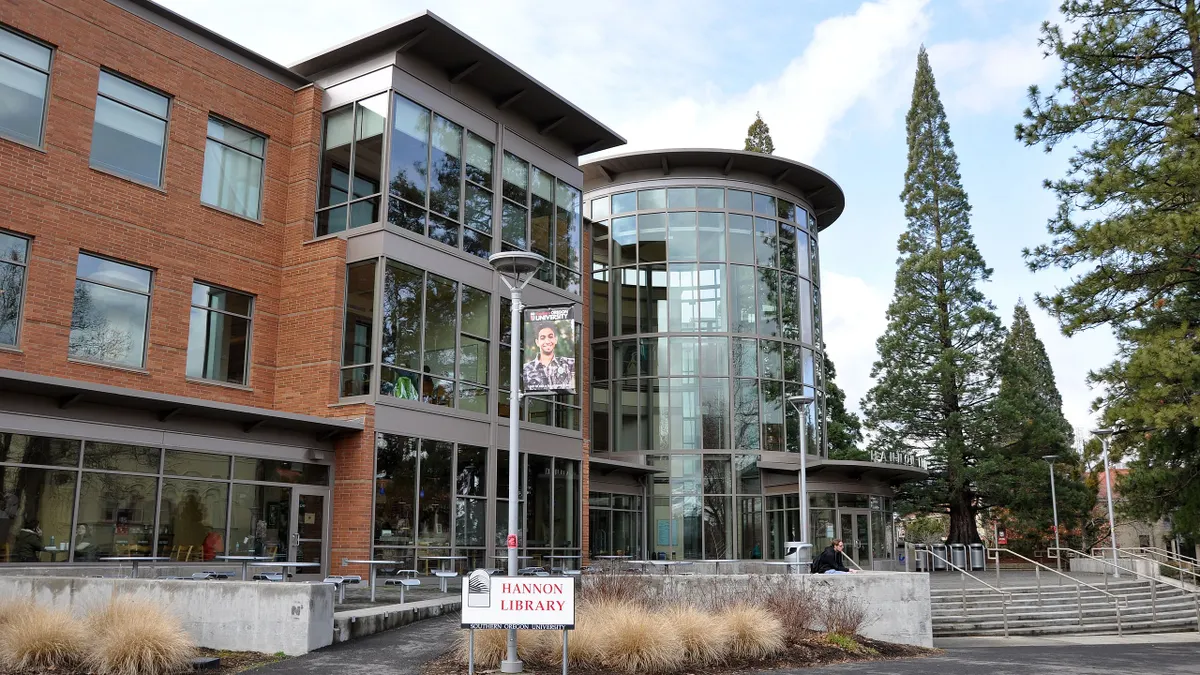
- Southern Oregon University will face “significant liquidity risks” by mid-year without additional financial resources as it wrestles with mismatched labor spending and revenue as well as longer-term enrollment declines.
- In a presentation Monday to the university’s governing board, SOU leaders said that on its current trajectory, the institution could fail to meet its financial obligations by spring 2027.
- Although the university’s budget might show more available resources, SOU’s cash flow “highlights an urgent operational reality,” they said in the report.
Dive Insight:
Three SOU administrators — President Rick Bailey, Provost Casey Shillam, and Vice President for Finance and Administration Carson Howell — told the board Monday that the university started February in a strong position, with $24.3 million in cash. But they project a “rapid decline” in cash flows through fiscal 2027.
That situation is due to high monthly spending on labor expenses — consistently around $5.7 million — combined with variable revenue intake from students’ tuition bills and quarterly influxes of state appropriations.
That situation could rapidly deplete the university’s cash reserves. By this June, leaders project SOU’s cash balances will fall to $11.3 million and breach what they call the university’s “safety threshold.”
Fiscal 2027 is on track to be even more precarious, they said, predicting SOU will have a negative cash balance of $825,689 by March of that year. By next June, that cash deficit could reach $7.4 million.
To preserve funds, officials have immediately frozen hiring and travel except for in special cases. A university spokesperson told Higher Ed Dive on Wednesday that Bailey is working with state legislators to address cash-flow issues at both SOU and Oregon's other public universities.
The university has deeper underlying fiscal issues beyond the variability of its revenue. Total student credit hours have declined annually since the 2017-18 academic year. In the current year, credit hours are down 3.4% from last year and a whopping 35.8% below 2015-16 levels, according to the presentation.
SOU’s student body shrunk during those years as well. Between 2015 and 2024, fall enrollment dropped about 16% to 5,113 students, according to federal data. The declines not only hurt SOU’s tuition revenue but also its state funding, which is tied to the number of credit hours students complete.
In September, SOU's board adopted a plan to axe 23 programs and lay off 18 employees after years of "unprecedented fiscal crises." The cuts came as leaders said SOU could no longer function as "a comprehensive university.”
Alongside those cuts, the university is now trying to boost its enrollment by beefing up data-driven marketing and recruitment. In their Monday presentation, senior leaders said that every 1% increase in revenue amounts to an additional $400,000.
Deeper cuts now would “severely erode the university’s viability as a regionally responsive public institution,” officials said in this week’s presentation.
They also acknowledged they “must have better awareness of all fiscal matters,” including through monthly cash flow reports. They plan to hire two “critical” positions in finance and budgeting despite the hiring freeze to provide more visibility into the university’s fiscal state.