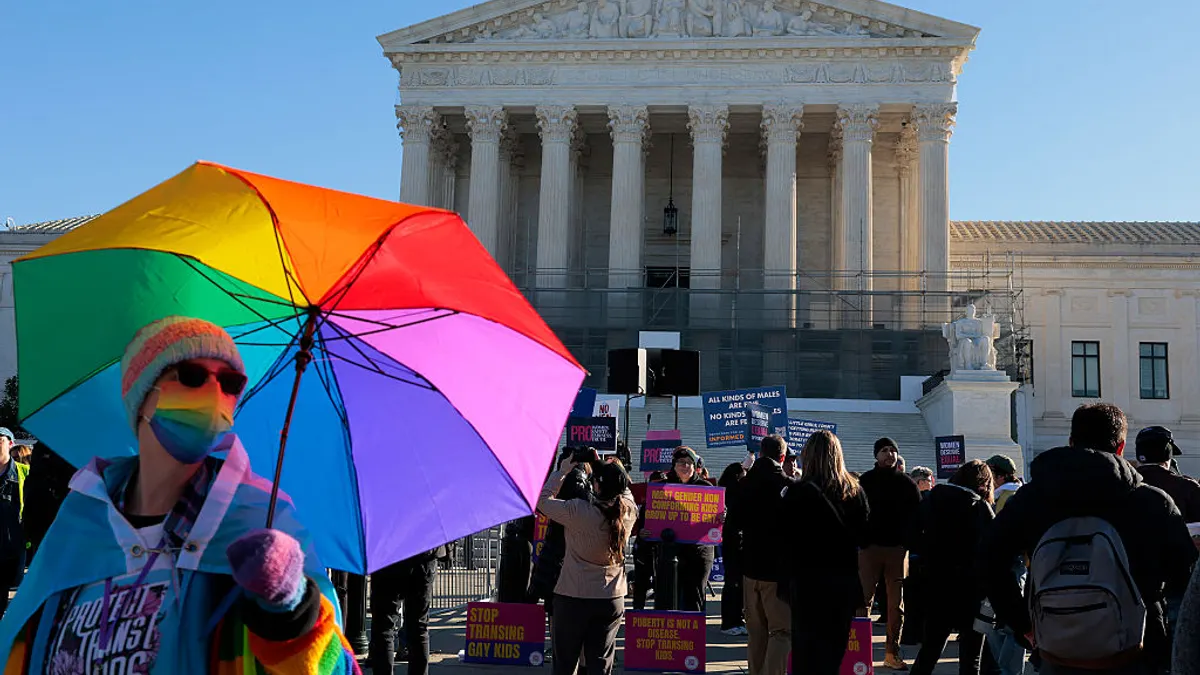
The U.S. Supreme Court heard back-to-back oral arguments Tuesday over two cases that could determine whether transgender women and girls can play on sports teams aligning with their gender identity.
The two lawsuits center on two states, Idaho and West Virginia, that have banned transgender women and girls from such teams. Idaho was the first state to implement such a restriction in 2020, and 26 other states have since passed similar laws.
The student in each lawsuit alleges that their state's restriction violates their 14th Amendment guarantee to equal protection under the law. One of them also contends that the restriction violates Title IX, the sweeping federal law banning sex-based discrimination in federally funded colleges and K-12 schools.
Conservative politicians have championed these policies, including President Donald Trump.
Early in his second term, Trump signed an executive order that threatened to pull federal funding from and open investigations into colleges and K-12 schools that allow transgender women and girls to play on sports teams aligning with their identities.
Comments of the Supreme Court’s conservative majority on Tuesday and their past rulings suggest that those justices may be reluctant to strike down state laws restricting transgender students’ participation in college and K-12 sports.
Last year, the conservative majority upheld a Tennessee law barring transgender teenagers in the state from accessing puberty blockers and hormone treatments. And Brett Kavanaugh, one of the conservative justices, voiced concerns Tuesday about allowing transgender women and girls to play on the same teams as their cisgender peers.
“One of the great successes in America for the last 50 years has been the growth of women and girls sports,” Kavanaugh said.
He added that “a variety of groups” have argued that allowing transgender women and girls to participate on such teams will reverse that success. “For the individual girl who does not make the team, or doesn’t get on the stand for the medal, or doesn’t make all-league, there’s a harm there,” Kavanaugh said. “We can’t sweep that aside.”
Lawyers defending the state bans made similar comments. In defense of West Virginia’s law, state Solicitor General Michael Williams argued that “biological sex matters in athletics in ways both obvious and undeniable.”
Allowing students to participate on teams aligning with their gender identity turns Title IX into a law “that actually denies those opportunities for girls,” Williams said.
Meanwhile, lawyers for the two transgender students suing over the state policies argue that the bans deny them their constitutional rights.
Joshua Block, a lawyer with the American Civil Liberties Union representing the student contesting the West Virginia law, argued that the 14th Amendment’s equal protection clause and Title IX are meant to “protect everyone.”
In that case, West Virginia v. B.P.J., Becky Pepper-Jackson, now a high school student, and her mother sued the state in 2021 over its ban on transgender girls participating in girls' sports.
Pepper-Jackson has identified as a girl since 3rd grade and takes puberty blockers. She won a narrow district court injunction in July 2021 that blocked West Virginia from applying the law to her, though the judge ended up ruling in favor of the state. The 4th U.S. Circuit Court of Appeals issued a ruling in 2023 allowing her to participate in girls’ sports again.
Block argued that if there are no “physiological differences” between Pepper-Jackson and other girls, there is no reason to exclude her from girls’ sports teams.
“West Virginia's law treats BPJ differently from other girls on the basis of sex, and it treats her worse in a way that harms her,” Block said.
In the other case, Little v. Hecox, Boise State University student Lindsay Hecox, a transgender woman, sued the state of Idaho in 2020 over its statute, arguing that it violated her constitutional rights by discriminating against transgender women.
Hecox, who receives hormone therapy to suppress testosterone and increase estrogen, scored a victory when a federal judge blocked the law in 2020. Afterward, she tried out for Boise State’s NCAA track and cross-country teams but wasn’t fast enough to make them, so she joined the university’s club soccer and running instead.
A federal appeals court partially upheld the ruling in Hecox’s case in 2024, though it asked the lower court to review the scope. However, Hecox is no longer participating in any college sports as she attempts to finish college “without the extraordinary pressures of this litigation and related public scrutiny,” according to a Supreme Court brief last year.
In September, Hecox asked for the Supreme Court to dismiss her case as moot, citing her impending graduation, her decision not to play sports in Idaho in the future, and the negative attention the case brought her. The justices said they would decide on her request after hearing oral arguments.
Many of Tuesday’s arguments focused on whether transgender women and girls would have a competitive advantage over cisgender women and girls. There is not consensus among medical experts, and there have been limited studies on the matter.
In one 2021 study, transgender women in the U.S. Air Force were faster than their cisgender peers following two years of hormone treatments, though they couldn’t complete more sit-ups or pushups.
But Joshua Safer, executive director of the Mount Sinai Center for Transgender Medicine and Surgery, wrote in a 2022 article for the Journal of the Endocrine Society that there “does not seem to be any reason to expect advantage for transgender people prior to puberty of or for transgender people whose gender-affirming treatment begins at the onset of puberty.”
He added that more research was needed on the topic.
In a 2024 study, researchers found transgender women who had completed at least a year of hormone therapy had higher absolute hand grip strength than cisgender women but lower relative jump height. They cautioned against “precautionary bans and sport eligibility exclusions that are not based on sport-specific (or sport-relevant) research.”