Dive Brief:
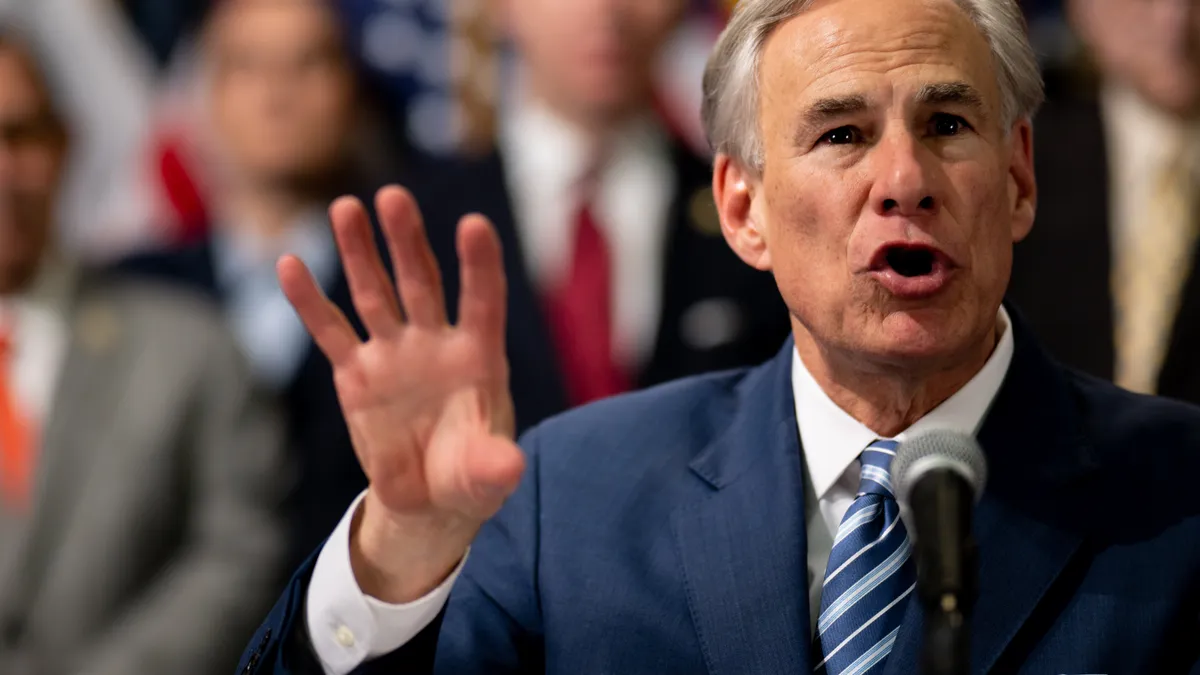
- Texas Gov. Greg Abbott on Tuesday ordered a pause on new H-1B visa applications from the state's public colleges and agencies through May 2027. The governor cited unspecified "recent reports of abuse" in the federal program.
- Under Abbott's directive, public colleges and state agencies have until March 27 to report how many H-1B visa holders they sponsor, the job classifications and descriptions of those workers, the employees' home countries, and the expected expiration date for each visa.
- The institutions must also share how many petitions they submitted in 2025 for new H-1B visas and renewals and demonstrate their "efforts to provide qualified Texas candidates with a reasonable opportunity to apply for each position filled by a H-1B visa holder," Abbott said.
Dive Insight:
Abbott's order could cause upheaval for Texas' higher education sector, as large research universities — such as the University of Texas at Austin and Texas A&M University — rely on H-1B visas to hire international scholars. The federal H-1B visa program allows U.S. employers to hire foreign workers with strong educational backgrounds for specialized jobs on a temporary basis.
But President Donald Trump threw the program into a tail spin last year when he issued a proclamation imposing a $100,000 fee on new petitions for H-1B visas. Employers had historically paid between $2,000 and $5,000 for such petitions, according to the American Immigration Council.
Abbott on Tuesday cited Trump's proclamation in his letter to the heads of Texas' state agencies and echoed the president's allegations of rampant H-1B visa abuse.
"Rather than serving its intended purpose of attracting the best and brightest individuals from around the world to our nation to fill truly specialized and unmet labor needs, the program has too often been used to fill jobs that otherwise could — and should — have been filled by Texans," Abbott said.
Texas is home to seven university systems and dozens of research institutions.
In fiscal 2025, UT-Austin sponsored 169 H-1B workers, per federal data. The university has roughly 20,000 employees overall, according to institutional data. Texas A&M, which employs over 26,000 people, sponsored 214 H-1B workers the same year.
Three days before Abbott publicly implemented the visa pause, he required the leaders of Texas A&M’s 12 campuses to submit the names of all H-1B visa-holding employees, according to internal emails obtained by the Quorum Report, an outlet covering Texas politics.
The Texas Workforce Commission, a state agency, will issue guidance to carry out the pause, Abbott said Tuesday. Public colleges and other employers can seek written permission from the commission for exemptions.
During the pause, Texas and federal lawmakers should establish "statutory guardrails for future employment practices," Abbott said. He also called on the Trump administration to "implement reforms aimed at eliminating abuse of this visa program."
Public universities in Florida could soon face a similar pause on H-1B visa applications. The State University System of Florida's governing board on Thursday plans to consider a new visa pause until next January, following a directive from Gov. Ron DeSantis to "crack down on H-1B Visa abuse in higher education."
Neither Abbott nor DeSantis cited specific studies of the H-1B program or examples of it being used to hire international workers over qualified U.S. citizens. However, participants in the decades-old program have faced plenty of criticism in recent years.
In 2020, research from the Economic Policy Institute found that 60% of H-1B positions in fiscal 2019 approved by the U.S. Department of Labor paid less than the regional median wage. It also noted instances of companies like Uber increasing H-1B hiring while simultaneously laying off U.S. workers.
The U.S. Department of Homeland Security in 2023 launched H-1B fraud investigations when it found that some employers sought to game the program's lottery by submitting the same prospective employee multiple times.
More recent research from EPI has also alleged that major private companies were mistreating H-1B workers who were working as subcontractors by paying them low wages.