Dive Brief:
- Virginia Attorney General Jay Jones has begun the hiring process for three university general counsel positions, framing the search as a counter to the Trump administration's "federal overreach" into the state’s public institutions.
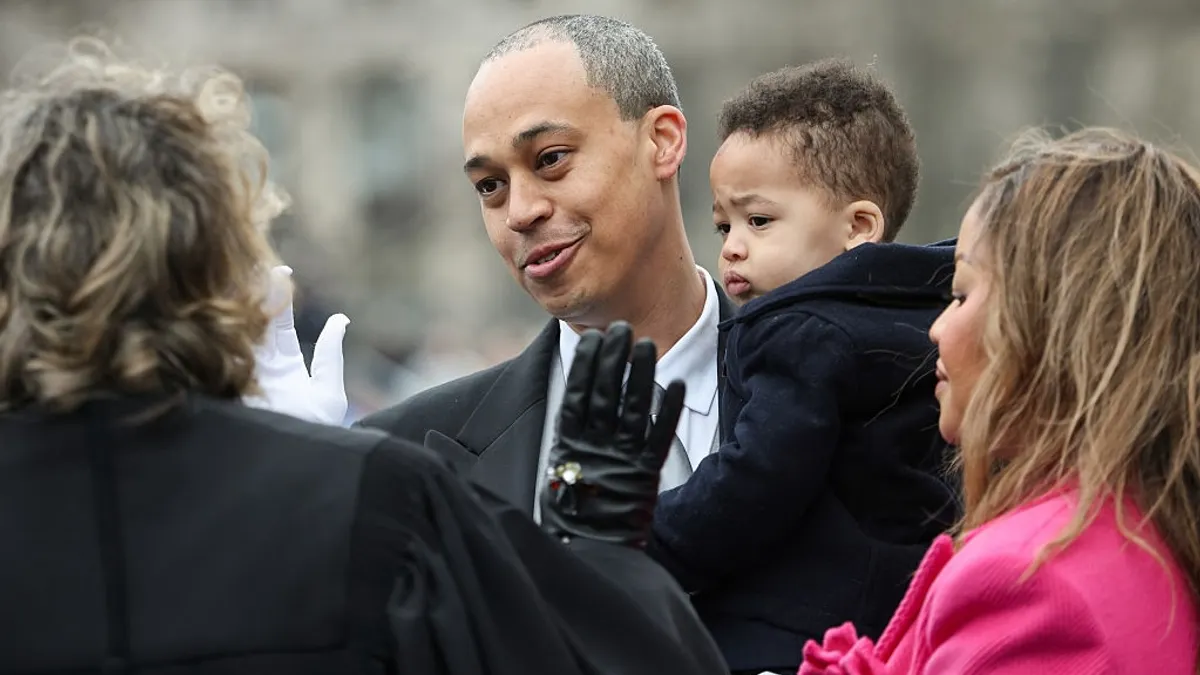
- Jones, a Democrat who took office on Jan. 17 alongside Gov. Abigail Spanberger, said this week that he would hire the "best and brightest legal counsel" for three public institutions with vacancies: the University of Virginia, George Mason University, and Virginia Military Institute.
- “Over the past year, the Trump Administration’s continued politically-motivated assaults on Virginia’s academic institutions have sought to tarnish their reputations and undermine their ability to successfully prepare our students for the future," Jones said in a statement. This national search will deliver on the promise to “fight back” against those attacks, he added.
Dive Insight:
Jones' announcement follows up on his campaign promise to "take politics out of Virginia’s higher education system." Both Jones and Spanberger have accused state officials of allowing undue political influence over their institutions.
Virginia's public universities have been in turmoil since the summer, when then-Gov. Glenn Youngkin, a Republican, sought to appoint a handful of members to UVA, George Mason, and VMI's boards. But when Youngkin faced opposition from Virginia’s Democrat-controlled Senate committee — which has the power to reject appointments — he instructed his picks to begin serving anyway. The ensuing legal battle ended with a federal judge blocking the appointments.
All three boards had numerous unfilled seats through the end of 2025.
Then, at the end of June, Jim Ryan abruptly stepped down as UVA's president amid pressure from the U.S. Department of Justice over the university's diversity work.
UVA's governing board did not defend Ryan publicly.
The board then struck a deal with the DOJ in October to pause its investigations into UVA and formally close them by 2028 if the university “completes its planned reforms prohibiting DEI,” the agency said at the time.
The agreement requires the university to make several policy changes, including adopting the DOJ’s contentious anti-DEI guidance and filing quarterly compliance reports with the agency.
In a November letter, Spanberger called on UVA trustees to hold off naming a new president until she took office.
Spanberger argued that trustees' response to the ouster of Ryan and their search for a new president had “severely undermined the public’s and the University community’s confidence,” citing votes of no confidence from the UVA faculty senate and the university student council.
She also pledged in the letter to fill vacant positions on the UVA board shortly after she was sworn in.
Instead of waiting, however, the governing board appointed Scott Beardsley as UVA's new president on Dec. 19. Beardsley took office on Jan. 1 — 16 days before Spanberger was inaugurated.
At least four members of UVA's board, including the board head, stepped down after Spanberger asked them to resign shortly before she became the first woman to serve as Virginia’s governor, The New York Times reported.
She then appointed over two dozen board members across all three universities' boards on her first day in office. The state Senate's committee on privileges and elections approved those appointments on Tuesday.
New members could prove especially impactful at George Mason, whose board has operated without a quorum in recent months. The Trump administration has targeted the university and its president, Gregory Washington, over its DEI work — similar to its play against UVA. But Washington has rebuked the DOJ's calls to fall in line.
Jones' national search for new general counsels isn't the only move the attorney general has made to undo former Virginia Attorney General Jason Miyares' last acts in office.
Just days before his term ended, Miyares filed a joint motion with the DOJ to strike down a state law allowing certain undocumented students to pay in-state tuition to public colleges.
Jones' office withdrew Miyares' joint motion three days after his swearing in. It also withdrew the former attorney general's opposition to third-party intervention in the case, easing the path for Virginia students to defend the state law.