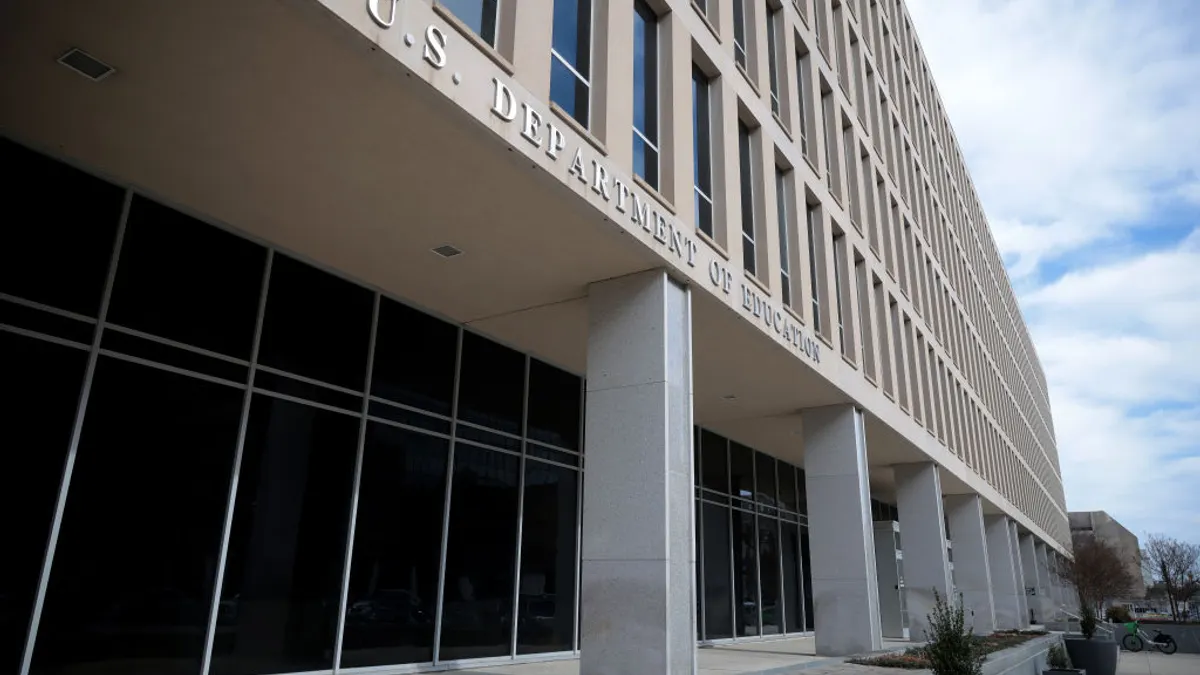
The U.S. Department of Education announced on Tuesday that it is moving key civil rights investigation and enforcement activities to the U.S. Department of Justice. The move furthers the Trump administration’s goal of dismantling the 46-year-old Education Department.
Under the partnership, the Education Department’s Office for Civil Rights will use DOJ’s Civil Rights Division to evaluate, investigate and resolve civil rights complaints, a senior department official said during a press call Tuesday. OCR has been responsible for investigating and resolving complaints of harassment and discrimination at colleges and K-12 schools.
The Education Department will retain management and leadership of OCR, along with other statutorily required duties, the official said. However, the Education Department will coordinate with the Justice Department on cases and reach resolutions using DOJ’s findings and proposals.
The official said the Education Department will make the final call on whether to pursue administrative enforcement or to refer cases to DOJ for judicial enforcement — a process involving the agency filing lawsuits to address civil rights violations.
OCR will also continue to oversee mediation and settlement negotiations in education-related civil rights cases, according to the official. And it will develop policy guidance, provide technical assistance to colleges and states, and collect civil rights data.
The senior Education Department official said OCR and the Justice Department will now begin discussing how to carry out the agreement, including factors such as staffing needs, resource allocation and timelines.
Under separate agreements announced Tuesday, the Education Department is shifting additional duties to DOJ, including certain enforcement activities related to student privacy laws.
The agency also said it would move some of the duties of its Office of Special Education and Rehabilitative Services to the U.S. Department of Health and Human Services. OSERS is tasked with implementing the Individuals with Disabilities Education Act, which guarantees a free and accessible public education to children with disabilities. Colleges are eligible to receive some grants from OSERS, such as for special education teacher training.
Critics slam Education Department’s newest moves to shift duties
The moves drew swift rebuke from student advocacy groups.
EdTrust, a nonprofit focused on educational equity, slammed the Trump administration for shifting education-related civil rights enforcement and disabilities services to other agencies.
“As is too often the case, traditionally underserved students — including students with disabilities, Black and Latino students, multilingual learners, students from low-income backgrounds, and students in rural communities — will bear the greatest burden created by this reckless decision, to which the disability and civil rights communities have already been vehemently opposed,” the group said in a Tuesday statement.
Shiwali Patel, senior director of education justice at the National Women’s Law Center, called the moves an “illegal transfer” in a statement Tuesday.
“With this move, the Trump administration would be systematically dismantling the Department of Education’s infrastructure that protects students’ civil rights and equal access to education, eroding protections for millions of students,” Patel said.
But the announcement drew praise from others.
Michigan Rep. Tim Walberg, the Republican chair of the House education committee, contended that the moves would reduce federal bureaucracy.
“The Trump administration is following through on its promise to fix the nation’s broken system by right sizing the Department of Education to improve student outcomes,” Walberg said in a statement Tuesday.
A sea change for the Education Department under Trump
Tuesday's pacts with DOJ and HHS bring the number of interagency agreements the Education Department has struck with other federal agencies to 14.
Among those, the Education Department announced agreements to shift responsibility for the $1.7 trillion federal student loan portfolio to the U.S. Department of Treasury and to co-administer major higher education grant programs with the U.S. Department of Labor.
In March, the Labor Department opened two grant competitions under the TRIO program, which is designed to help first-generation and low-income students access and complete higher education. However, critics raised concerns that the grant competitions were shifting focus away from traditional higher education to workforce development pathways like apprenticeships.
U.S. Education Secretary Linda McMahon has caught flak from lawmakers over the agency’s handling of civil rights cases under the Trump administration. OCR last year reached only 112 resolution agreements with colleges and K-12 schools, representing just 1% of pending cases, according to a report released in April from the office of Sen. Bernie Sanders. That’s the lowest level in over a decade, the report said.
Moreover, OCR didn’t reach any resolution agreements for major cases involving sexual violence or racial harassment, the report found. The office also didn’t resolve any cases through its standard process that involved complaints of antisemitism, Islamophobia and national origin discrimination, according to the findings.
The findings came after a tumultuous year for the civil rights office. In March, the Education Department moved to lay off about half of the OCR staff and closed seven of its 12 regional offices. But following a court order, the agency eventually reinstated many of those employees who had been placed on administrative leave.
“We are bringing back many of those lawyers which were part of that RIF,” McMahon told lawmakers during a congressional budget hearing in April. “There was a time when we were not processing cases as quickly as we should, but we are now focused on doing that.”
Under the Trump administration’s proposed fiscal year 2027 budget, the department’s civil rights office would get $91 million, representing a 35% cut from fiscal 2025 levels. Education Department budget documents also call for reducing OCR staffing from an equivalent of 530 full-time employees to 271.