Dive Brief:
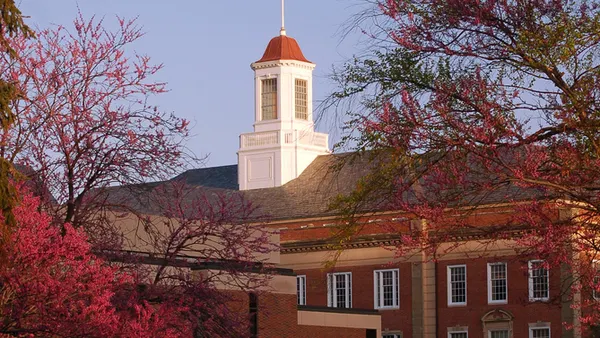
- The American Association of University Professors is advocating against the University of Nebraska-Lincoln's return to a highly selective higher ed group following the university's recent program and faculty cuts.
- UNL last year approved cutting four academic departments over heavy faculty pushback as part of a bid to slash $27.5 million from its budget and close a structural deficit. In January, the university also began laying off faculty, whose last day will be in May.
- In a Monday letter to the Association of American Universities, AAUP Todd Wolfson said that the group should not consider readmitting UNL until it "demonstrates a clear and credible commitment to restoring shared governance, protecting tenure, and aligning its practices with the principles that define leading research universities.”
Dive Insight:
UNL began undertaking significant cost-cutting initiatives under former Chancellor Rodney Bennett. Last summer, he attributed the multimillion-dollar gap in the university's budget to insufficient state funding, declining tuition revenue and high inflation.
“Despite our best efforts to live within our means, our revenue has not kept pace with expenses,” he said at the time.
The university ultimately approved the elimination of four departments — educational administration; statistics; earth and atmospheric sciences; and textiles, merchandising and fashion design.
The decision came despite prolonged faculty objections, including allegations of potential problems with the university’s data used to identify cuts.
As part of the cuts, the university’s governing board approved the termination of 58 faculty members, most of whom had tenure, Wolfson said Monday.
Bennett abruptly resigned in January, leaving behind a historic no-confidence vote from the faculty senate and taking a controversial $1.1 million severance payment. UNL's AAUP chapter called for the academic cuts to be reconsidered in the wake of Bennett's departure. But the university is still going forward with the budget plan he set in motion.
"While fiscal pressures driven by state disinvestment are real, UNL’s response raises fundamental concerns," Wolfson said in his letter to AAU leadership. "The elimination of entire departments to achieve relatively modest short-term savings risks long-term damage to research capacity, student enrollment, and institutional reputation."
"More importantly," he added, "the process by which these decisions were reached appears to have violated core principles of shared governance and relied on evaluative tools inappropriate for personnel actions of this kind."
In a statement to Nebraska Public Media, UNL said AAUP presented "a partial account of these complex circumstances."
"These difficult but necessary decisions have been made through established university processes in response to enrollment, program demand, financial sustainability and the university’s long-term academic mission," the university added.
UNL did not immediately respond to Higher Ed Dive’s request for comment Tuesday.
The university helped found AAU in 1900 but was removed from the group in 2011 — the first university to be formally voted out by members — after it failed to meet AAU’s standards for a sustained period. One of the key issues that resulted in UNL's ouster was an insufficient amount of research funding.
Rejoining the organization has been a public goal of UNL since 2023, when then-University of Nebraska System President Ted Carter made reobtaining AAU membership a top priority.
Carter noted at the time that, because UNL and the University of Nebraska Medical Center operated as separate entities, AAU did not count the center's research outcomes toward UNL's total.
In November, NU System's governing board approved a proposal for UNL and the medical center to seek joint accreditation, part of the flagship's bid for readmittance.
UNL has since approved two more program eliminations — bachelor’s degrees in ethnic studies and insect science — citing low enrollment and graduate numbers that fell short of state requirements.