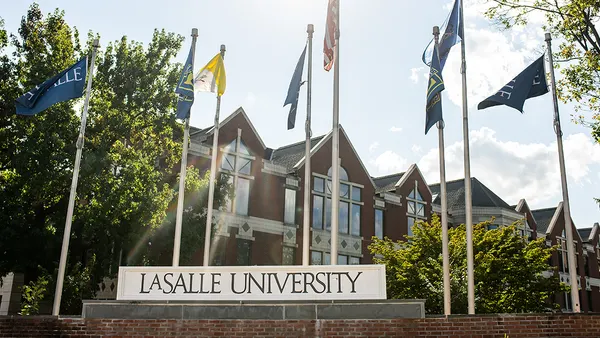


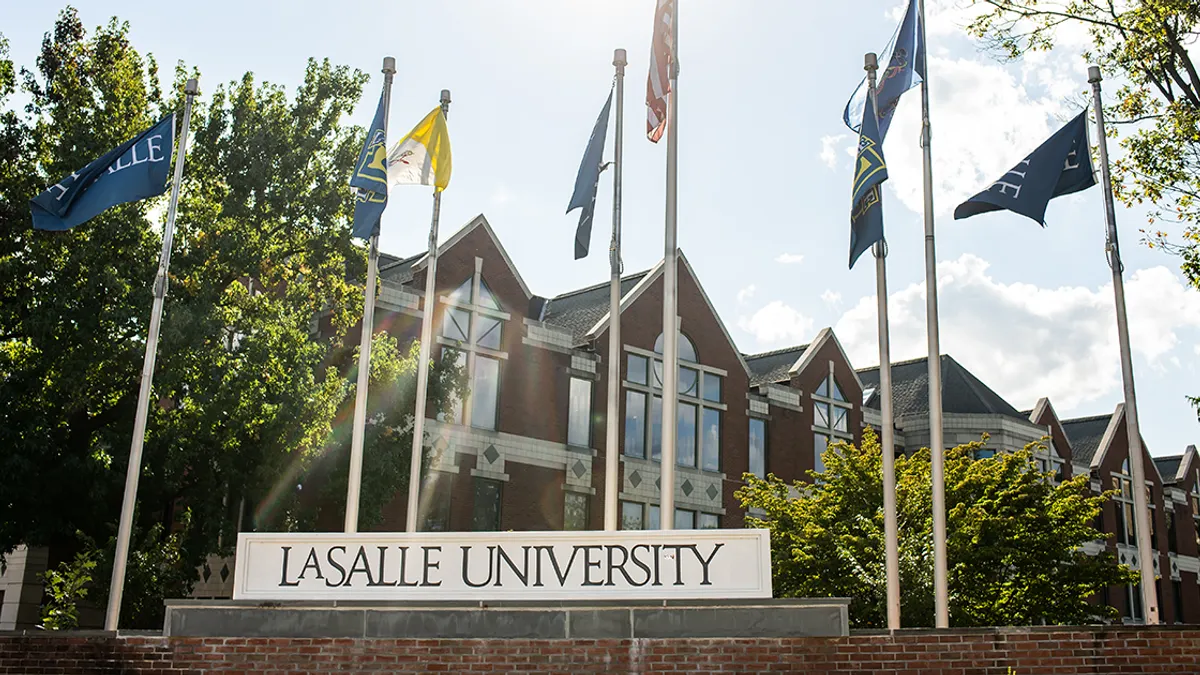
Last fall, La Salle University reported its largest incoming class in six years, with roughly 900 new undergraduate students. Its first-year student body ballooned by 40% from the previous year, and the number of transfer students grew by 60%.
That growth was more than welcome for La Salle, a Catholic institution in Philadelphia co-founded by the Brothers of the Christian Schools, a faith organization of nonclergy — it was crucial after years of declines and financial pressures.
Between 2019 and 2024, La Salle’s fall headcount plummeted by just over 36% to 3,153 students, according to federal data. With shrinking enrollment came operating losses — to the tune of $17.9 million in fiscal 2024 and $16.3 million in fiscal 2025.
Its financial statements from those years had “going concern” warnings, accounting language indicating an entity might not have the financial resources to sustain itself over the next year. During that time, La Salle freed up cash by selling property and refinancing debt.
Even worse: Last summer, the Middle States Commission on Higher Education warned La Salle that its accreditation was at risk over its standards on financial resources — a message no college leader wants to hear. Accreditation loss renders institutions ineligible for federal student aid. But this May, about a year later, MSCHE gave La Salle a clean bill of health, saying it was fully compliant.
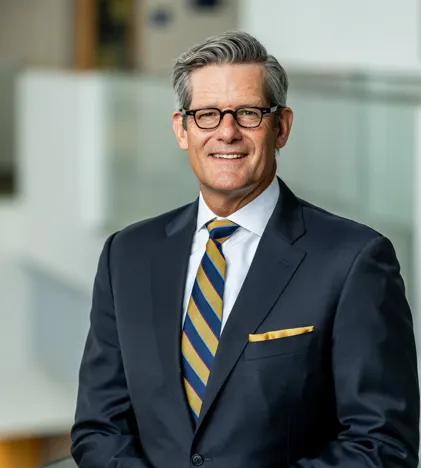
President Daniel Allen, who joined La Salle in 2022, spoke to Higher Ed Dive about the institution’s journey back from its earlier precarious state and how it rebuilt enrollment by refocusing on the basics.
Editor’s note: This interview has been edited for clarity and brevity.
HIGHER ED DIVE: How did you diagnose your enrollment problem in such a way that you can find a potential treatment?
DANIEL ALLEN: There are schools that are doing well despite the demographic cliff, and it gives you an opportunity to think differently about what you need to do from a strategy perspective. For us, we looked at how we were recruiting prospective students and how we were talking about and positioning the university in the market with those prospective students and their families.
There were a couple things that were super-important that we found out. One, most schools will recruit three classes of students at a time. So they're communicating with and engaged with high school sophomores through the senior year. La Salle was only recruiting one class at a time. Fundamentally, you're behind everybody because they've been talking to students for two years, and you're just getting into the mix.
Also, we're in Northwest Philadelphia. We were recruiting students from parts of the country where we said, “Why would a student from that city, that state, that part of the country be interested in coming to Northwest Philadelphia? That's probably not a good match.” So we fundamentally changed where we were going to recruit students. For example, we think that we have a better alignment with a student from Chicago who's at a Christian Brothers high school than, say, a student who's going to high school in Maine.
On the narrative side of things, what we found was that in our marketing and our communications, we talked a lot about the ascribed characteristics of students. La Salle is a great place for students from Philadelphia who are the first in their families to go to school and who may need a Pell Grant to go to college.
We are really proud of the work that we do with that demographic of students. And yet, that was only like 35% of our students. It's not the entire university. What we were concerned about is the student who's not the first in their family, who doesn't need a Pell Grant, who's not from Philadelphia, saying, "Man, I really like La Salle, but all I hear from them is ‘first generation Philly kids,’ and that's not me.” What we want to do is talk about La Salle in the marketplace in terms of the things that we do really well, and the things that we are doing that are different from, say, a Temple or a Drexel.
What are those things you do differently?
First and foremost, we compete with schools that are bigger than us. What we say to prospective students and their families is: “We really do care about you as an individual student. And from the president of the university on down, folks will know you by name, and you literally have the ability to send the president of the university an email and get a response. If you are interested in an environment where you will be known for who you are, we think we do that exceptionally well.: I've told prospective students and families on visit days, “Look, if you’re interested in going to a school that six weekends a year is going to have 80,000, 90,000 people at a football game, and massive Greek life and that sort of thing, you should leave now. You're just not going to be happy.”
When you came up with this slate of strategies, how did you determine their potential? How did you gauge whether a strategy might be successful before you actually start trying to execute it and devote resources?
Folks try to get too cute with strategy. There's this desire to be innovative, be cutting edge. In the end, it's pretty simple. We knew that you just can't recruit one class at a time. If your competitors have been talking to students for two years, they're ahead of you.
We also know that — for the type of school we are, the values we have and what we think we're really good at — being relational and knowing our students personally in the recruitment process, and not treating them to mass emails and cold informational communications, was something that was going to work for us because it’s part of the branding.
We talk about La Salle being a place that cares about you as a person and that is going to provide a hyper-personalized experience — you have to show them that before they actually start.
We're not trying to chase R1 or R2 status. We're really focused on students, student success, and what happens in the classroom. Revisiting and recommitting why we are in this business to begin with, and why this particular university was founded, has been fundamental to the change.
With the enrollment turnaround you've had, do you feel comfortable that the momentum will carry through into the future?
I do. I feel comfortable with what we are building. We're not making wild projections such as growing 10% every year in our first-time class. We think that the growth that we have had is absolutely sustainable.
We also have to be focused on what the net tuition revenue is and what our discount rate is. I've said [to the board], “Look, I could get you more students than what we have, but we're probably not going to make as much money, because we're going to have to heavily discount to get more students.”
In some respects, one could say we're in the business of postsecondary education. We're not in the business necessarily of making money, but we need to generate revenue in order to strengthen our mission, enhance the quality of the experience for our students, and reinvest in our own faculty and staff and their programs. We have to be focused on generating more revenue year over year. At times, we become too focused on whether we're growing enrollment.
Are you projecting a balanced budget?
In 2027, we are projecting a net-positive operating margin on a cash basis. When you throw in depreciation and those other things, then we're looking at break-even or running a small deficit.
Was that true for 2026?
That was not true for ‘26. It was negative.
And you're anticipating positive margins going forward?
It better be the case going forward. We can't lose money every year. That's just not a sustainable model. We’ve got to get that fixed.
What do you think are still your biggest challenges on the horizon, and your biggest opportunities?
The biggest challenge will continue to be financial — it is running the university in a way generating enough revenue year over year so that we can make investments.
The biggest opportunity that we have is in thinking creatively about how we can generate some of that revenue through philanthropy and fundraising. There is an opportunity to engage with our alumni community, which really does care deeply about this university and has a real commitment to what we're doing.
We talk a lot about not chasing the latest shiny new toy. What's the next big idea? Well, higher education is such that the next big idea fades away in three or four years, and then you're chasing the next big idea. We need to focus on what is it that we do well, what is it that we have been called to do in terms of our mission with the population we serve, and not be distracted by the desire to have some big new bold idea that nobody's ever thought of before.