Research has shown that a college degree offers a pathway to increased earnings and upward mobility, but access to and benefits from higher education are unequally distributed.
Low-income students see lower average early-career earnings compared to their peers, even those that attended the same colleges. Many institutions, especially those that serve students from historically marginalized backgrounds, are working to bridge those types of gaps.
A new analysis from nonprofit research firm Public Agenda examines, in part, how some colleges are tailoring their student support services to low-income students to improve their economic mobility.
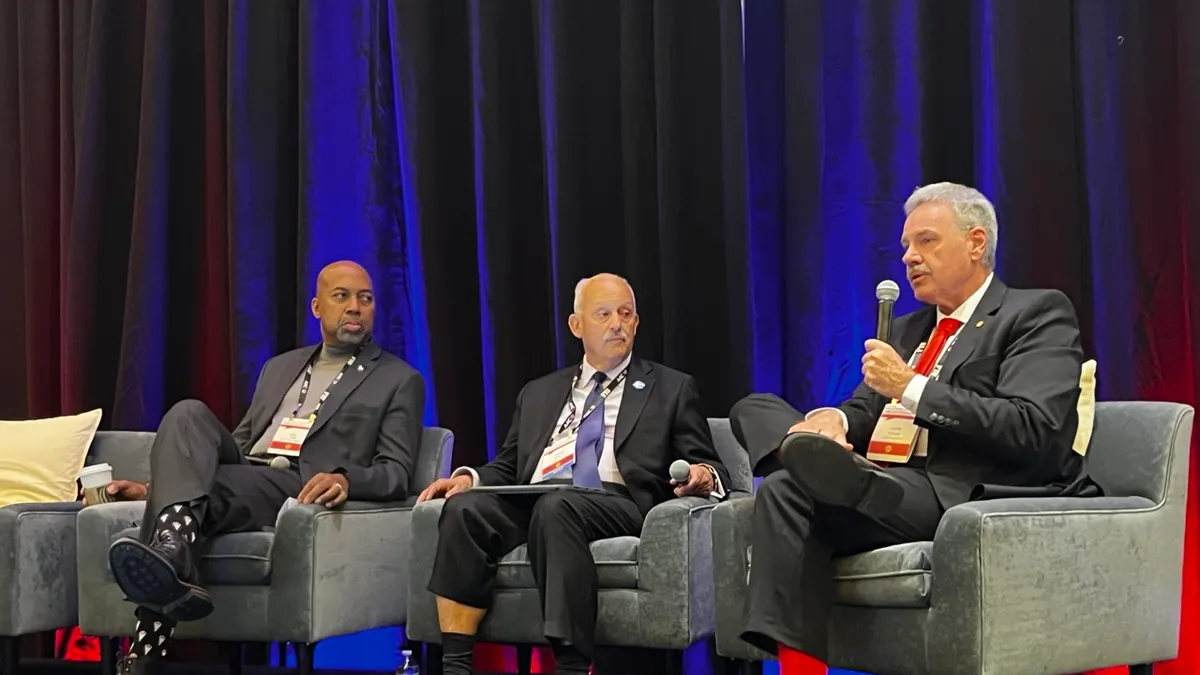
The presidents of three of those institutions — Ferris State University, Lamar University and California State University, San Bernardino — spoke to attendees at the American Association of Colleges and Universities′ annual conference last week about practical ways they work to improve student outcomes.
Higher graduation rates, higher wages?
Public Agenda's economic mobility analysis, released last month, includes every U.S. college that enrolled at least one student in the 2022-23 academic year and awarded at least one undergraduate degree between 2020-21 and 2022-23.
Researchers found that higher completion rates at an institution were associated with stronger earnings outcomes for graduates. As a result, boosting graduation rates “is key” for “fair returns to higher education for all students,” the report said.
For example, a bachelor’s degree-awarding college with a completion rate of 61%, 5 percentage points higher than the national median of 56%, could expect to have graduates with median annual earnings that were an average of $1,283 higher.
"A $1,283 increase in earnings can mean the difference between living paycheck to paycheck or starting to save as a recent graduate,” the report said.
At associate degree-awarding institutions, a jump from the national median completion rate of 35% up to 40% was associated with an average $736 increase in graduates' median annual earnings.
Those jumps can have an even greater impact on economic mobility when multiplied over decades, the report said.
Getting resources to the right students
Andrew Seligsohn, president of Public Agenda, told attendees that the universities his organization selected as case studies didn't just aim to improve completion and retention rates. They focused on using data to improve those outcomes specifically for the lowest income students.
"It's not just moving numbers in the way that's easiest to move the number, but moving in the way that most serves this enterprise," Seligsohn said.
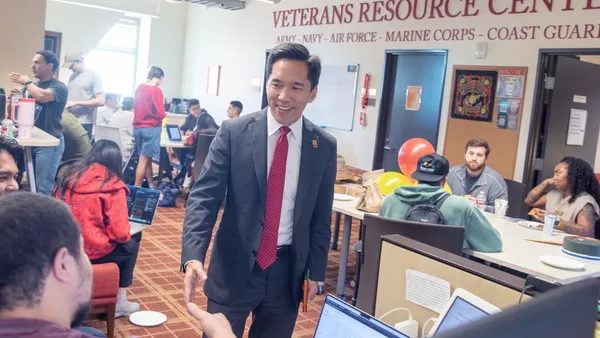
Data was top of mind for Tomás Morales when he took over as president of Cal State San Bernardino. As one of his first acts in office, Morales met with the leadership from every administrative unit and every academic department. His goal was to simultaneously get the lay off the land, identify potential pain points for employees, and secure their buy-in for creating an institution-wide research operation focused on student data.
"That allowed us to break down data at the micro level," he said. "We knew exactly what was the four-year graduation rate, six-year graduation rate, and two-year transfer student rate of, say the history department."
The university could then identify what areas needed improvement and work from there.
Back to basics
The colleges that successfully improved economic outcomes were "laser-focused on removing the specific barriers that block low-income students by addressing basic needs," according to Public Agenda.
Ferris State President Bill Pink said that mindset is front and center at the Michigan public university. It has undertaken multiple efforts to address one of students' most basic needs — food.
Ferris State opened a campus food pantry last year, and several hundred people showed up on the first day alone, Pink said. He also told attendees that his campus is working to battle the stigma that is sometimes associated with food pantries to ensure no students in need decline to use the service.
University employees also use a designated Facebook page to share when food is freely available following a campus event, such as a department luncheon or campus dinner.
"We'll also get students just as they're walking by," Pink said. "Like, "Hey, come on in and just just fill up the plate.'"
Ferris State is also constantly evaluating its services to find potential areas of redundancy or possible improvement.
"It's not just about saying we've got it, 'Here's what we do,'" Pink said. "It's also about asking the question, 'But is it working?'"
If students need something Ferris State cannot or does not yet provide, the university works to connect them with off-campus nonprofits and services, he said.
Culture, inclusion, and serving diverse student populations
Jaime Taylor, president of Lamar University in Texas, told conference attendees that, even with his background in mathematics, he believes "culture is radically more important" than having a perfectly engineered system for student services. If people don't believe in the mission and buy in, it still won't work, he said.
And that methodology hasn't just worked at Lamar.
Taylor, who previously served as provost at Marshall University in West Virginia, said the public institution improved its retention rate by 7% shortly after he took the role in 2018.
How? Taylor credited a new guiding principle: "If you have a job and you can't tie what you do back to how it's helping students, you might want to rethink your job and what it's doing here," he said, recounting what he told university employees at the time.
The goal is to have every person on campus either know how to fix an issue a student is facing or have the ability to find the person who can, he said.
At Cal State San Bernardino, Morales has made diversity and inclusion efforts central to the university's culture.
His Diversity, Equity & Inclusion Board includes over 70 people and six subcommittees focused on topics from curriculum to student recruitment to faculty retention.
"We have not backed off," Morales said, nodding to the increasing federal attacks on DEI work. "I have not scrubbed my website."
The university's focus on diversity is embedded into its organizational structure, rather than existing as an appendix, he said. Cal State San Bernardino is home to a LGBTQ affinity center, a Women's Resource Center, and Latinx and Pan African centers.
Location, location, location
Lower-income students are more tied to their geographic region that those from more affluent backgrounds, the Public Agenda report said.
"For Americans from wealthy families that have had access to higher education for generations, the marketplace of college and university options may seem national — or even international — in scope," it said. "For the vast majority of Americans, the actual range of options is extremely local."
That means that state policymakers are also key partners in this process, Seligsohn said last week.
But that process likely looks radically different for Morales, in California, than it does for Taylor, in Texas.
Even so, "it is possible to get the work done successfully in different contexts," Seligsohn said. "And I salute everybody for doing it in the best way they can given that context."