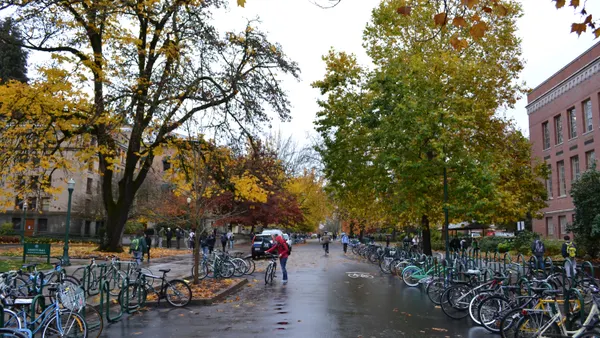
The University of Oregon is considering a proposal that would eliminate over 100 staff positions — just a third of which are vacant — and nearly 20 academic programs amid its efforts to resolve a projected structural deficit of $65 million.
The plan, presented by UO President Karl Scholz to the university’s faculty senate on Wednesday, would also merge or consolidate several academic departments.
Scholz said the latest proposal includes average cuts of 7.25% across all administrative and academic units, down from the 10% that had been forecasted over the summer. That comes out to $17.6 million in administrative services savings and $25.8 million in reduced academic costs, according to the plan.
“We will not be implementing these budget cuts across the board but instead will be applying the actions strategically to minimize the impact as much as possible on essential campus services,” he said in a campus letter Wednesday.
The university is taking campus comment on the plan, which is still in its recommendation phase, and will hold a series of listening sessions. Scholz will also meet with UO’s vice presidents in November before he makes a final decision on the proposal in early December.
Academic cuts on the horizon?
Under the budget plan, UO would eliminate 18 graduate-level academic programs, most of which are in liberal arts fields. It noted that each program on the chopping block has had few graduates in recent years.
Most of the proposed academic cuts would affect the liberal arts
And one program, the business school’s Ph.D. in Management, has already paused admissions “because the faculty do not feel it is serving students well,” the proposal said. It averaged fewer than two degrees annually over the last three years.
Affected programs would stop enrolling new students effective fall 2027 and conclude once their current cohorts finish their degrees. The average master’s program would conclude its teach-out by spring 2028, and closing Ph.D. programs would typically shutter by spring 2032.
The cost of graduate students
Central to many of the proposed cuts is the cost of graduate student-employees. Graduate students awarded GE support get a full tuition waiver and stipend in exchange for filling a research or teaching role at the university, according to UO’s website.
Most doctoral students receive research appointments that are externally funded. But some graduate students are supported through teaching appointments paid by UO.
“GE appointments represent a substantial recurring expenditure,” the proposal said. It seeks to bring the cost of graduate funding “into alignment with available resources” and preserve appointments for departments “where graduate students contribute most significantly to faculty research and scholarship.”
That means focusing GE funding on doctoral training and research, where ongoing support “is central to the degree model,” it said.
Those priorities mean a significant shift away from supporting graduate students in the university’s College of Arts and Sciences. Under the plan, the college would reduce the number of graduate students it supports by up to 40%.
Other programs are restricting their admissions to avoid doling out as much financial support for graduate students.
If approved, the university would pause recruitment for four Ph.D. programs — Architecture; Landscape Architecture; History of Art and Architecture; and Planning, Public Policy and Management — while it conducts cost-benefit analyses and aligns GE-supported admissions “with college priorities and budget.”
Similarly, UO would accept at most five students a year into its art MFA program to limit costly admissions.
The university plan said it will honor the GE support to which it has already committed.
Department mergers
UO is also eyeing several organizational consolidations, including combining its Classics and Religious Studies departments. The merger would “eliminate duplicate leadership responsibilities and reduce faculty service and administrative demands,” the plan said.
The university would similarly combine its earth sciences and geography departments under the proposal. And it would merge its design college with its school of music and dance.
Three undergraduate literature departments — German and Scandinavian Studies; Romance Languages; and Russian, East European, and Eurasian Studies — could also be consolidated into one academic unit.
If approved, department mergers in the design college would be complete by next fall. Department mergers in all other colleges would be expected to be in place by fall 2028.
The university’s libraries, which UO classifies as an administrative unit overseen by the provost, would see a 5% budget reduction under the plan and could lose up to eight full-time positions.
UO’s ongoing financial struggles
If the university approves the proposed budget plan in December, the resulting job cuts would be its second round of significant workforce reductions in less than two years. In 2025, UO laid off some 120 employees and cut about 60 vacant positions.
Several converging factors, most of which center on enrollment, have resulted in UO’s budget pinch, according to Scholz.
Oregon's high school graduate population is expected to drop about 19%, outpacing the national forecast of a 13% decrease according to data from the Western Interstate Commission for Higher Education.
Scholz cited increased competition with peer universities for students and a significant loss of out-of-state enrollment. Nearly half of UO’s students, 47.1%, are from outside of Oregon, a notable share for a public flagship. And the university’s tuition sticker price for out-of-state undergraduates is more than double when it lists for in-state students.
The university also faces a politically engineered drop in international enrollment.
“These dynamics are not only affecting the University of Oregon,” Scholz said. “They represent a changing reality across higher education and are likely to be the new market environment to which we must adjust.”
At the start of 2026, Oregon’s Higher Education Coordinating Commission said all seven public universities are facing shrinking pools of potential students, declining enrollment and constrained state funding.