Dive Brief:
- Kansas is poised to restrict race-related classroom instruction across the state’s public colleges, and at least one free expression group is calling on Gov. Laura Kelly to intervene.
- Last month, Kansas lawmakers added language to the budget that would ban academic programs at public colleges from requiring students to take a "DEI-CRT course" beginning in the 2028-29 academic year. The bill does not define "DEI-CRT," instead giving that power to the State Board of Regents, whose members are all political appointees.
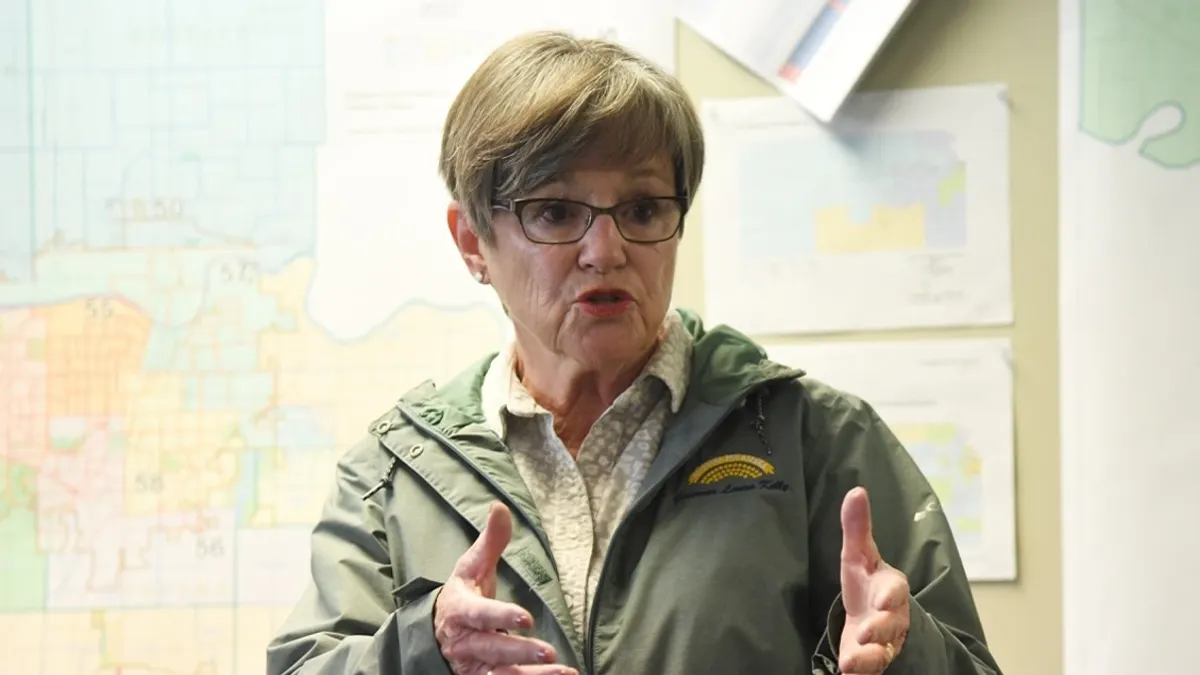
- PEN America on Monday said the additions would create "significant barriers around the teaching of issues related to race and gender" at Kansas public colleges and urged Kelly to veto them. The Democratic governor has until April 9 to do so.
Dive Insight:
Two years ago, Kansas legislators outlawed all positions focused on diversity, equity and inclusion at colleges and other public institutions. They also banned all mandatory DEI training and DEI-related grants and contracts. The changes took effect in August.
Conservative lawmakers are now using the state's budget bill to take aim at required classroom instruction related to race. Their additions also call out CRT, which stands for critical race theory, a decades-old academic concept that teaches racism is systemic.
If enacted, public colleges could seek an exemption from state regents for required classes "whose title clearly establishes its course of study as primarily focused on racial, ethnic or gender studies." In Kansas, regents are appointed by the governor and must receive approval from the state Senate.
Amy Reid, program director for PEN America's Freedom to Learn program, described the anti-DEI additions to Kansas's budget bill as "a sloppy strategy to camouflage censorship." Should they become law, Kansas students would receive "an education redlined by political whims," she said in an April 6 statement.
"When lawmakers tell students and faculty that some ideas are off-limits, it doesn’t just censor classroom discussions, it also impoverishes communities as students enter the workforce with a redacted education," Reid said. "Politicians and political appointees should not be in the business of telling students what ideas are allowed and which are taboo."
PEN America also noted that much of the language inserted by Kansas lawmakers is lifted from model legislation published by the conservative think tank Goldwater Institute and the conservative advocacy group Speech First.
Kelly, who did not immediately respond to questions on Tuesday, is known to line-item veto parts of bills coming out of Kansas' Republican-controlled Legislature. In 2025, she made dozens of changes to the state's budget via vetoes.
However, the governor did not veto the ban on DEI at Kansas public institutions when the legislation crossed her desk in 2024. Instead, she allowed the bill to become law without her signature.
Even if she had, Republicans hold veto-proof supermajorities in both chambers of the Kansas Legislature. About half of Kelly's vetoes to last year's budget were reversed the following day by lawmakers.