

Dive Brief:
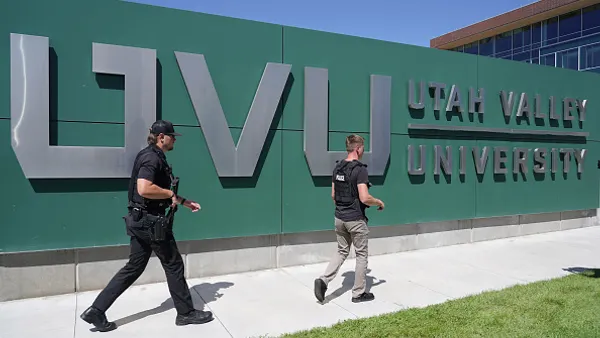
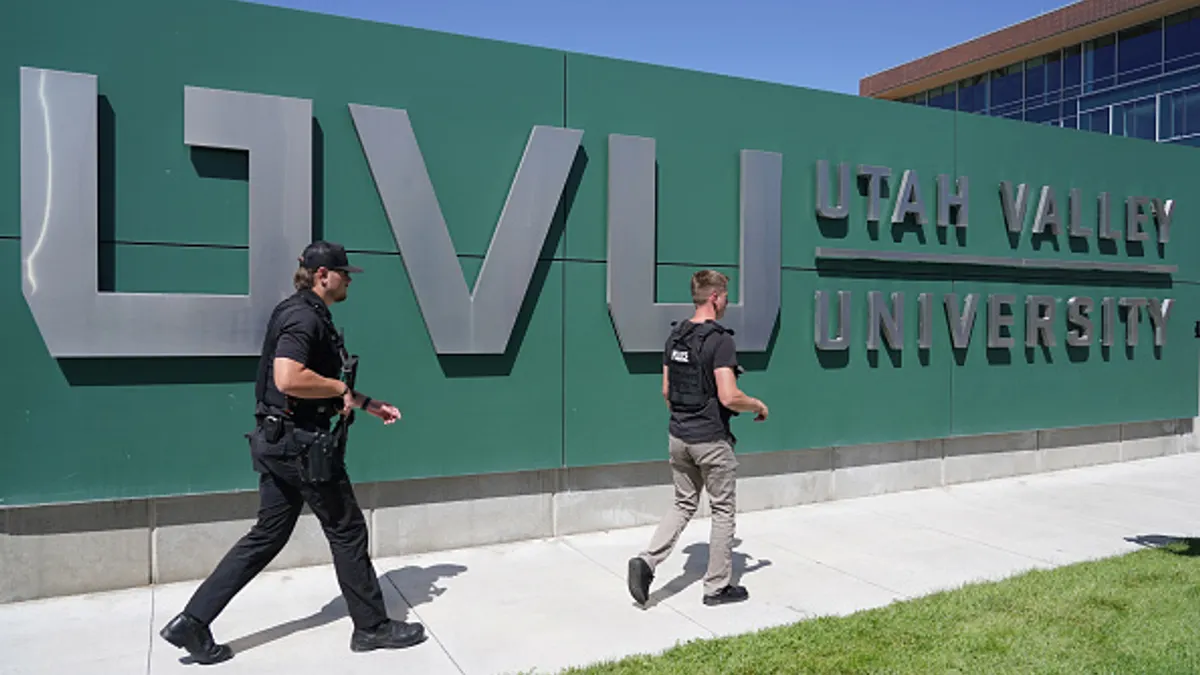
- The family of Charlie Kirk took a first step toward suing Utah Valley University over alleged security failures that their attorneys say led to the right-wing activist’s shooting death on UVU’s campus last year.
- In a letter last week to the Utah attorney general’s office, attorneys argued that the Kirk family could have both federal due process and state wrongful death claims against the state, UVU, the university’s then-president, and UVU’s police department and its chief.
- Attorneys alleged that UVU should have better secured the rooftop area from which Kirk was shot, had more police present at his speaking event, and refused to allow it to happen outdoors if UVU couldn’t provide additional security resources.
Dive Insight:
The family’s attorneys, with the firm Parkinson Benson Potter, argued that UVU should have beefed up its security measures given Kirk's prominence and in light of U.S. political violence preceding the event, including the attempted assassination of President Donald Trump on the campaign trail.
“Through a series of stunning failures and reckless decisions, the UVU Parties created a foreseeable danger to Charlie,” they wrote. “Those decisions ultimately rendered Mr. Kirk helpless to the rooftop shooter in an assassination that could have been avoided had the UVU Parties only taken reasonable steps to plan and oversee a safe event.”
A UVU spokesperson said in an email Wednesday that the university was aware of the Kirk family’s claims and that it addresses legal matters through its established processes. “Our focus remains on supporting our campus community,” the spokesperson said.
The Kirk family attorneys alleged several security failures, including:
- The decision to allow Kirk to speak in an outdoor location attorneys described as “a fishbowl” surrounded by tall buildings and platforms that didn’t have sufficient security measures. “The UVU Parties could have declined to approve the Tour event in the outdoor quad location, or could have moved the venue indoors or to a more secure location, as it had done for controversial speakers in the past,” the Kirk family attorneys wrote. Kirk had specifically requested an outdoor location, The Salt Lake Tribune reported shortly after the shooting.
- A security detail of “only six campus police officers,” which represented roughly a quarter of the total UVU police force, for an event with about 3,000 attendees. The attorneys allege that the campus police department’s chief asked for more officers but that then-UVU President Astrid Tuminez denied the request.
- Failing to take added measures such as limiting access points, using metal detectors, screening attendees and monitoring campus cameras in real time.
- “Ignoring” student concern about easy rooftop access to a nearby building that Turning Point USA, the activist group Kirk founded, passed along to the police chief.
The letter’s allegations came as a notice of claim that could form the basis of a potential lawsuit. The threat of litigation over Kirk’s death highlights the tight spot many colleges face when campus groups invite controversial speakers to campus.
Disallowing such figures from speaking raises concerns about free speech, while allowing them can incur heavy operating costs for those events.
Shortly after Kirk’s death last year, the Foundation for Individual Rights and Expression argued that colleges had “a moral and legal obligation to redouble their efforts to protect free speech as well as their campus community.”
Yet FIRE warned that “administrators must not pass those security costs along to speakers or use security concerns as pretext to cancel a speaker’s appearance.” The organization pointed to a 1992 U.S. Supreme Court case limiting the use of security fees by public campuses for events based on administrators’ judgments about the potential hostility toward speakers and their messages.
But eschewing security fees can lead institutions to absorb high security costs in an age of tight budgets.
One famous example is the University of Florida spending $500,000 on security when the white supremacist Richard Spencer came to speak on campus in 2017.
The University of California, Berkeley likewise spent $4 million the same year to protect a handful of speakers over the course of one month. The university later settled a free speech lawsuit over security fees and moving speaking locations away from the campus center for controversial right-wing speakers. UC Berkeley paid $70,000 and agreed not to charge fees tied to concerns speakers’ ideas will “provoke disturbances.”
Not long after those speaking events, Columbia law professor Suzanne Goldberg described a situation “where a commitment to free expression has enabled provocateurs not only to spew hostile messages into our communities but also to divert extraordinary levels of resources to protect their messaging.”