Dive Brief:
- Private colleges could lose their federal tax-exempt status if they engage in diversity, equity and inclusion work, under a proposed rule issued by the U.S. Department of Treasury on Thursday.
- The IRS tax code does not grant tax-exempt status to private colleges that discriminate based on race. The Treasury's proposal would align the agency's definition of racial discrimination with a January 2025 executive order from President Donald Trump that declared DEI policies and programs to be violations of federal civil rights law.
- The Treasury will accept public comments on the proposal until early November, after which the agency will create a final rule. A final rule would go into effect in June, the proposal said.
Dive Insight:
The Treasury proposal, set to be published in the Federal Register on Sept. 4, is the Trump administration's latest attack on diversity work, and the higher education system more broadly.
If enacted, the proposal would revoke a decades-old IRS rule that allows a college to favor racial minority groups in admissions, programming and financial assistance decisions if that supports the college's racial nondiscriminatory policy for students.
The use of race-conscious college admissions has been banned since the U.S. Supreme Court ruled the practice unconstitutional in 2023.
The proposed Treasury rule seeks to establish that "all forms of racial discrimination in education, regardless of the intent behind or the legality of such discrimination," run contrary to U.S. public policy.
It cited Trump's executive orders directing federal officials to root out DEI in colleges and K-12 schools, which it likened to President Dwight Eisenhower's 1957 executive order authorizing the use of the National Guard to enforce the public school desegregation in Little Rock, Arkansas.
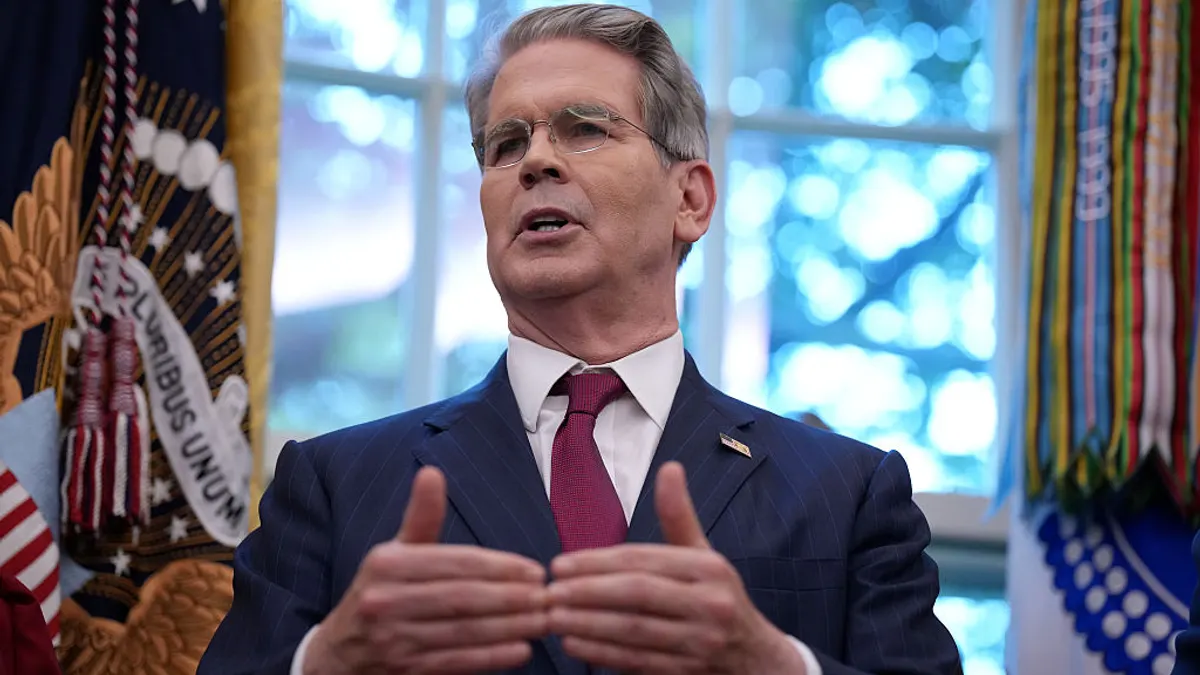
U.S. Treasury Secretary Scott Bessent said in a statement Thursday that the rule would set "a clear standard" for what is expected of tax-exempt colleges.
“Today’s proposed regulations put institutions on notice and schools that continue to engage in racial discrimination should expect to lose that status," added Frank Bisignano, head of the IRS.
Colleges could still "adopt policies intended to eliminate prejudice and discrimination" under the proposal so long as they don't discriminate "on the basis of race, color, or national or ethnic origin." And the rule would not prevent religious colleges from admitting students "on the basis of religious affiliation or membership."
Kara Freeman, president and CEO of the National Association of College and University Business Officers, said Thursday that the proposal “far exceeds” the Treasury's authority and urged policymakers to reconsider it.
"Any change with potentially profound consequences for an institution’s tax-exempt status should be firmly grounded in statute, clearly defined, and should provide colleges and universities with fair and predictable standards for compliance," she said in a statement.
The Trump administration has already alleged that a number of high-profile private colleges — including Harvard, Yale, Duke and George Washington universities — are in violation of federal nondiscrimination laws, often citing their campus diversity efforts. A loss of tax-exempt status would dramatically reshape and weaken each institution's financial standing.
Vanessa Williamson, a senior fellow at the Brookings Institution specializing in tax policy and governance studies, described the Treasury's proposal as "the latest indication of a deeply concerning effort by the administration to politicize tax administration."
"The threats to the neutrality and nonpartisanship of the IRS are an issue that should worry every American who supports the rule of law," Williamson said in a statement Thursday.
The proposal also invoked the Supreme Court’s ruling, which the Trump administration has sought to use to crack down broadly on DEI at colleges. While the high court’s landmark ruling only addressed admissions, the administration has sought to apply the decision to everything from housing to graduation ceremonies.