Dive Brief:
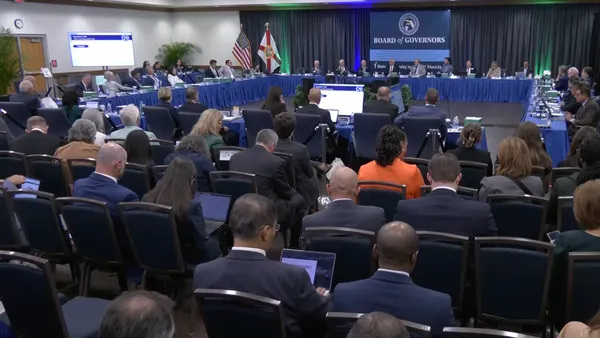
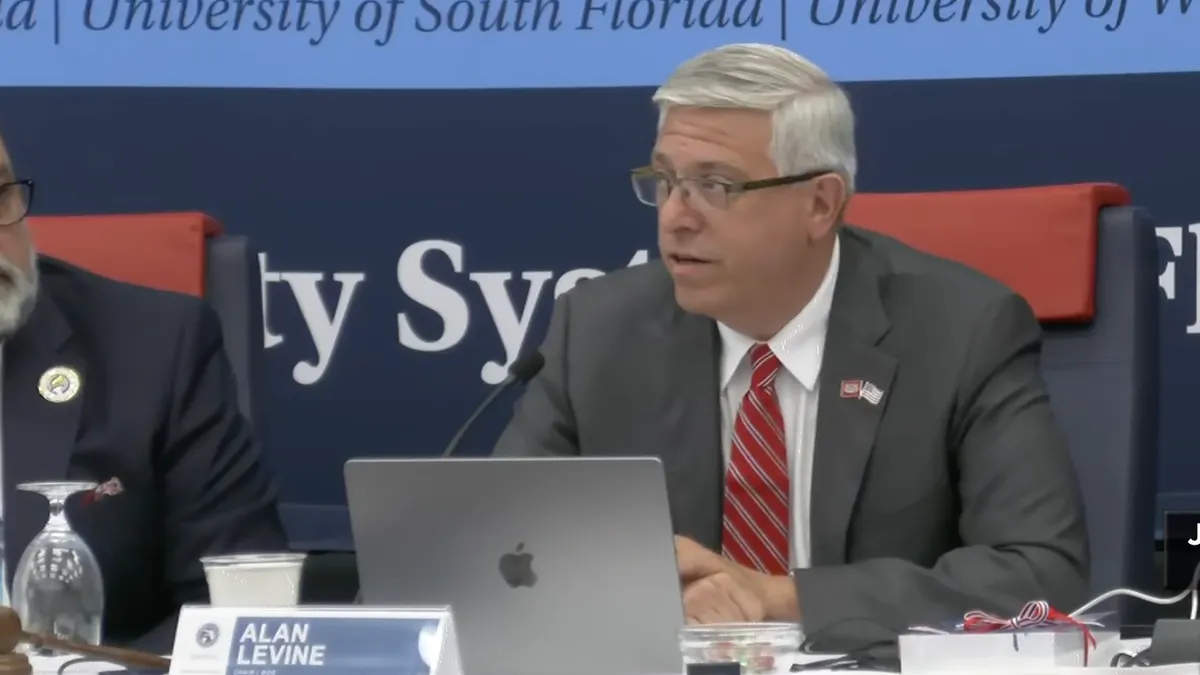
- The State University System of Florida's board of governors on Thursday voted to advance a proposal to ban undocumented students from attending its selective public universities.
- Under the change to the system’s admissions policy, public Florida universities that did not admit all academically qualified applicants in the two most recent academic years would not be able to accept prospective students who are "present in the United States unlawfully."
- The ban, which would take effect for the 2027-28 academic year, would effectively block SUSF from admitting undocumented students, as all 12 of its campuses have selective admissions. The proposed policy change will now enter a 14-day public comment period, after which it will return to the board of governors for a final vote.
Dive Insight:
Florida officials and conservative politicians have increasingly scrutinized undocumented students' participation in public higher education.
The state has one of the largest populations of undocumented college students, with one report estimating some 40,000 attended Florida's colleges in 2021. It also has some of the top-ranked public universities in the U.S.
Admissions at the University of Florida, for example, have become "ultra competitive," according to Florida Gov. Ron DeSantis. The system's flagship accepts 24% of applicants, per U.S. News & World Report data. But even SUSF's less-selective institutions turn away at least 1 in 4 applicants.
6 of Florida's public universities accepted less than half of applicants
The system’s board of governors on Thursday framed the policy change as a way to prioritize Florida citizens in the universities' admissions process.
"We all want to do what's best for students and for the state of Florida," said Alan Levine, chair of the board.
Emily Sikes, the system’s vice chancellor for academic and student affairs, confirmed the change would not affect undocumented students who are currently enrolled, according to the Florida Phoenix.
Before the full board vote, Alexander Lambridis, a junior at Florida Atlantic University, lambasted the move to functionally ban undocumented students from the state's public universities moving forward.
"They try and dress this rule up in the bureaucratic language of enrollment capacity and qualified applicants. They tell us it's just about fairness at selective schools," he said of the governors. "What an absolute insult to our intelligence."
Lambridis also criticized the board for opening the floor to public comment after its academic affairs committee had already advanced the admissions change.
"To expect the public to stand up and speak after the vote has already been cast isn't democracy, it's political theater," he said. "You shut the doors, you pass the rule to satisfy a partisan agenda, and then you allow the community to speak into a void."
Last year, then-Florida State Sen. Randy Fine introduced a bill that would have imposed similar restrictions on all Florida public institutions with acceptance rates below 85%. Though his proposal would have included the Florida College System, most of its 28 colleges have open enrollment admissions and would have been unaffected.
The bill failed to gain traction and was ultimately withdrawn from consideration.
However, Fine and other Republican lawmakers successfully revoked a policy that allowed certain undocumented students to pay in-state tuition rates, effective last July. The move predated the U.S. Department of Justice’s campaign under the Trump administration to sue states over similar policies with the goal of having them struck down.
Fine has since become a Florida representative in the U.S. House.
DeSantis voiced his support for the proposed system ban at a press conference on Wednesday.
"Now that we've addressed the tuition issue and aren't giving the tuition breaks for some here illegally, then this is the next step," he said. "I'm fully supportive of it. I think what they're doing is the right thing to do.