The first year of President Donald Trump’s return to office brought unprecedented and far-reaching changes to the higher education sector, and 2026 is poised to continue the trend.
The conservative-led spending and tax bill, dubbed the One Big Beautiful Bill Act, is set to go into effect in July. But effects of the forthcoming policy changes, including how certain students can finance their college educations, are still in flux.
The Trump administration also looks poised to continue opening investigations into colleges as a means of gaining influence over the sector, putting higher ed leaders in a tight spot. And federal officials are likely to further restrict the ability of certain international students to study in the U.S.
All that comes as analysts predict a tough financial year ahead.
To help higher education leaders prepare for the year ahead, we’ve rounded up six trends we expect to shape the sector in 2026.
Enforcement actions against universities may escalate
The federal government under President Donald Trump last year launched a flurry of investigations into colleges, often suspending or canceling their federal research funding to pressure them into implementing vast policy changes. If the final days of 2025 offer any clue, the Trump administration doesn’t plan to slow down this tactic.
On Dec. 22, the U.S. Department of Education opened a Clery Act investigation into Brown University over the shooting on its campus earlier that month that left two dead and nine injured. The Clery Act requires federally funded colleges to warn their campuses of emergencies in a timely manner and provide support to victims of sexual assault, domestic and dating violence, and stalking.
“After two students were horrifically murdered at Brown University when a shooter opened fire in a campus building, the Department is initiating a review of Brown to determine if it has upheld its obligation under the law to vigilantly maintain campus security,” U.S. Education Secretary Linda McMahon said in a statement.
The new investigation capped a year in which the Trump administration pursued probes against dozens of colleges over potential civil rights violations.
Notably, Brown is one of a handful of institutions that struck formal agreements with the administration to settle these investigations in 2025. But its July deal did not prevent the Education Department from opening a probe into Brown over its actions that occurred after the deal — and does not preclude more such activity from the Trump administration in the future.
And in its ongoing battle with Harvard University, the Trump administration has even threatened to take over patents for inventions made with the help of government research funding. The U.S. Department of Homeland Security also revoked Harvard's ability to enroll international students, but a federal judge blocked the move.
James Finkelstein, professor emeritus of public policy at George Mason University, said he expects federal enforcement actions to ramp up in 2026.
“They're going to weaponize almost every available tool, whether it's Title VI investigations, adding new conditions to federal grants and contracts, reviewing tax exempt status, putting pressure on accreditors, [or] going after individual presidents,” Finkelstein said.
Will college boards stand up for their leaders?
In the latter half of 2025, the Trump administration tried a new tactic in its quest to reshape the higher education sector — pressuring college presidents to step down.
The U.S. Department of Justice successfully deployed this strategy in June, when then-University of Virginia President Jim Ryan abruptly resigned. He said he was leaving to avoid endangering federal funding for the university, which faced a Trump administration investigation into institutional diversity efforts pursued under his tenure.
Ryan was not alone. Following a short investigation, the U.S. Department of Education found George Mason University in violation of civil rights law and called out its president, Gregory Washington, for what it has described as illegal diversity, equity and inclusion efforts.
Washington has pushed back on the Trump administration, calling the allegations a “legal fiction” through his attorney.
For its part, George Mason's board said it would focus on its “fiduciary duty” to serve the best interests of the university. So far, the board — which has too few members to have a quorum — hasn’t announced any major actions.
Finkelstein said other colleges will experience what happened at UVA “unless you find real pushback on a campus and within a community, whether it’s faculty, students, alumni or civic leaders.”
“The boards themselves really are not going to be there to support presidents,” Finkelstein said, arguing that many boards “are being captured by governors and legislatures,” which in turn pack them “with political operatives.”
“Those aren't really trustees who are going to defend presidents against these attacks,” Finkelstein said. “They're really there to ensure that the institutions submit.”
As a case in point, Finkelstein pointed to the head of George Mason’s board, Charles Stimson. The lawyer had held several positions at The Heritage Foundation, the conservative think tank that spearheaded the Project 2025 blueprint for Trump's second term. He left the group in December.
Lindsey Burke, who previously led the Heritage Foundation’s Center for Education Policy and authored Project 2025’s chapter on education, served on George Mason’s board until she stepped down last year to take a position within the Education Department. Both Stimson and Burke were appointed to the George Mason board by Gov. Glenn Youngkin, a Republican.
“The boards are being built for compliance today,” Finkelstein said. “They’re not being built for independence.”
In Virginia, the ideological tilt of university boards may soon change following the Jan. 17 inauguration of Gov.-elect Abigail Spanberger, a Democrat.
“The question is, in Virginia, will the pendulum swing too far the other way, and will Gov.-elect Spanberger try to balance the board by going to the other extreme?” Finkelstein said. “That doesn't seem to be in her political nature, given her record. But who knows?”
Another year of college cuts?
Last year marked more downsizing for many U.S. colleges. But in addition to the now-perennial enrollment and inflation laments, many major universities slashed their ranks of staff and faculty to adapt financially to the torrent of policy changes brought on by the Trump administration.
The federal government disrupted research funding, targeted institutions with investigation and threats, and introduced obstacles to international student enrollment. Student loan caps, higher endowment taxes and other recent statutory changes could add further pressure to college budgets this year.
In its 2026 outlook for higher education, Moody’s Ratings estimated 3.5% growth overall in revenue for the higher education sector, down from 3.8% in 2025. Meanwhile, the credit rating agency forecast that costs would increase by 4.4%. S&P Global Ratings and Fitch Ratings have similarly predicted a gloomy year ahead for colleges and universities, which could well mean more budget cuts.
“We are definitely expecting more expense control measures, and layoffs are certainly one of those,” said Patrick Ronk, a vice president and senior analyst with Moody’s. “Inflation is tempering, which is nice for the sector, but at the same time we see the revenue growth being more constrained.”
While more cuts may be ahead for large institutions trying to weather the political landscape and macro trends, Ronk pointed out many smaller colleges don’t have much wiggle room left in their budgets after enduring pandemic disruption and historic inflation.
“There's not much left to cut” for those institutions, Ronk said. “A lot of these smaller liberal arts colleges have been downsizing for years.”
Not only that, but institutions are also under pressure to spend. Moody’s and other higher ed observers have pointed to a massive backlog of facility and capital needs that colleges can’t put off addressing forever.
“At some point you have to make the dorms look nicer,” Ronk said. He added that Moody’s analysts expect capital spending in higher ed to pick up in 2026, with a potential boost coming from lower interest rates as the Federal Reserve eases its inflation fight.
OBBA goes live
Republicans’ massive spending and tax bill that passed last summer, dubbed the One Big Beautiful Bill Act, contained some of the most sweeping changes to federal higher ed policy in years. At the time, one policy leader in the sector described it as “akin to a Higher Education Act reauthorization,” referring to the primary federal law governing higher education and student aid last reauthorized in 2008.
Changes under OBBA include ending Grad PLUS loans — which became the largest new student aid program when Republicans created it two decades ago — and capping total student borrowing. Specifically, federal loans will tap out at $100,000 for graduate students and $200,000 for professional students. That latter cap has come under debate with the definition of “professional” up in the air, and some programs, including nursing, excluded.
OBBA also increased tax rates on the income of the wealthiest college endowments, expanded Pell Grants for accredited short-term programs, and developed a new accountability system that would cut off access to federal student loans for college programs whose graduates don’t meet earnings thresholds.
The new limits to student borrowing could have broad impacts on colleges. Many worry that the end of Grad PLUS and the new borrowing caps will reduce access to programs and lessen student demand. That, in turn, could weigh on colleges’ finances and drive some institutions to cut graduate programs.
Ronk said the loan system changes will likely deliver the heaviest financial impact for institutions under OBBA. But there are still many unknowns, including how private lenders will respond to the end of Grad PLUS and the start of the caps.
“It's just a little uncertain how much the private market is going to step up, or how much the private market needs to step up,” Ronk said. For student loan caps, he said it remains unclear to what extent graduate program costs will run up against the borrowing limits.
Meanwhile, the endowment tax could amount to a hefty government payment, causing financial pain for a subset of institutions. Yale University, for example, in December announced budget measures and likely layoffs that leaders tied, in part, to a looming $300 million annual tax bill under the new law.
Yet, as Ronk noted, the tax will land hardest on colleges that typically have the highest credit ratings and the most resources and flexibility to weather the financial hit.
“Those happen to be the wealthiest institutions, with really sophisticated investment offices and really big donor bases,” Ronk said.
Ronk predicted their overall wealth would stay “pretty strong,” though he said the tax could lessen their operating activities due to lower endowment income.
Likewise, the new accountability system is not expected to have a massive impact on most colleges. Only 2% of programs are at risk of failing the earnings test, according to a recent analysis from the policy organization HEA Group of data released by the Education Department in late December.
The new accountability test is "going to put a lot more focus on specific programs and outcomes,” Ronk said. “If there is a greater scrutiny of post-grad outcomes for programs, that will lead to generally better student outcomes and benefits for the sector.”
Shifting policies for international students
Higher education is bracing for a 2026 decline in international enrollment, following a slew of Trump administration policies that have targeted foreign students and sought to clamp down on the visa programs that allow them to study at U.S. institutions.
A preliminary survey included in the latest Open Doors report found that over half of polled colleges, 57%, reported a decline in international enrollment during fall 2025.
The following week, a study from NAFSA: Association of International Educators found that polled colleges reported an average of 6% fewer new international students enrolling in bachelor’s programs and 19% fewer in master’s programs.
NAFSA is entering 2026 expecting to see "a sharp drop" in graduate degree enrollment among international students "due to the current administration’s policy decisions," said Fanta Aw, the group's executive director and CEO.
Those decisions brought dramatically slowed student visa processing times, pressure on research institutions to limit the share of international students they enroll, the revocation of over 8,000 student visas, and the high-profile detention and attempted deportation of international students critical of American foreign policy.
A Trump administration proposal to cap student visas to four years would also hit graduate students especially hard.
In Fitch Ratings' "deteriorating" 2026 outlook for the higher ed sector, analysts predicted that last year's federal policies would continue to weaken the international student pipeline to the U.S. For colleges, that could mean the further erosion of growth in tuition and fee revenue, the credit rating agency said.
Less than a month after Fitch issued its outlook, Trump expanded his travel ban to include 39 countries. Among the newly added is Nigeria, one of the top 10 countries of origin for international students in the U.S.
Higher ed experts say that even if foreign students have the chance to study here, they may not want to.
Neal McCluskey, director of the libertarian Cato Institute's Center for Educational Freedom, said prospective international students are increasingly seeing the U.S. as an unfriendly place for them to study.
And Aw said the U.S. can expect to lose students to "nations that have clear, consistent welcoming policies to attract, enroll, and retain international students." She predicted an uptick in foreign enrollment in Asian and Middle Eastern countries, as well as in Western Europe.
"Unless we reverse course on current policies, we risk a major loss of talent and innovation along with social and economic benefits," Aw said.
McCluskey noted one factor that could change the sector's course — Trump's comments regarding international students as "a good business decision."
At times last year, Trump voiced support for international students during interviews and extemporaneous remarks. But those comments have stood in contrast to his policy priorities.
"It is possible he will increasingly take that position and work to ease obstacles to international enrollment," McCluskey said. "But that is not reflected in current administration policy."
Standardized test requirements in flux
A new round of colleges will return to requiring prospective students to submit standardized test scores with their applications this fall.
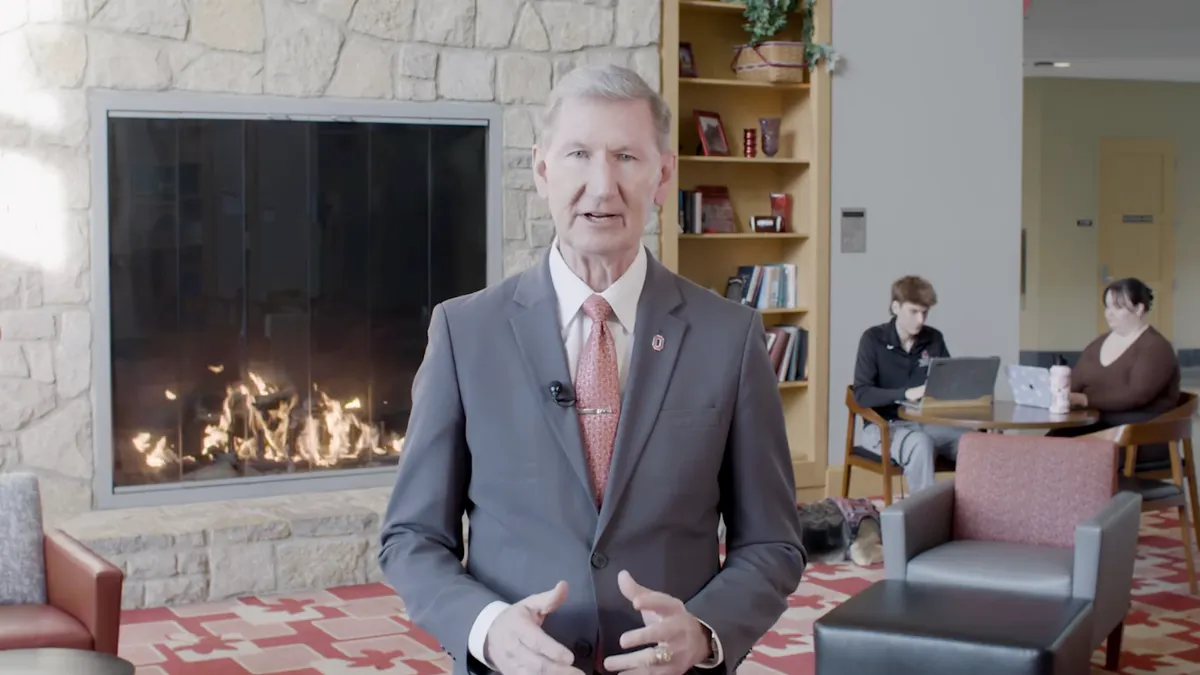
The University of Miami, for example, said last January it would require test scores from fall applicants for the first time since the pandemic. Ohio State University made a similar announcement in March.
COVID-19 shuttered testing sites across the country in 2020 and forced colleges that required SAT and ACT scores to go test optional. But a steady trickle of institutions — selective and well-known ones in particular — have since reinstated mandatory test scores.
Many officials have cited internal research that tied test scores to collegiate success and that found students held back scores they incorrectly believed would hurt their chances of being admitted.
Increasingly, conservative politicians have favored the testing metrics as well.
The Trump administration is seeking to incentivize high-profile colleges into adopting standardized testing requirements via the president's wide-ranging compact. The compact — first offered to nine research institutions in the fall — would give priority for research and other federal funding in exchange for adopting numerous policy changes. Seven of the nine institutions have turned down the deal, while the other two have yet to comment publicly.
But Trump appears to have opened the compact up to all colleges since, with at least a few voicing interest. Two such institutions — New College of Florida and Valley Forge Military College — are currently test optional and would have to change their admissions structure should the president accept their signatures.
Whether due to institutional or external pressures, the switch from test optional to requiring scores seldom goes into effect right away.
Applicants to Cornell University will have to include test scores in their packet this fall, more than a year and half after the Ivy League institution said it would step away from test optional.
In October, Princeton University announced it would reinstate test score requirements for applicants in the 2027-28 admissions cycle, citing internal data that found students who submitted scores had stronger academic performances than those that didn't. Prospective students applying this year will still be able to submit without scores should they so choose.
Some institutions are taking an even more tapered approach.
The University of Alabama System announced last month it would phase out its test-optional policy over the next few years. For the 2026-27 admissions cycle, applicants with GPAs below 3.0 will be required to submit either an ACT or SAT score. Test scores will be required of all applicants beginning in the 2027-28 cycle.
Some institutions — such as Vanderbilt University, the University of Maryland, and the Universities of Wisconsin — are extending temporary test-optional policies, rather than codifying them or doing away with them altogether.