Dive Brief:
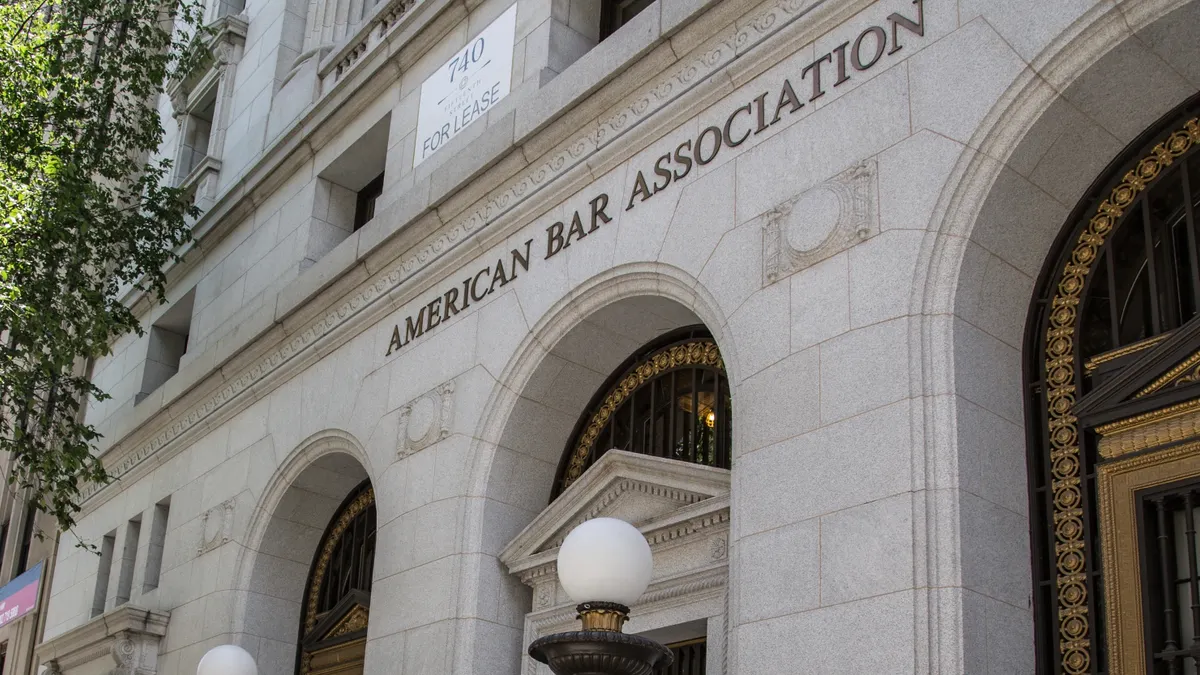
- The American Bar Association's accreditation council will no longer require the roughly 200 law schools under its purview to meet diversity standards in the accreditation process.
- During a Tuesday meeting, the council voted to repeal Standard 206, the diversity-focused aspect of ABA’s accreditation process. Enforcement of the rule had already been suspended until at least August 2027.
- Last month, a report from U.S. Department of Education staff recommended the agency strip the ABA’s accreditation council of its power, alleging it did not meet more than two dozen criteria required for recognition. In part, it cited the ABA's guidance on diversity, equity and inclusion as a sign of its noncompliance.
Dive Insight:
Amid increasing conservative scrutiny, the ABA said it would review Standard 206 to ensure it complied with federal law and suspended enforcement of the rule. The association is the only national accreditation agency for law schools, and students in almost every state cannot take the bar exam without a degree from an ABA-accredited law school.
Under Standard 206, law schools were required to "demonstrate by concrete action a commitment to diversity and inclusion by providing full opportunities for the study of law and entry into the profession by members of underrepresented groups, particularly racial and ethnic minorities." The rule also mandated a commitment from law schools to maintain a diverse student body and employee roster.
But the second Trump administration has targeted diversity standards in accreditation and repeatedly singled out the ABA in that campaign. In March 2025, then-Attorney General Pam Bondi called Standard 206 unconstitutional and threatened the ABA's ability to accredit law schools.
At one point, the ABA proposed changing the rule’s name — from “Diversity and Inclusion” to “Access to Legal Education and the Profession" — and having it spelled out that no law school should "take race or any other identity characteristic into account" when making individual admissions or employment decisions.
But the plan did not satisfy the Trump administration, which ramped up attacks on the ABA.
Melissa Hart, chair of the ABA accreditation council, said Tuesday that repealing Standard 206 was necessary to preserve "continued recognition by state supreme courts and the Department of Education.”
All but two of the 50 public comments submitted to the ABA about the rule opposed repealing it. Many of the submissions echoed common themes, including that diversity and inclusion are "necessary for quality legal education and competence in the legal profession," and that Standard 206 helps protect the rule of law and a multiracial democracy, according to an ABA analysis.
They also argued the diversity rule is necessary to address the legal profession’s history of exclusion and that existing law does not necessitate that the standard be repealed.
"A number of comments assert that the repeal demonstrates capitulation to the current federal administration and demonstrates a lack of integrity and courage," the ABA's standards committee said in a May memo.
Even so, the committee recommended the ABA repeal Standard 206 based on the organization's "unique, essential role as an accreditor in a national system of accreditation and the current legal landscape.”