Dive Brief:
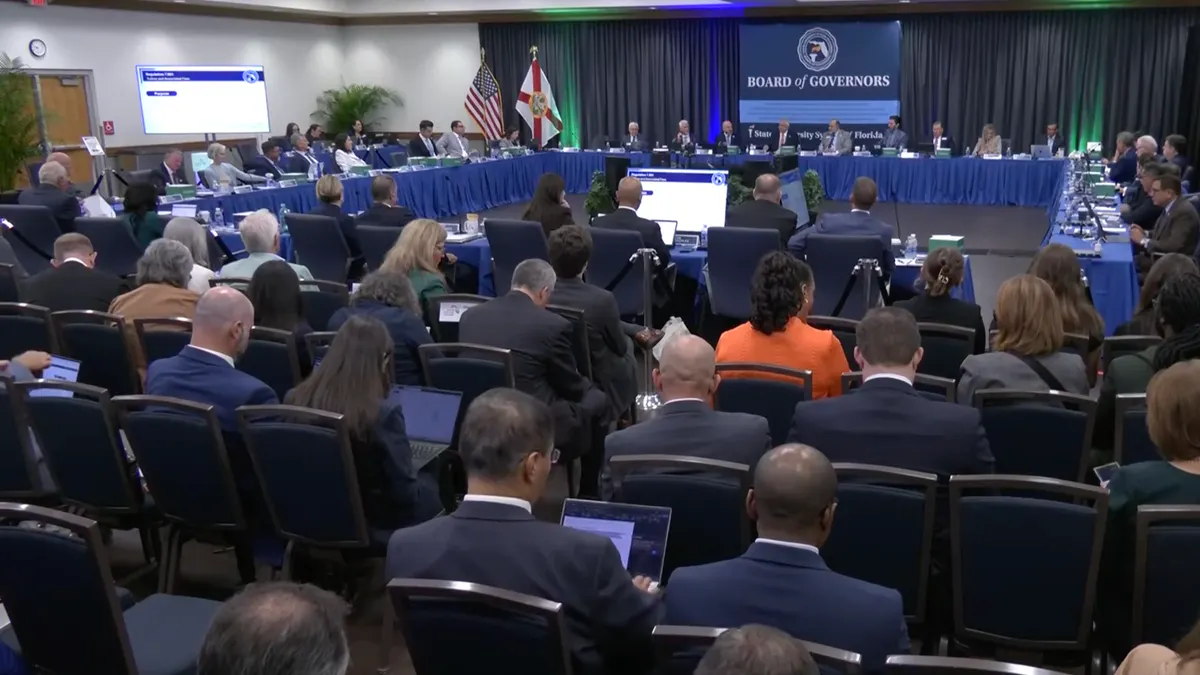
- The State University System of Florida’s board of governors on Thursday banned undocumented students from attending its universities with selective admissions — effectively shutting them out of the highly ranked public system.
- Beginning in the 2027-28 academic year, prospective students who are “present in the United States unlawfully" would only be able to attend public Florida universities that accepted all academically qualified applicants in the two most recent academic years.
- The policy change follows a July vote from the Florida State Board of Education to bar undocumented students from attending all of the Florida College System's 28 institutions.
Dive Insight:
SUSF, one of the largest public higher ed systems in the U.S., includes 12 universities that enroll over 430,000 students, according to system data. It is unclear how many students are undocumented.
The University of Florida enrolled nearly 4,800 "non-resident aliens" in fall 2025, according to institutional data. The data did not specify which, if any, lacked legal status.
The system's flagship accepts 24% of applicants, per U.S. News & World Report data, making it one of the most selective universities in the system. But even SUSF’s least-selective institutions turn away at least 1 in 4 applicants.
6 of Florida’s public universities accepted less than half of applicants
The SUSF board first proposed the policy in June with support from Gov. Ron DeSantis.
During the public comment period, organizations like the Florida Policy Institute and the Presidents' Alliance on Higher Education and Immigration expressed concern or flat-out opposition to the proposal. The board, however, did not make any changes and this week passed it as introduced.
Florida Lt. Gov. Jay Collins praised the policy on Thursday, calling it "common sense" and "the Florida way."
"Florida taxpayers should not be expected to subsidize opportunities for people who broke our laws to come here," he said on social media.
DeSantis appointed Collins as lieutenant governor last year, after Jeanette Nuñez resigned to become president of Florida International University. FIU, located in the immigrant-rich Miami community, is likely to be one of the universities most affected by the policy change given its status as a commuter school with a 93% in-state student body.
The Florida Education Association on Thursday condemned the enrollment ban, saying "despite public outcry, the BOG approved the rule unanimously with no discussion."
FEA President Andrew Spar said the ban will cut off access for undocumented students who grew up in the state and attended its K-12 public schools.
"Florida has already invested in the future of these students, many of whom were brought here as children through no fault of their own," he said in a statement. "Forfeiting that investment is not only wasteful, but it also harms our communities and Florida’s economic future."
Robert Cassanello, president of the United Faculty of Florida, argued that the SUSF board had "lost sight of its responsibility to safeguard higher education for the common good."
"This rule stymies growth and closes doors that have helped our communities, which is especially devastating at a time when Florida faces critical shortages in healthcare, education, and skilled trades," Cassanello said in a Thursday statement.
Florida has one of the largest populations of undocumented residents in the U.S. That, combined with its now-revoked educational access policies, resulted in the state also having one of the largest populations of undocumented students in higher education — some 60,000, according to the Higher Ed Immigration Portal.
Following Thursday's SUSF vote, undocumented students will be unable to attend any public college or university in the state.
Conservative Florida lawmakers have tried repeatedly to reduce undocumented students' access to higher education. The Legislature successfully repealed its decades-old law allowing certain undocumented students to pay in-state tuition rates. But recent attempts to restrict admissions at public institutions have fallen through.
For example, then-Florida State Sen. Randy Fine — now a member of the U.S. House — introduced a bill last year to block students without legal status from enrolling at public colleges with acceptance rates below 85%. The proposal covered both Florida's college and university systems, though most of the state's 28 public colleges have open admissions.
Fine ultimately withdrew the bill after it failed to gain traction.
When legislative efforts failed, the governing boards of Florida's public institutions — many of whose members were appointed by DeSantis — enacted policies of their own. One estimate from the Florida Policy Institute found the Florida College System's ban could cost it $15 million in lost tuition and fee revenue annually, based on fiscal 2025 data.