

Dive Brief:
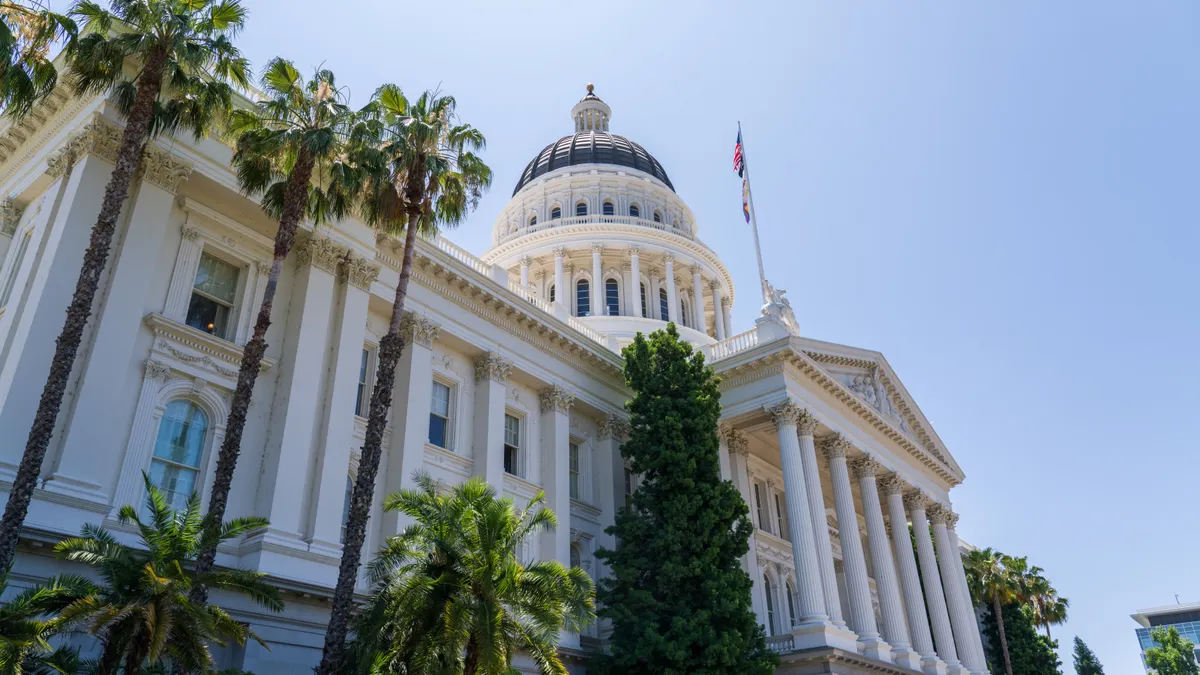
- California’s state Senate passed a bill on Wednesday that would create a new public entity to help fund health and science research, including at California universities, amid the Trump administration’s disruption to the federal research system.
- SB 895, which passed by a 29-9 vote, would establish the California Foundation for Science and Health Research and issue $12 billion in bonds to fund the foundation’s grants and awards. That’s down from $23 billion in an earlier version.
- To become law, the proposal would require passage in the House, Gov. Gavin Newsom’s signature and voter approval at the next statewide general election. Dozens of unions, professional associations, faculty groups, universities and other organizations have endorsed the bill.
Dive Insight:
The foundation’s goal would be to “facilitate scientific research” in California, according to the bill. SB 895 stipulates that it would “prioritize funding research that replaces funding cuts by the federal government.”
Some of the potential research areas listed in the bill are among those targeted by the Trump administration, such as climate change, public health, and HIV and AIDS.
SB 895 would grant the top leaders of California’s two public university systems each their pick of a scientist to sit on the council overseeing the foundation. The president of the Association of Independent California Colleges and Universities, or a designee, would also have a seat on the council, which would have 11 to 13 members in total.
The foundation would be tasked with distributing grants based on “the scientific merit of the proposed research, as determined by an open, competitive, scientific peer review process,” per the bill.
In addition to public money raised through the bonds, SB 895 would create a fund through which private donors could contribute toward loans and grants to public and private universities and research institutions.
California’s colleges have experienced both general and targeted funding disruption from the Trump administration. Just this week, the U.S. Department of Justice opened a new front in the administration’s long-running feud with the University of California system and its Los Angeles campus.
Repeating the administration’s allegations that UCLA has been deliberately indifferent to antisemitism on campus, the DOJ sued the UC system and asked for court permission to stop paying UCLA the remaining money owed on its existing federal grants. It also asked for UCLA to be ordered to pay back grants it received from the government during the years it was allegedly noncompliant with civil rights law.
This comes after the administration suspended $584 million of grant funding to UCLA based on similar claims about campus antisemitism. A federal court later blocked the suspension and other penalties the Trump administration threatened under civil rights laws after faculty groups sued the government.
The Trump administration has also targeted California State University with multiple investigations.
Last September, the UC system’s top leader warned that it would need up to $5 billion in state support if the federal government cut its research support and other federal funding to the system.
“Classes and student services would be reduced, patients would be turned away, tens of thousands of jobs would be lost, and we would see UC’s world-renowned researchers leaving our state for other more seemingly stable opportunities in the US or abroad,” UC President James Milliken said at the time.
SB 895 aims to offer some protection and stability for the state’s research institutions.
“Because the federal government has been one of the largest funders of scientific research in California, foundations, nonprofits, and corporations alone cannot make up the gap when cuts are made by the federal government,” the bill states. “Unless the people of California rise up, much of this critical work may come to a halt.”
Milliken spoke in favor of the bill earlier in May, citing federal research disruption, which a news release from his office called “one of the most severe threats” to the system’s research enterprise in its history.
“SB 895 comes at a pivotal moment, providing a lifeline that delivers economic opportunity and life-saving medical care for our residents,” Milliken said in a May 4 statement.
But the vote could face a difficult road. “Bonds are always very hard politically in the Legislature,” state Sen. Scott Wiener, a Democrat who co-introduced the bill, told the news site Mission Local on Wednesday. “It’s not guaranteed.”