

Dive Brief:
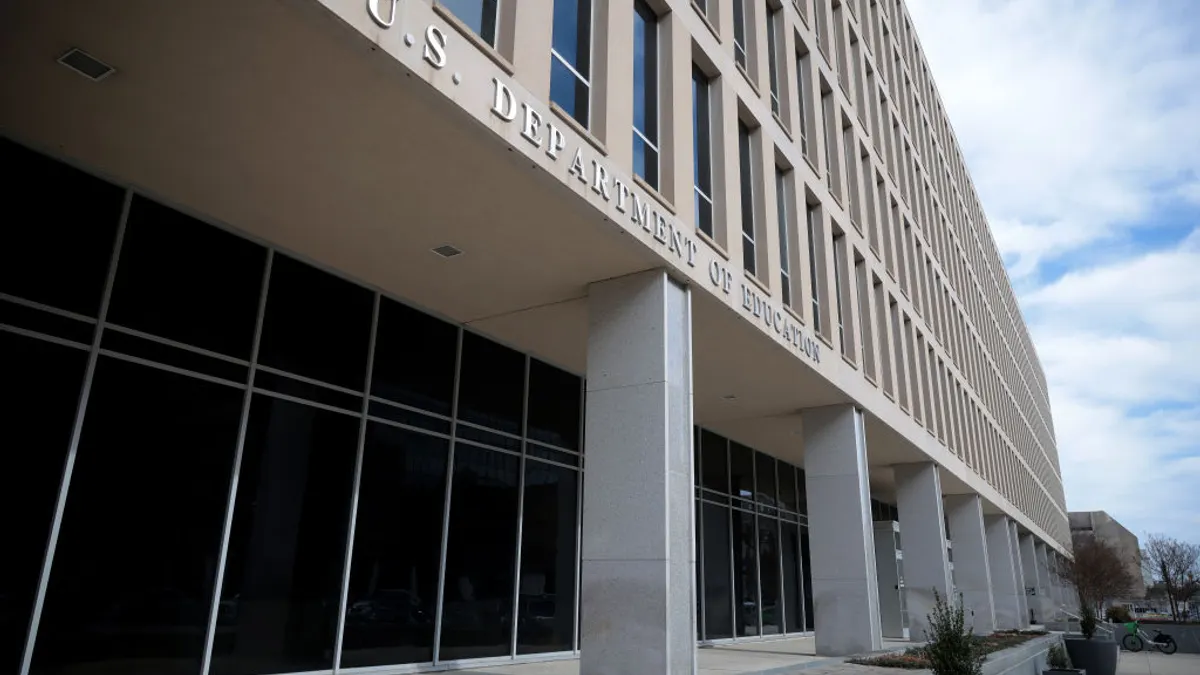
- The U.S. Department of Education on Thursday released final regulations to tighten the federal student loan system to comply with the massive tax and spending law passed by congressional Republicans last year.
- The final rule largely adheres to language from negotiated rulemaking sessions held late last year. Notably, the regulations stick with a limited and contested definition of “professional student" that excludes major graduate fields such as nursing and education from higher lending caps.
- The regulations also outline the sunsetting of Grad PLUS loans, a narrowed slate of loan repayment options and other changes mandated by the law. Most provisions take effect July 1.
Dive Insight:
When the Education Department in January proposed a definition of “professional student” that included just 11 fields, it drew tens of thousands of comments.
The distinction has significant financial implications for students. Professional students under the rule can borrow up to $50,000 annually and $200,000 in aggregate for their graduate programs. Meanwhile, the total cap for all other graduate students is half that amount, and the annual cap is $20,500.
Professionals, educators and associations from a wide range of fields — from nursing to physical therapy to landscape architecture to accounting — protested their exclusion. Many argued their fields require graduate-level degrees and licensure that can be costly to attain.
Ultimately, the department’s final rule included the original 11 areas it outlined: pharmacy, dentistry, veterinary medicine, chiropractic, law, medicine, optometry, osteopathic medicine, podiatry, theology and clinical psychology.
Some groups decried the final rule on Thursday. The Association of Public and Land-grant Universities President Waded Cruzado said the group was “profoundly disappointed” in the department’s narrow definition of professional.
“Many of the programs not included in higher loan limits are in critically important sectors, such as health care, that are already facing labor shortages and their exclusion will only make problems worse in decades to come,” Cruzado said.
In its final rule, filed with the Federal Register on Thursday morning to be published Friday, the Education Department acknowledged concerns over the excluded fields, but argued that last year’s law bound ito an existing regulatory definition of professional programs.
That regulation states that professional degrees signify “completion of academic requirements for beginning practice in a given profession and a level of professional skill beyond that normally required for a bachelor's degree” and also typically require licensure.
That regulatory language also cites as examples 10 of the 11 of the degrees the department settled on. However, the original definition — as some commenters pointed out — says that professional degrees “include but are not limited” to those examples.
In the final rule, the department said that it is not treating the examples as “indicative of an open-ended category to be added to at the Department’s discretion.” The agency did, however, add clinical psychology to the list of professional degrees, citing in part doctoral-level requirements for professional licensure, though that was not a criterion in the original regulatory definition.
The department also found that a negotiated rulemaking proposal that would have broadened the range of eligible professional degrees would have resulted in larger budget outlays and loan disbursements.
Beyond graduate and professional loans, all student borrowers beginning in July will have a total aggregate borrowing limit of $257,500.
Counting toward that cap will be any Grad PLUS loans students have taken out, unless they started a program before July, have already received a loan for it and remain enrolled, according to an Education Department fact sheet.
That exception expires after three years or the expected end of their program, whichever comes first. During that time, they will be able to continue accessing Grad PLUS loans.
Institutions can also limit borrowing for a given program, as long as the limits are applied for all students in the course of study.
Additionally, the new regulations put into place a new student loan repayment system that includes just two “streamlined” options that become available in July. One plan is for fixed payments, and the other is income based that increases as the borrower makes more. Other current income-contingent options will sunset in July 2028.
When Republicans revamped the student lending system last year, they described many provisions — including the borrowing limits and ending the Grad PLUS program — as a means to reduce debt loads for students. Total outstanding federal student loan debt today stands at nearly $1.7 trillion, according to the Education Department.
In a press conference Thursday, Under Secretary of Education Nicholas Kent echoed that reasoning.
“Collectively, our changes will ensure students continue to have the access that they need for federal student loans, while helping prevent borrowers from taking on unmanageable debt levels that they may never be able to repay,” he said.
He also argued that decreasing lending will put downward pressure on tuition prices. “This is just basic economics, right? When there is more money in the system, institutions of higher education are going to raise their prices,” Kent said.
Critics, however, have voiced concerns that students will merely be forced into private lending markets. These loans could end up costing borrowers much more because they typically carry higher interest rates and less favorable terms than federal loans.