

Dive Brief:
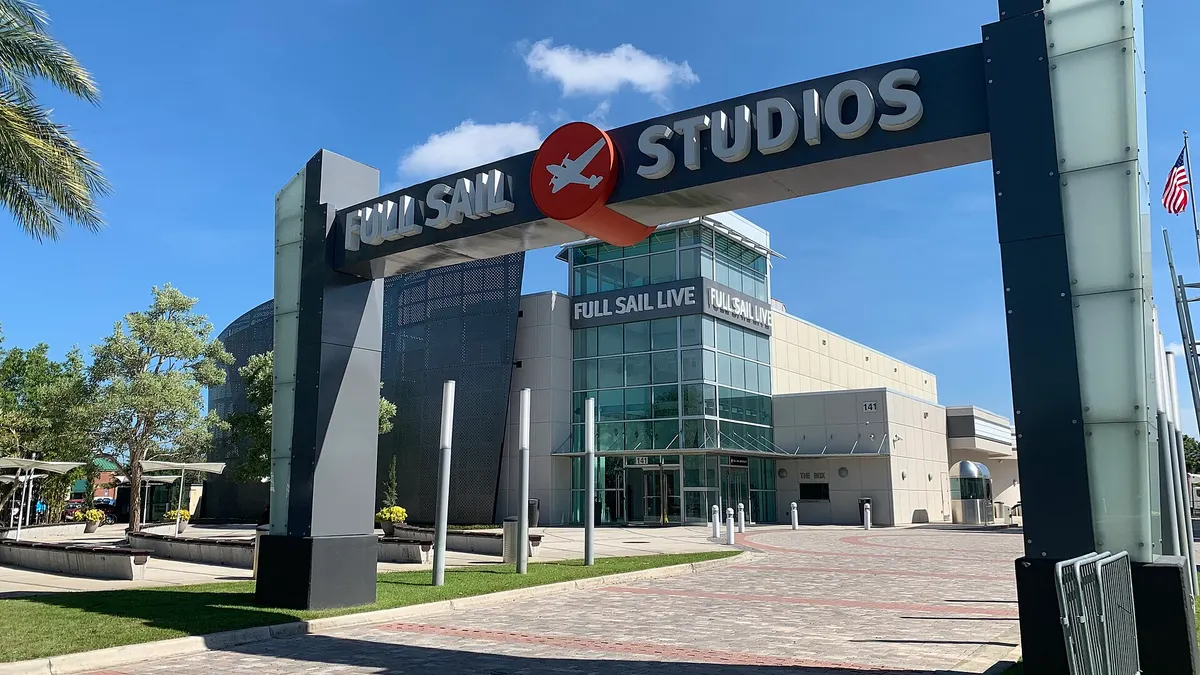
- Full Sail University eliminated 180 jobs as part of a restructuring “tied to our current and future institutional priorities,” a spokesperson for the Florida for-profit institution confirmed.
- The cuts spanned academic, administrative and operational positions. “Changes in workflows, enrollment patterns, and technology have altered where Full Sail needs to focus and which roles are required to best serve the institution for the future,” the spokesperson said by email on Wednesday.
- The restructuring did not affect Full Sail’s academic portfolio or student services.
Dive Insight:
Founded in 1979, Full Sail began as a recording workshop in Ohio. Today, it's an arts and media college near Orlando with around 27,000 students.
The latest round of layoffs comes just a little over a year after the university laid off 120 staff and faculty. The university told local media at the time that the cuts, about 5% of its workforce, were aimed at supporting its “long-term sustainability.”
Despite this second round of cuts, Full Sail remains “confident in our ability to deliver an exceptional educational experience now and into the future,” the spokesperson said.
Unlike many institutions trimming their workforces, Full Sail has actually seen some enrollment growth in recent years. Its fall 2024 enrollment rose slightly, by 2.8%, from the year before. And that headcount — 27,169 students — grew 25% from five years prior, according to federal data.
However, Full Sail’s student population fell by 13.1% from 2025 to 2026, according to the spokesperson.
Arts colleges have had a rough few years. This past January, the California College of the Arts announced it would close at the end of the 2026-27 academic year and turn its campus over to Vanderbilt University. The closure came after years of struggle but also what looked like the beginning of a turnaround with $45 million in fundraising announced in 2025.
Ultimately, CCA leaders determined the college’s “tuition-driven business model is not sustainable” amid demographic shifts and persistent financial deficits, its president said in January.
Recent years have also brought the closures of the University of the Arts in Philadelphia, which collapsed in dramatic fashion in June 2024, and the Delaware College of Art and Design. Prior to those closures, the Art Institutes — a system that once had dozens of campuses across multiple states — shuttered their remaining locations, marking the end to a long-running disintegration of the college chain.