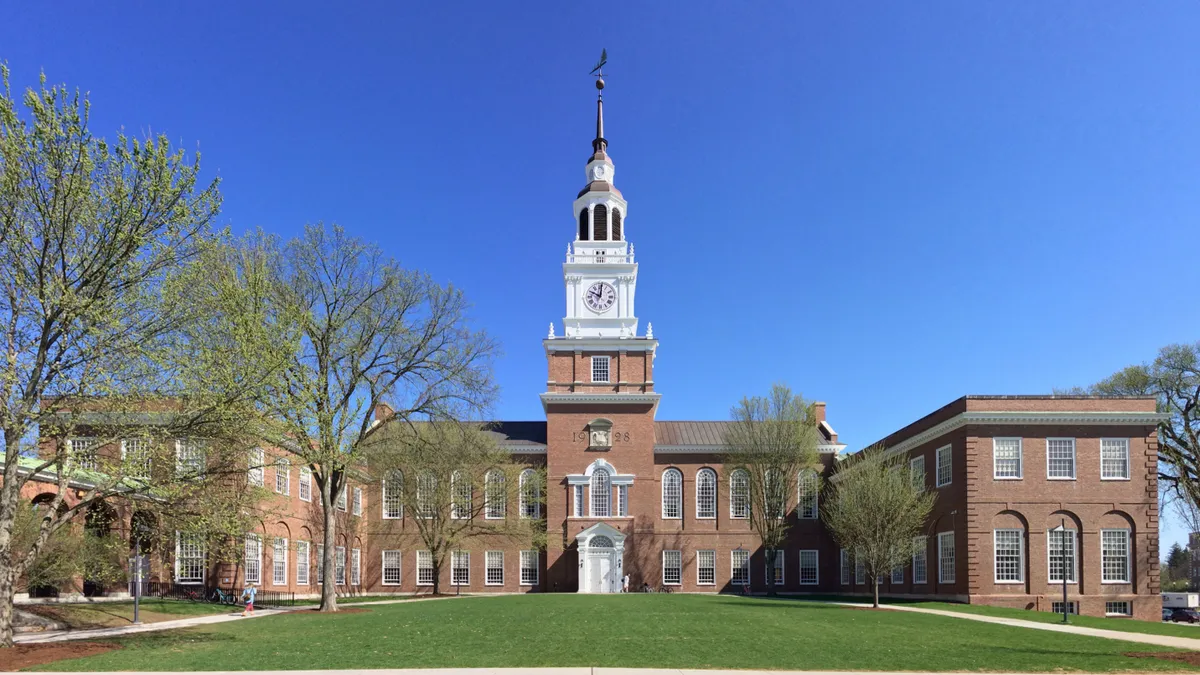
As some institutions move to restrict certain classroom instruction, Dartmouth College has been taking a different tack — teaching its students how to engage in debate about polarizing topics.
Dartmouth Dialogues aims to teach students how to engage in difficult conversations inside and outside the classroom.
The program provides baseline dialogue training to first-year students during orientation and hosts additional elective dialogue workshops for students, said Kristi Clemens, the inaugural executive director of Dartmouth Dialogues.
That includes trainings specific to campus leadership roles, such as Greek life leaders, sports team captains and undergraduate advisers. It also offers workshops to teach faculty members how to create space for dialogue in their classrooms, said Clemens, who left the program in July to serve as Dartmouth’s associate vice president of institutional case management and community support.
Since the program's launch in 2024, the New Hampshire college has gained greater repute as a campus that promotes free speech.
The university has risen dramatically in the Foundation for Individual Rights and Expression’s free speech rankings over the past two years. And numerous incoming students have cited the university’s commitment to dialogue and institutional neutrality as a reason they decided to attend, said Clemens.
Donors have noticed, too. The university has raised at least $29 million toward the initiative, including a $25 million endowment from one alumni family.
Dartmouth is among a growing number of universities that have tried to promote civil discourse and debate about polarizing topics in classrooms.
The movement comes as state lawmakers and university leaders in states such as Texas, Indiana, and Florida work to restrict classroom discussions about topics such as gender identity and diversity, equity and inclusion. Similarly, some administrators, student groups, activists and government officials have tried to bar controversial speakers or performers from holding campus events.
Over the past two years, Dartmouth Dialogues has hosted panels with divisive conservative and liberal high-profile speakers to discuss issues such as the ongoing tensions in the Middle East. It has also held workshops and seminars teaching employees and students — including first-year students during orientation — how to engage in challenging conversations.
There’s been a noticeable shift on campus over the past few years, according to Jonathan Smolin, a Dartmouth professor. Smolin, who co-teaches a Dartmouth Dialogues seminar course on difficult conversations about the Middle East, said more students are starting to engage with offensive texts or materials, reversing a trend that had proliferated on campus in the 2010s.
“At least at Dartmouth, it feels like that era has passed,” he said. “We are seeing a much more openness to recognizing the difference between disagreeing or even being uncomfortable with the perspective versus refusing to engage with it, or wanting to shut it down.”
Bringing constructive dialogue back to Dartmouth
Dartmouth faculty and administrators started discussing the idea of an initiative designed to promote constructive dialogue skills on campus back in 2019 after noticing students were not engaging in classroom discussions the way they used to, said Clemens.
The project — temporarily shelved during the COVID-19 pandemic — finally started to take shape after student protests broke out on campuses nationwide in the wake of the Oct. 7, 2023, terrorist attack and the ensuing war between Israel and Hamas in Gaza.
Earlier that year, Sian Beilock and Philip Hanlon, then Dartmouth's incoming and outgoing presidents, respectively, co-authored an op-ed for The Boston Globe arguing that academic inquiry was under attack and discourse was driven down by a fear among students about speaking up in classrooms.
Universities, they wrote, needed to provide so-called “brave spaces” — giving students the skills needed to engage in conversations and speak up when others disagree.
Following the terror attack, Smolin said he and leaders from Dartmouth's Jewish Studies department launched Middle East Dialogues. The forum series brought high-profile speakers to campus to present different perspectives on the conflict with intellectual rigor, critical thinking and analysis. For example, experts discussed Palestinian support for Hamas and the potential one and two-state solutions within the region, he said.
Those discussions showed the Dartmouth community that “we can have these tough conversations about deeply, deeply divisive issues and still do it respectfully,” said Clemens.
She said Dartmouth Dialogues emerged from there.
Creating space for dialogue
During the Dartmouth Dialogues workshops, Clemens said she generally discusses the challenges with normalizing disagreements on campus and how students can work through them and find some common ground with others. Attendees learn how to ask another person how they formed their beliefs before sharing their own perspectives and experiences with the topic, she said.
The university also ramped up how many speakers that were brought to campus over the past two years, said Clemens.
The student-led Dartmouth Political Union, for example, held discussions between progressive journalist and broadcaster Mehdi Hasan and conservative commentator Michael Knowles about Constitutional norms under the Trump administration.
The group has also held conversations about U.S. foreign policy with John Kerry and Mike Pompeo, who served as secretaries of state under the Obama administration and the Trump administration, respectively.
The dialogues are “not about bringing everybody to the center or getting everybody to agree,” said Clemens. “But finding ways to recognize the other person is a human, and that you can find some elements that are shared, even if you deeply disagree.”
‘There’s been a dramatic change’
Smolin said he enters his Middle Eastern seminar course from the perspective of “academic neutrality.” He requires his students to use critical thinking and analytical skills as they learn about perspectives they may disagree with — including on gender, colonialism, religion, and conflicts between Israel and Palestinians from the pre-Islamic era to the modern day war in Iran, Smolin said.
His Dartmouth Dialogues seminar course, in particular, teaches students how to hold difficult conversations and then applies those skills to “some of the most challenging topics related to the Middle East today,” Smolin said. The course, in its second year and co-taught by a former Egyptian diplomat Ezzedine Fishere, holds roughly 10 students who meet for two hours twice per week, he said.
Smolin lets students know on the first day of class that he’s not trying to change their views and is not there to tell them whether one side is right or wrong.
Students often arrive on the first day with an idea of how they could win an argument but quickly realize the goal is not to win the discussion, Smolin said. Rather, the objective is to approach it with curiosity, humility and an open mind so they can learn something new or accept the possibility that they could be wrong, he said.
According to FIRE, Dartmouth Dialogue’s efforts have been working. Of the 250-plus colleges it ranks on free speech, Dartmouth shot up from 224 in the rankings published in 2024 to 6 today and is first among Ivy League institutions.
Last year, FIRE attributed the rankings growth to the university’s support for allowing polarizing speakers on campus and its “major policy revamp” that formally adopted institutional neutrality — meaning officials won’t weigh in on issues that don’t impact its mission.
Clemens said the university plans to continue broadening Dartmouth Dialogues, and bringing in more diverse speakers, as well as fund related research projects, such as how the brain responds during difficult conversations.
So far, Dartmouth’s students have shown they don’t want a campus environment of polarization or divisiveness — they want to be able to engage in open debate with free speech, Smolin said.
“There's been a dramatic change in the perspective of the student body at Dartmouth in the past three years, and an improvement with each passing year,” said Smolin.
Correction: This story previously included incorrect information about FIRE rankings data. It has been updated.