

Dive Brief:
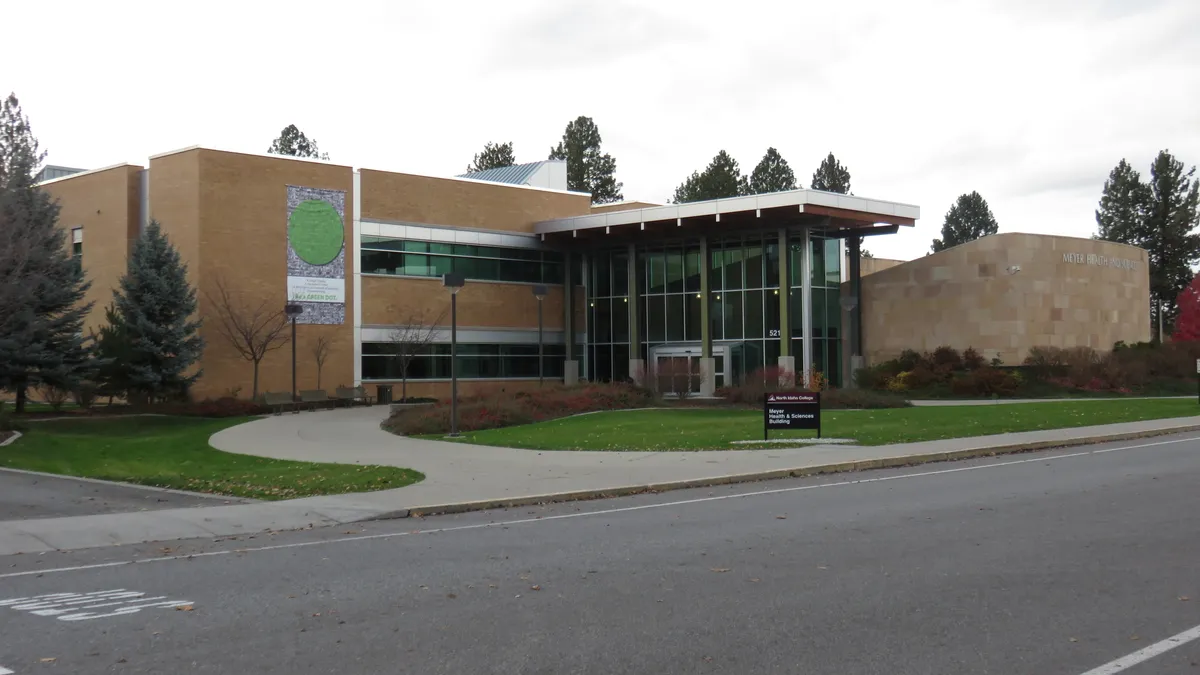
- North Idaho College’s accreditor lifted the institution’s probation after a yearslong effort to regain compliance.
- The Northwest Commission on Colleges and Universities made the decision at its meeting in late January. NWCCU President Selena Grace wrote in a letter Monday that “we commend North Idaho College for its meaningful progress and continued engagement in this process.”
- However, the accreditor flagged areas where it said the public two-year college is substantially compliant but still needs to improve, mostly around establishing metrics and processes to meet institutional goals and assess the quality of learning.
Dive Insight:
Roughly three years ago, NWCCU issued a “show cause” letter to North Idaho College, signaling that the institution was out of compliance with the body’s standards and thus at risk of losing accreditation.
Losing accreditation can be fatal for colleges, as it renders them ineligible to access federal student aid funds, to say nothing of the reputational harm from being dropped by a quality-assurance organization.
The show-cause letter cited voluminous organizational troubles at the college. Among them were an “exodus” of faculty and staff, as well as “frequent changes in leadership with little to no input from relevant stakeholders, without following institutional policies and procedures.”
At the time, NWCCU officials pointed to confusion about who was even in charge of the institution, with one president — Nick Swayne — put on nondisciplinary leave by the board and another — Greg South — appointed concurrently in the interim. Swayne was later reinstated and remains president today.
Prior to Swayne’s initial hire in August 2022, the board of trustees had fired an earlier president without cause and replaced him with the college’s wrestling coach, who left after less than a year and a half in the role.
And then there were financial issues. NWCCU cited declining enrollment, waning donor support, increasing insurance expenses, a looming downgrade from Moody’s and potential added costs from expanding the college's athletics program and changing conferences without consulting its community.
The college’s board at the time failed to “sufficiently appreciate the jeopardy it is placing the institution in with respect to the welfare and viability of the institution,” NWCCU officials wrote in February 2023.
Since then, NIC has seen a big bump in enrollment, regaining many of its losses from the prepandemic era. Between 2023 and 2024, fall headcount spiked 15.2% to 4,585 students, according to federal data. Over the five years prior to 2023, fall enrollment had fallen 24.4% from 5,265 students in 2018.
In an August report to its accreditor, NIC attributed its enrollment boom to improved marketing and an effort to rebuild community trust. These moves followed a period when a politicized board gave rise to community concerns around academic freedom and heavy-handed governance.
The college also said last year that it had “alleviated past governance challenges” through a shakeup in its board membership, while also adding trustee training and undertaking measures to make board meetings more transparent and efficient.
In its letter this week, NWCCU said the college still needs to improve on developing metrics to measure “institutional goals and objectives in its evaluation, planning, and resource allocation processes to support institutional effectiveness and student achievement.”
The accreditor also recommended that NIC “engage in an effective system of learning outcomes assessment processes across all academic and learning support programs” to improve its student support planning.
“The strength of this college lies in its people, those who refused to give up and stood firm against the chaos,” Swayne said in a statement Monday after the college regained good standing with NWCCU. “With the distractions behind us, we can now focus entirely on delivering the quality education and opportunities our students expect and deserve.”