

Dive Brief:
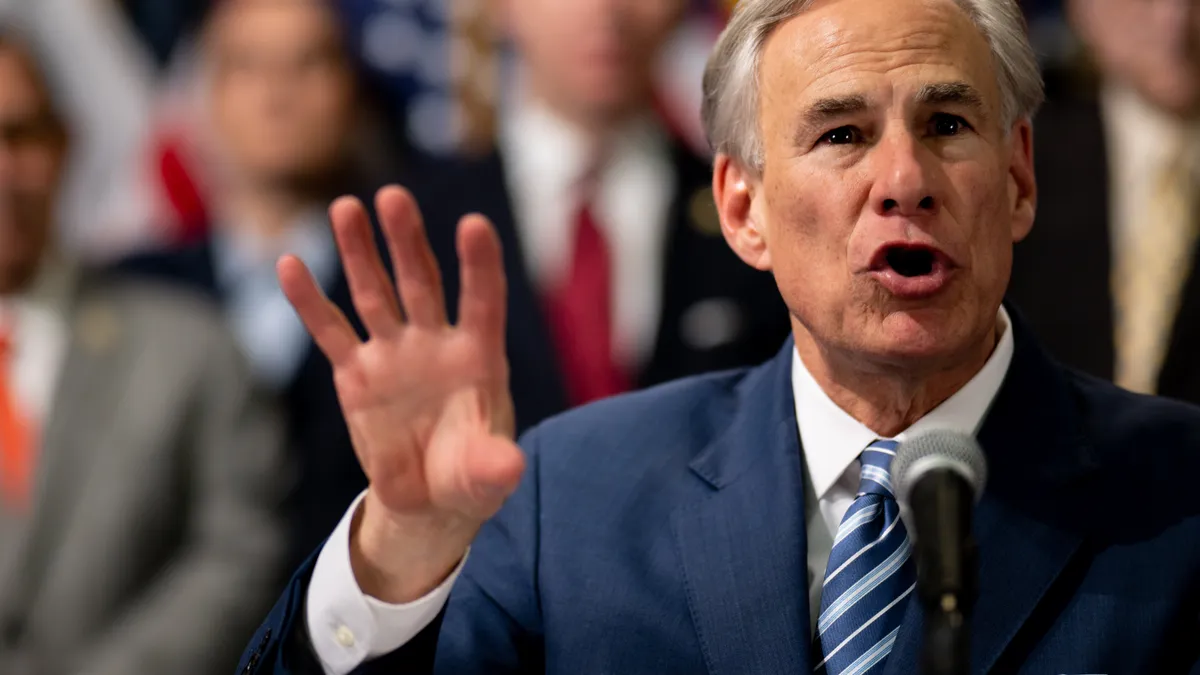
- Texas Gov. Greg Abbott on Wednesday directed the state’s higher education board to develop recommendations for three-year pathways to bachelor’s degrees.
- Abbott instructed the Texas Higher Education Coordinating Board to gather public college officials and faculty leaders, as well as employers and accreditors, into a working group to mull the issue and report back to his office by the year’s end.
- The governor directed the working group to make recommendations on academic standards, appropriate degrees and occupations, student demand, workforce needs and accreditation requirements for the accelerated degrees, as well as the legislative changes needed to allow them.
Dive Insight:
Abbott primarily cited costs in his push for three-year degrees.
“Every semester adds to tuition, fees, housing, food, transportation, and other living expenses, and delays students’ ability to begin their careers,” Abbott said Wednesday in a letter to Wynn Rosser, Texas’ higher education commissioner. “Texas students are our future leaders and the workforce of tomorrow.”
In the next legislative session, which starts in January, the governor said he plans to work with lawmakers "to codify an accelerated three-year degree pathway."
The Southern Association of Colleges and Schools Commission on Colleges — which accredits institutions within the University of Texas, Texas Tech University and Texas A&M University systems — approved three-year accelerated bachelor’s degrees for the first time in December. That approval was for two such programs at the University of Lynchburg, in Virginia.
Other states have been exploring accelerated three-year degrees recently as well.
The State Council of Higher Education for Virginia announced plans in June to work with several private and public colleges in the state, as well as Ohio higher education representatives and nonprofit groups, to develop a blueprint for three-year degrees that require 90 total credits. Ten Ohio institutions, including Ohio State and Cleveland State universities, are also part of the initiative, called “Scaling College in 3.”
Also in June, Massachusetts’s state higher education board approved the state’s first three-year programs, at Merrimack College and Suffolk University. Each program requires a little over 90 credits to complete.
The top leaders of the American Association of University Professors and the American Federation of Teachers spoke out against the approval, warning that the accelerated bachelor’s programs threaten academic integrity by “substituting for a comprehensive education a stripped-down curriculum that prioritizes speed over essential intellectual development.”
Yet three-year programs have advocates across the political spectrum. Beth Akers, a senior fellow with the right-leaning think tank American Enterprise Institute, wrote in an op-ed earlier this year that “there is nothing magical about 120 credits,” and that the traditional requirement “persists largely because it was a convenient administrative benchmark.”
“If the goal is preparing students for productive lives, outcomes — not the number of credits — should matter most,” Akers added.
Meanwhile, back in 2018, the Progressive Policy Institute criticized the traditional four-year degree model as antiquated and argued three-year programs could make college more affordable and accessible.
As of March, at least 70 institutions offered three-year degrees or were considering them, according to a report published by the American Association of Collegiate Registrars and Admissions Officers.