
Dive Brief:
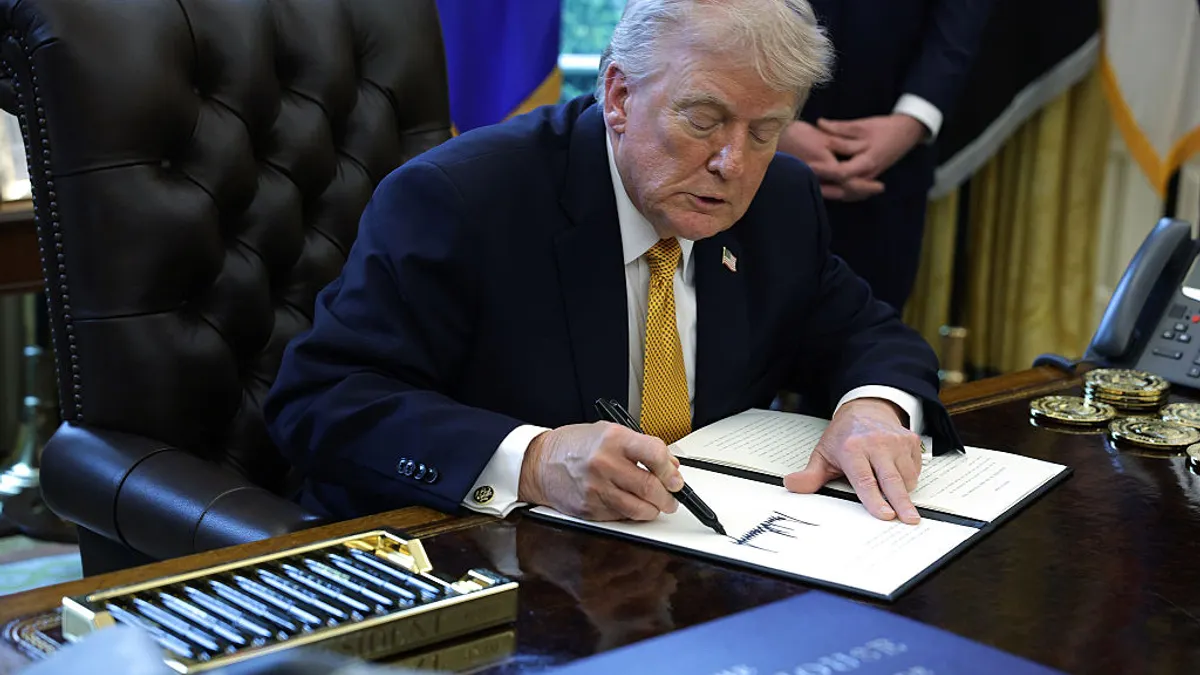
- President Donald Trump has directed executive departments and agencies to require federal contractors and subcontractors, including colleges, to agree they will “not engage in any racially discriminatory DEI activities” or risk the cancellation of their contracts, according to a Thursday executive order.
- Federal departments and agencies have until April 25 to insert such a clause in their contracts, and agency leaders have until July 24 to review their agency’s implementation of the order and ensure compliance.
- Trump's order additionally directs several agency leaders, including the chair of the U.S. Equal Employment Opportunity Commission, to identify economic sectors that present a “particular risk” of entities engaging in racially discriminatory diversity, equity and inclusion practices and provide further guidance for contracting agencies to ensure compliance.
Dive Insight:
In the order, Trump touted his administration’s “significant progress” in ending DEI initiatives. But he contended that some groups continue their DEI programs and “often attempt to conceal their efforts to do so.”
DEI initiatives “create unnecessary costs by reducing the pool of available labor by artificially limiting companies to hiring or promoting certain individuals, suppliers, or intermediaries based on their race or ethnicity,” according to the order. “These costs are inevitably passed on to the Federal Government when it contracts with companies who engage in racially discriminatory DEI activities, or who use subcontractors who do so.”
The order defines unlawful DEI as “disparate treatment based on race or ethnicity in the recruitment, employment (e.g., hiring, promotions), contracting (e.g., vendor agreements), program participation, or allocation or deployment of an entity’s resources.” Past executive orders have left such terms undefined.
That includes a sweeping January 2025 order that directed federal agencies to terminate all “equity-related” grants and DEI offices and positions. Another order targeted DEI practices at private colleges, foundations and other types of institutions.
A federal court recently vacated a lower court’s preliminary injunction against major parts of those two orders, notching a win for the Trump administration’s crackdown on DEI initiatives. Groups challenging the executive orders had contended that they were unconstitutionally vague by leaving key terms, such as “illegal DEI,” undefined.
Thursday's executive order requires contractors to turn over “all information and reports,” including “books, records, and accounts,” for review by agencies. It also directs the attorney general, in consultation with contracting agencies, to consider whether to bring False Claims Act charges against contractors or subcontractors who violate the clause.
The directive comes on the heels of a General Services Administration proposal that would require federal funding recipients to certify they’re complying with the Trump administration’s anti-DEI orders and guidance.
The GSA specifically cites sweeping July guidance from the U.S. Department of Justice, which targets practices ranging from race-based scholarship programs to having identity-based lounges and study spaces on campus — even if they are open to all.
The public comment period for GSA’s proposal ends Monday. On behalf of roughly two dozen higher education associations, the American Council on Education urged the GSA last week to rescind the proposal.
Colleges must already comply with federal civil rights law to receive federal grants, ACE President Ted Mitchell said. However, he argued, the proposed certification takes a step further by requiring colleges to say they’re complying with executive orders and subregulatory guidance.
In the case of the DOJ’s guidance, the agency even explicitly said its recommendations are “non-binding suggestions,” Mitchell wrote.
“The proposed certification goes well beyond settled law, requiring endorsement of legal interpretations that are the subject of current federal litigation and have not yet been resolved by the courts,” he added.