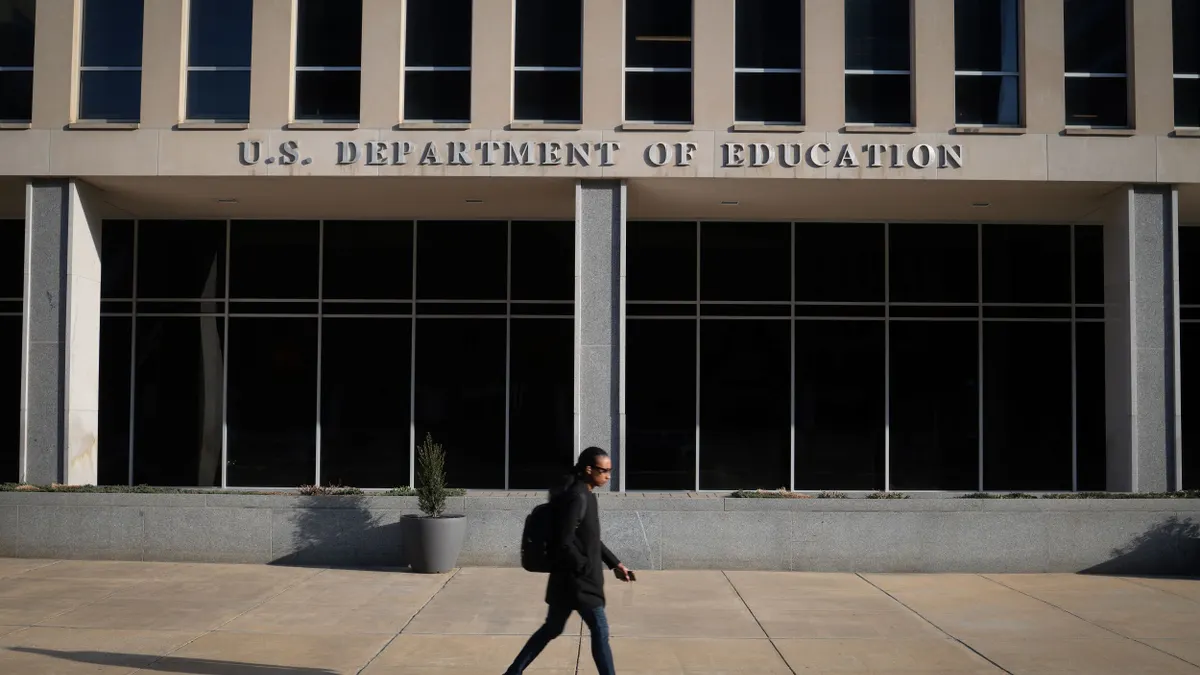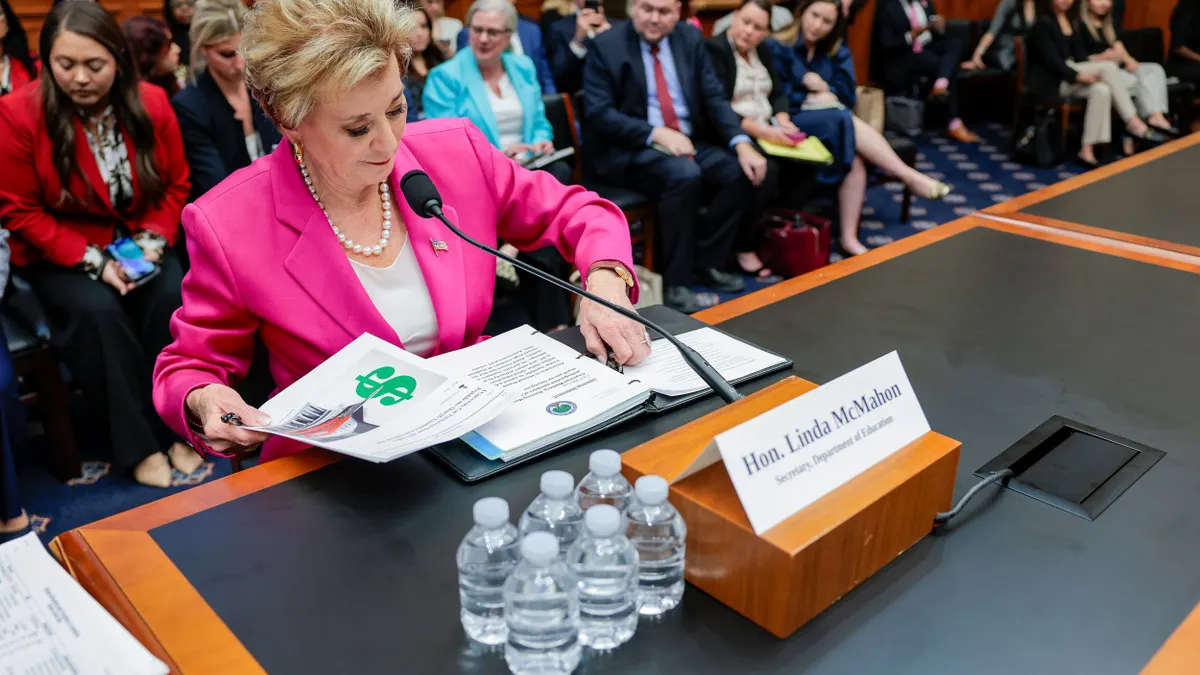
U.S. Education Secretary Linda McMahon on Thursday faced a grilling from congressional lawmakers over her agency’s implementation of new federal loan caps and its handling of civil rights cases.
Testifying before the House Committee on Education and Workforce, McMahon defended the U.S. Department of Education’s record, arguing that new regulations that cap federal borrowing for graduate programs will drive down the cost of higher education.
McMahon also touted the Education Department’s handling of the Free Application for Federal Student Aid, which debuted this cycle about a week before the congressionally mandated deadline of Oct. 1. She cited the agency’s fraud prevention work on the FAFSA, efforts that she said have saved $1 billion in federal aid from flowing to scammers.
Additionally, McMahon made clear her sights were still set on dismantling the Education Department, a policy priority of President Donald Trump.
“Americans re-elected President Trump with a clear mandate: to sunset a 46-year-old, $3 trillion failed education bureaucracy in D.C. and return authority to where it belongs — to parents, teachers and local leaders,” McMahon said.
Although some Republicans praised this goal at Thursday's hearing, Democrats widely panned the moves made to date. Some argued that the 10 agreements the Education Department has struck with other federal agencies to offload its duties are illegal.
“The administration is not simply moving a few people to a different building in Washington, D.C.,” Virginia Rep. Bobby Scott, the top-ranking Democrat on the committee, said in his opening statement. “No, these actions represent the administration's abdication of the federal government's responsibility to ensure that all students — regardless of their race, religion, disability, income or zip code — have access to quality public education.”
Republicans and Democrats alike take aim at ‘professional student’ definition
Lawmakers on both sides of the aisle raised concerns about the Education Department’s new regulatory definition of “professional student,” a status that allows graduate students in 11 fields to borrow up to $200,000 in federal loans.
All other graduate fields — including nursing, social work and education — were excluded from the final definition, meaning students in those programs will only be able to borrow up to $100,000. The new loan caps take effect July 1, with some exceptions for currently enrolled students.
Republicans established the new caps in the One Big Beautiful Bill Act enacted last summer, while the Education Department ultimately decided which fields would be labeled as “professional.”
However, Republican and Democratic lawmakers alike raised concerns that graduate nursing students would face hurdles in financing their education and that the loan caps would exacerbate healthcare worker shortages.
Rep. Lisa McClain, a Republican from Michigan, suggested that the law gave the Education Department the leeway to include more fields that it ultimately settled on.
“What I’m here to do is really advocate for these programs because I think they’re extremely important,” McClain said. She added that federal lending for these programs provided a “good return on the investment,” pointing to high repayment and employment rates for their students.
McMahon pushed back, however, contending that the borrowing caps would force colleges to lower their tuition prices.
“They’re just too high,” McMahon said. “I really do believe as more market competition is available, you will see universities and colleges bring down these costs.”
Rep. Ilhan Omar, a Democrat from Minnesota, didn’t mince words, arguing that excluding nursing programs from the professional student designation would force borrowers to turn to the private lending market and reduce educational access.
“When you create policies that make education unreachable for Americans that want that education, then you are failing at your job,” Omar said.
Democrats attack the Education Department’s civil rights record
Democrats on the committee pointed to recent data from Sen. Bernie Sanders' office that showed the Education Department’s Office for Civil Rights reached just 112 resolution agreements last year out of nearly 12,000 pending cases. They also criticized the Education Department for moving to terminate about half of its OCR staff in March as part of a broader reduction in force.
Following a court order, the Education Department has in fact been bringing back many of those staffers, who had been placed on administrative leave. A recent report from the U.S. Government Accountability Office found that the Education Department paid these OCR staff up to $38 million while on leave through December.
In defense of her department’s record, McMahon said the Trump administration inherited a backlog of 19,000 cases from the Biden administration and praised Trump's appointment of Kimberly Richey as the head of OCR. Richey, who was confirmed in October, previously worked for OCR under the first Trump administration, as well as the George W. Bush administration.
“I'm really delighted to have her,” McMahon said. “She is bringing back lawyers. She's addressing this.” McMahon added that the Education Department settled over 4,000 cases over the past quarter.
Rep. Mark Takano, a Democrat from California, grilled McMahon on the Trump administration’s budget request for fiscal 2027, which would fund OCR at $91 million — a 35% reduction from fiscal 2025. The Education Department’s budget documents also call for cutting OCR staffing by about half, from 530 full-time employees to 271.
McMahon said that the request is the “floor that we submitted.”
“We hope then to work with Congress to raise that so that we will hire more lawyers,” McMahon said.