Dive Brief:
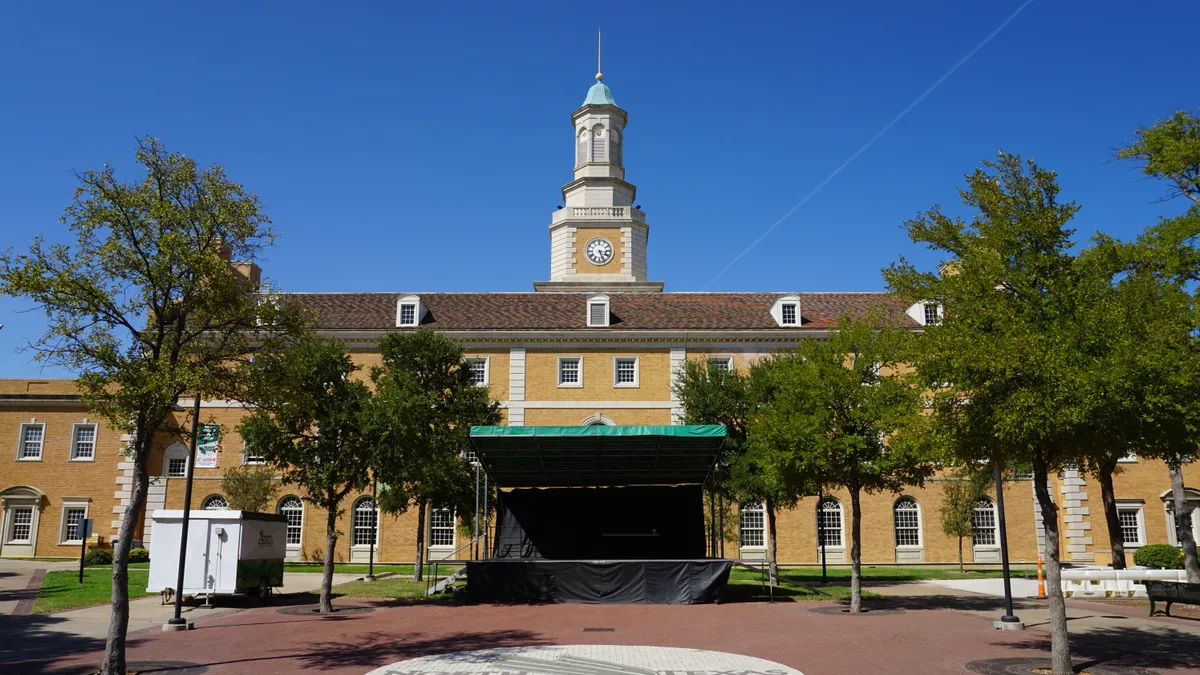
- The University of North Texas plans to shed over 70 academic programs ranging from certificates to master’s degrees in order to address a $45 million budget shortfall, top UNT leaders announced Thursday.
- The public university is merging its Department of Linguistics with its Department of World Languages, Literatures, and Cultures. As part of the change, UNT will phase out all degrees offered by the linguistics department.
- Leaders selected which programs to phase out based on factors such as their enrollment, use of resources and alignment with the university’s mission, according to UNT President Harrison Keller and Provost Michael McPherson.
Dive Insight:
Keller warned the university community in February that tackling the $45 million budget gap would “inevitably require hard choices, and the impact will be felt across our university.” He attributed the larger-than-expected shortfall to a more significant loss of graduate international students than university officials had predicted. He also pointed to a recent $32 million decline in state appropriations for instruction and operations.
UNT on Friday did not answer questions about whether the program cuts would lead to faculty layoffs.
However, the leaders said in their announcement that students already enrolled in the affected programs would be able to complete their studies. New students won’t be able to enroll in the programs, they said.
Officials focused their program cuts on academic offerings with low enrollment, according to their announcement this week.
The linguistics department, for example, has seen enrollment decline since 2021 and has “relatively lower time to value and higher costs of instruction," they said. UNT defines “time to value” as how quickly graduates earn back the cost of their degrees.
All five of the linguistics department's academic programs — including one master’s and one bachelor’s degree — will come to an end, and the department’s merger with the world languages department will be effective Sept. 1, they said.
Along with the linguistics cuts, three other master’s programs — in media studies, gender studies and early childhood education — will be phased out. Each has enrolled an average of 15 students or fewer annually in the past five years, Keller and McPherson said.
The only other bachelor’s degree to be eliminated, Latino and Latin American Studies, also faced low enrollment, high instruction costs and relatively low earnings for recent graduates. A dozen other graduate and undergraduate degrees in subjects like English, biology and sociology will be merged, though the pair's announcement did not provide a timeline.
The largest cuts at UNT will hit the university's undergraduate minors and certificate programs. Officials are ending 25 minors that enroll an average of 20 or fewer students each year. Likewise, they are ending 42 certificate programs — 21 for graduate students and 21 for undergraduates — that averaged fewer than two students each year.
“These decisions are not made lightly. Every academic program reflects years of dedication, scholarship, and care, and we are grateful for the contributions of the faculty, staff, and students who have built and sustained them,” Keller and McPherson said.
UNT’s overall enrollment declined 5.7% year over year in fall 2025, representing a decrease of about 2,600 students, according to data from the state’s higher education coordinating board. A sharp decline in graduate international students drove that change — UNT enrolled about 3,400 in last fall, compared to the 6,200 who attended the university the year before, The Texas Tribune reported.
That overall drop came after years of steady increases, with the university’s enrollment rising 19% to 46,864 students between fall 2019 and fall 2024, federal data shows.