The University of Florida governing board on Monday voted to appoint Stuart Bell as the institution's interim president, a month after it named the former University of Alabama president as the sole finalist for the permanent job.
The State University System of Florida’s governing board had been set to vote on Bell's permanent selection this week. But system board Chair Alan Levine delayed that vote, citing concerns over the UF board's compliance with system regulations related to governance.
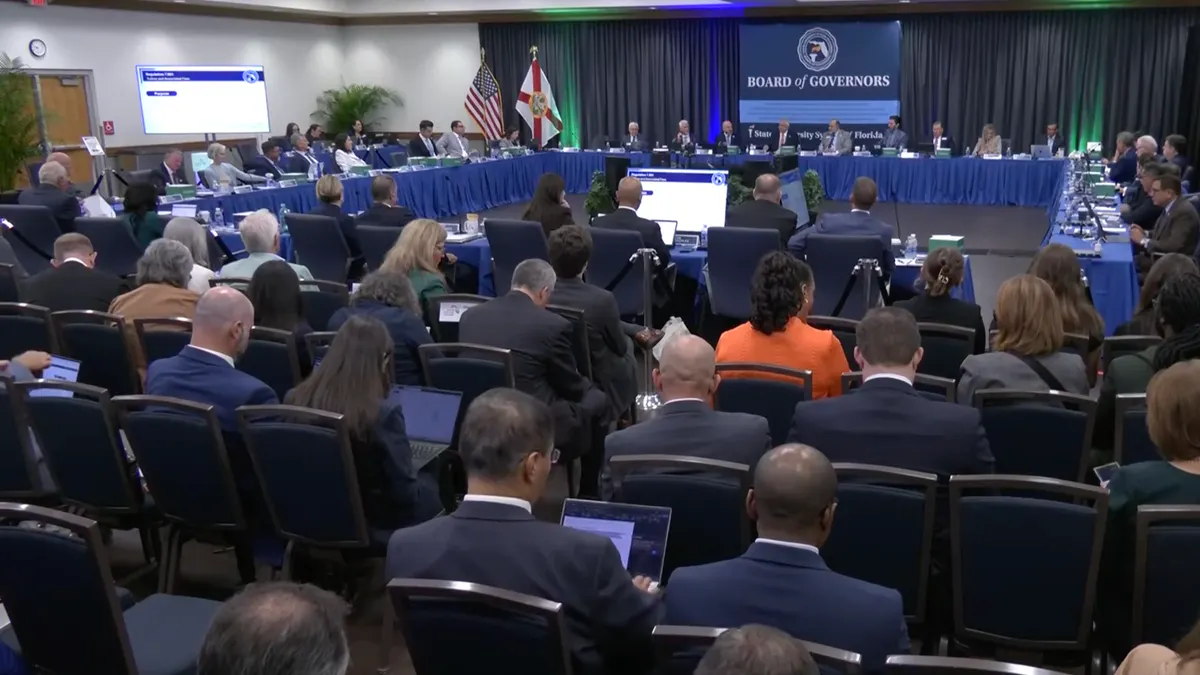
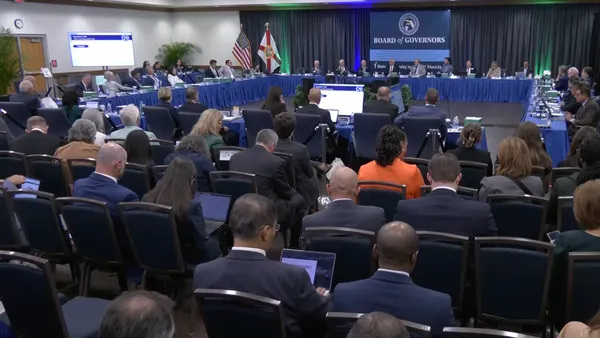
UF’s board partially sidestepped the holdup by opting to make Bell interim leader in a unanimous vote during a special meeting late Monday. Under the approved contract, Bell will receive a base salary of $2 million annually upon assuming the role July 1. Should he be confirmed to the role permanently, a new contract would replace the one approved Monday, according to the employment agreement.
University board members vehemently pushed back against concerns raised by Levine, including that UF Board Chair Mori Hosseini had been delegated too much power and that the governing body may be out of compliance with system regulations.
An hour after the vote, Levine said in a statement that the system board would schedule a special meeting "as soon as legally possible" to vote on Bell's permanent presidency, among other topics.
The back-and-forth comes amid a right-wing campaign to reject Bell as the public flagship’s next leader over his past support of diversity, equity and inclusion initiatives when leading the University of Alabama. The ongoing tension between UF and the system’s boards is reminiscent of the fight that derailed the candidacy of the university's last pick for president.
'The University of Florida cannot afford to remain in limbo'
In a June 17 letter to system Chancellor Ray Rodrigues, Levine said he had asked staff for a preliminary review of SUSF's 12 campus boards amid his concerns about the “sweeping authority” exhibited by Hosseini.
As a result of that review, Levine accused Hosseini of “problematic” financial and contractual practices that are “inconsistent with best practices in governance,” according to a copy of his letter published by right-wing advocates.
Levine also cited “certain allegations made involving real-estate and financial transactions at UF” and called for the system board’s inspector general to look into “credible” claims on the matter. Hosseini is the CEO of one of the state's largest residential developers.
“The allegations appear to evolve out of a disturbing, concerted and excessively hostile social media campaign against the University of Florida's presidential search finalist.”

Ryan Fuller
Vice president and general counsel at the University of Florida
At the time, Levine said that he would not place a university-specific item on the system board's agenda — including presidential appointments — while a university's governing board is out of compliance.
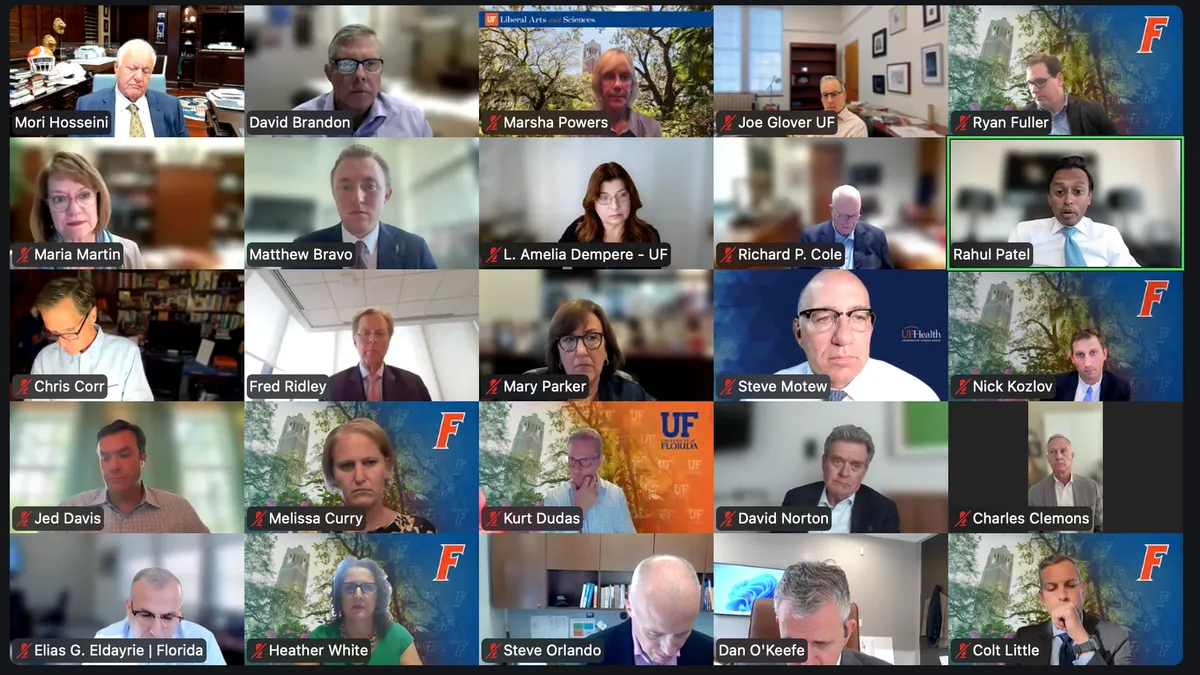
Rahul Patel, vice chair of the university's board and head of its presidential search committee, lambasted the real estate and financial allegations during Monday's meeting as originating "from an anonymous letter."
"They were amplified through social media commentary and online speculation by social media figures with no firsthand knowledge of any facts," he said. "None of this is based on substantiated findings or established reporting."
Ryan Fuller, the university's vice president and general counsel, added that an individual on the state system’s governing board cannot unilaterally direct its Office of Inspector General to investigate an anonymous letter. To do so would violate the SUSF governing board’s regulations and standards, Fuller said.
"The allegations appear to evolve out of a disturbing, concerted and excessively hostile social media campaign against the University of Florida's presidential search finalist," Fuller said, noting that Hosseini's position as board chair makes him "particularly vulnerable to frivolous and vexatious complaints."
Prior to the meeting, the office of Florida Attorney General James Uthmeier affirmed that the University of Florida is in compliance and said the board would be “incorrect to withhold consideration of the Trustees’ nomination on that basis," according to a Friday letter obtained by local news outlets.
Patel said Monday evening that the UF board had asked an independent outside counsel with experience in university governance to review the board's governance standards.
"They earlier today issued an opinion stating that not only are our governance standards related to hiring proper, but all of our governance standards are appropriate and consistent with the law," Patel said.
Like the state attorney general's office, Patel criticized the voting delay.
"By Chairman Levine’s own admission, this delay has nothing to do with Dr. Bell," he said in a Thursday statement shared by UF. "The University of Florida cannot afford to remain in limbo while these matters are addressed."
The university has not had a permanent leader in almost two years, following Ben Sasse's unexpected departure from the role in July 2024. Sasse's brief tenure ended when he stepped down citing his wife's health.
Patel also raised concerns that Levine decided to delay the vote unilaterally, rather than with the full cooperation of the system’s board of governors.
"Delaying consideration of the unanimously approved president designate of Florida’s flagship university is a consequential action that should be decided by the Board of Governors as a body, not by a single individual acting alone," he said prior to the meeting.
After Monday's vote, Levine said that he would hold a special meeting to consider Bell’s permanent appointment following "productive discussions" between the university and system's boards.
The two boards agreed to have "a third-party expert in University governance to be engaged to review the governance documents of all universities in the System, all delegated authorities and BOG policies," Levine said in a statement.
During Monday’s board meeting, Patel expressed gratitude to Bell for "staying the course" and continuing to show interest in the UF presidency.
"It would have been really easy for Dr. Bell to say, 'You know what, this isn't worth it.' But he didn't," Patel said. "He's continued to show up. He's continued to engage with us.”
DEI déjà vu
Both the University of Florida and Bell have faced backlash from conservatives since the public flagship's board announced him as its pick for president in May.
Much of the criticism has focused on the University of Alabama's handling of DEI during Bell's tenure there. But some state leaders have also accused UF's board of violating regulations related to transparency and governance during the presidential search process.
“It is clear to me that once again, UF has engaged in a search process that lacked any transparency or public input and failed to interview three candidates as mandated under Florida law.”
Rick Scott
Senior U.S. Senator from Florida
Levine first requested compliance reviews of UF and other university boards shortly after Bell was announced as the finalist, according to a letter obtained by Florida Politics.
At the time, Sen. Rick Scott, a Republican from Florida, made similar accusations via a letter to Rodrigues he shared on social media.
"While I don’t know Dr. Bell, it is clear to me that once again, UF has engaged in a search process that lacked any transparency or public input and failed to interview three candidates as mandated under Florida law," Scott said in the May 20 letter.
The University of Florida rejected his characterization, saying in a May 22 statement that it "followed the exact process required under Florida law."
"Reasonable people may hold differing views regarding any candidate," the university said. "But it is wrong to suggest that UF circumvented the law or operated outside the bounds of transparency established by the State of Florida."
If the state board of governors blocks Bell's appointment as permanent president, it would be the second time in a year it denied the finalist selected by UF's trustees.
In an unprecedented move last June, the board rejected Santa Ono as the sole finalist to replace Sasse. Ono's selection had been dogged by conservative uproar over his previous support for DEI efforts as the president of the University of Michigan — even though he softened or walked back much of that work prior to his Florida nomination.
Like Ono, Bell has faced a sea of conservative critics over DEI. But, notably, Florida Gov. Ron DeSantis has not been among them. DeSantis, a staunch opponent of any and all activity labeled DEI, gave Bell his full support last month.
“Dr. Bell did much to elevate the University of Alabama when he was the president in Tuscaloosa and I have no doubt that he will help UF reach new heights during his tenure in Gainesville,” the governor said on social media shortly after Bell's selection was announced.