MINNEAPOLIS — Any college official overseeing a holistic admissions process knows the complexities of reviewing a prospective student's application. What can be even more challenging is selecting application questions and what, if anything, to require beyond the prompts in the Common App or other standardized applications.
At the annual National Association for College Admission Counseling conference Friday, university leaders spoke about the role essays and other supplemental materials play in evaluating applicants and how that could change as artificial intelligence evolves.
Supplemental essays and materials
At first glance, the University of Michigan and Rice University may appear to be very different institutions. U-M is a public flagship with over 54,000 students, while Rice is a private Texas university with fewer than 10,000 students.
But both are highly selective research universities that require undergraduate applicants to submit supplemental materials with their Common App.
Charles Murphy, Rice's executive director of admission, said the university is striving for balance in its application requirements.
Rice, which accepted 8% of prospective students in the 2024-25 application cycle, gives applicants three additional writing prompts. Along with completing the Common App personal essay, they must share how they will "contribute to the Rice community" in no more than 500 words and respond to two short-form questions with a 150- word limit each.
"You don't want to make a supplement or anything in your packet so onerous that it stops students who would be good students at your institution from completing the application," Murphy said. On the other hand, he acknowledged some students and counselors have requested higher word limits for the shorter responses.
Overall, Murphy said if prospective students are deterred by carefully considered application supplements, they are probably not strong candidates in a competitive pool.
U-M, meanwhile, requires undergraduate applicants to submit three essays total — one based on a Common App prompt and two supplemental prompts. It will also consider a response to the optional prompt given by the Common App about students' challenges and life circumstances. The combined essays can total between 450 to 1,750 words.
That adds up quickly for Blaire Moody Rideout's team.
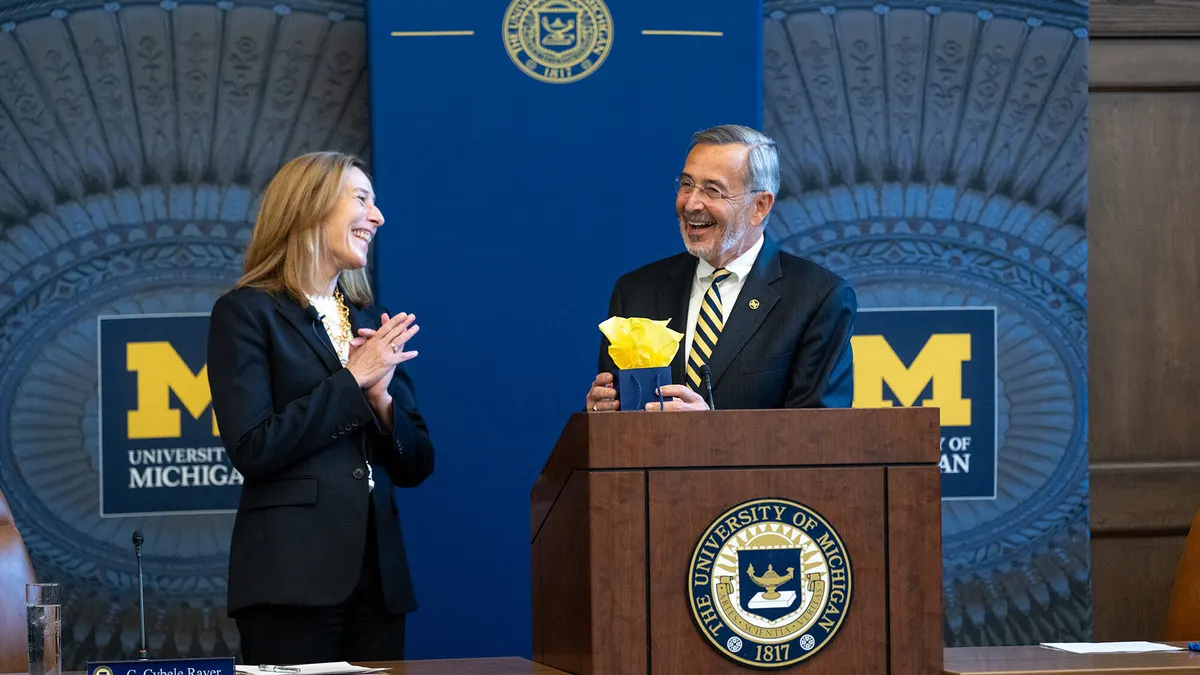
Moody Rideout, director of undergraduate admissions for U-M's business school, said reviewing applications takes a tremendous amount of time and money, largely because of the supplemental materials.
"Each application takes a half hour," she said. "We put a lot of time into it."
U-M has an acceptance rate of about 16% and received over 115,000 undergraduate applications for fall 2026. The university hires 125 to 150 part-time readers — up from 25 to 30 in years past — to help review application essays, according to Moody Rideout.
The annual cost? $500,000.
Even so, requiring supplemental materials is worth the work, she said. Her team uses the essays to learn more about applicants and the students they may become, rather than as assignments to be graded for their language abilities or mastery of business terminology.
"They all have to take a first-year writing course at Michigan anyway," said Moody Rideout. "So for us, it's more about what they've learned."
On top of the broader application, U-M's business school requires prospective undergraduates to submit a portfolio that includes a community-focused business proposal and a "document or artifact" that shows the applicant's "learning in action."
Moody Rideout said the business school introduced the portfolio to allow more unique student qualifications and experiences — such as public speaking or participation in national high school pitch competitions — to stand out amid high application volumes.
Some degrees at Rice, such as architecture and music, also require major-specific materials.
Other supplemental requirements are a university tradition. Rice’s application includes a portion known as "The Box" that requires applicants to submit an image "of something that appeals to them" without providing an explanation.
While the image isn't used as an evaluation tool, Murphy said it gives students another avenue to infuse their applications with personality and creativity.
Easing the process for 'staff and applicants alike'
The University of Georgia is taking a different approach. For fall 2027 admissions and beyond, applicants will no longer have to submit a supplemental essay.
In part, that decision was a logistical one, according to David Graves, UGA's executive director of undergraduate admissions. He estimated that applications to the university have doubled over the past eight years, translating to many more hours of review.
"I wanted to look and say, 'How can I help my staff survive and not just be reading night and day?'" he told conference attendees.
UGA will continue to require applicants to complete one of the essay prompts on Common App. It spends about $150,000 on part-time application essay readers each admissions cycle, according to Graves.
The public flagship received some 51,600 applications from prospective first-year undergraduates and accepted around 30% for its class of 2030, according to its website.
When reviewing its application process, Graves said UGA determined the supplemental essay didn't provide admissions staff with meaningfully more insight than the Common App essay alone did.
Removing the additional essay is also intended to relieve some of the application stress and help everyone — "staff and applicants alike" — get through the process more easily in the long run, Graves said.
AI in the admissions process
Graves, Moody Rideout and Murphy all said that their institutions do not use AI to read or review applications. Likewise, they do not use AI detection software on admissions submissions.
Essays can at times "feel off, for lack of a better term," Murphy acknowledged. "Maybe there's a decent probability" an applicant used AI, "but we don't know that for a fact."
He raised concerns about detection software's likelihood to flag false positives, an issue that has made headlines and plagued higher education since generative AI exploded.
"I'll speak for myself, not the university. But my thinking is, even if it's 90% right, every 10 times it's wrong," Murphy said. "Is that really good enough?"
To get a sense of what a totally AI-generated response could look like, the admissions team at Rice will enter their prompts into generative AI, Murphy said.
U-M's business school has no plans to do away with supplemental essays over AI concerns, Moody Rideout said. She acknowledged the speed at which generative AI's capabilities are evolving but said that her team is not asking applicants "research-based prompts."
"Reflective writing is not its strong suit right now. And that's really what essay writing should be," she said.