

The share of students who say they have ruled out colleges solely because of a state’s politics has jumped 10 percentage points in just three years, according to a poll released Tuesday from the higher education consultancy Art & Science Group.
That share came to 34% in summer 2026. The spike since 2023 represents “a consistent and legitimate upward trend” rather than “simply a one-time reaction to a particular political moment,” according to the Art & Science Group’s report on the poll’s findings.
A ‘legitimate upward trend’ in politics-based enrollment choices
That 34% share represents only students who ruled out a college solely based on politics. When including those who “partly” ruled out colleges because of politics and those who said politics had “some influence” on their decisions, the share came to about half of all students polled in the summer and winter of 2026.
For most students, political considerations factor into the decision process early on.
Nearly three-quarters of students who ruled out colleges based on politics said they were a factor when first considering institutions. Among the same group, 59% likewise said politics were a factor when deciding where to apply.
“For many students, politics appears to be shaping the consideration set before institutions ever have the opportunity to make their case,” the report said. “For some students, certain states, regions, or institutional environments may be removed from consideration before the student has engaged more deeply with any particular school.”
Because politics factor in so early in a student’s decision-making process, institutions might “underestimate the extent to which political context is affecting their market position.”
Not surprisingly, the states students avoided depended on their political orientation. Conservative-leaning students tended to rule out colleges in California, Colorado and New York, while liberal-leaning students tended to rule out many southern states, including Texas, Florida, South Carolina, Louisiana, Alabama and Georgia.
“In this environment, colleges need to demonstrate not only that they are different from the political reputation of their state, but why the experience they offer is appealing enough for students to consider them despite those broader concerns,” the report said.
This year’s results came from a survey in August and September of over 1,500 domestic students who recently graduated high school and another of over 1,300 high school seniors in February and March.
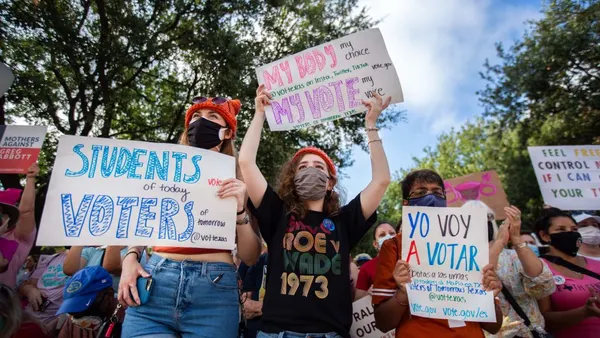
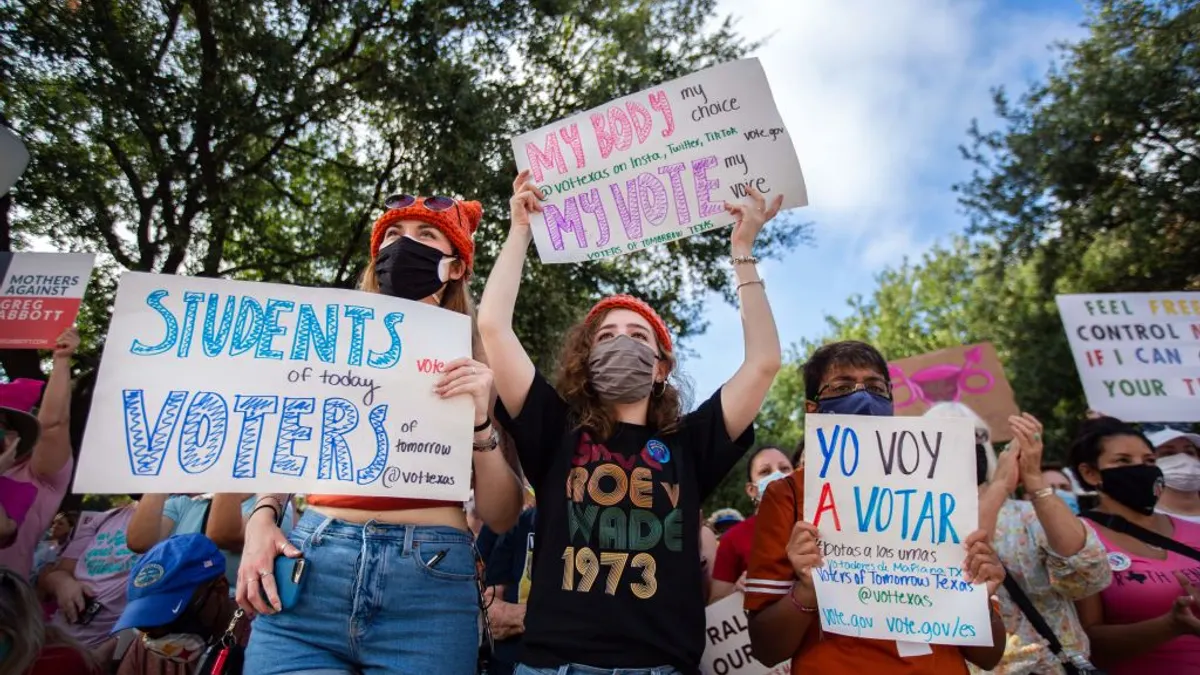
Other research has suggested that specific political issues can influence college decisions. Nearly half of students, 44%, of students said reproductive health rights in a college’s home state was “very” or “extremely” important to them, according to a poll after the 2024 election conducted by higher ed marketing and enrollment management firm Carnegie Dartlet.
A March 2024 report from Gallup and the Lumina Foundation found that states’ reproductive healthcare policies were at least somewhat important in 71% of students’ enrollment decisions.