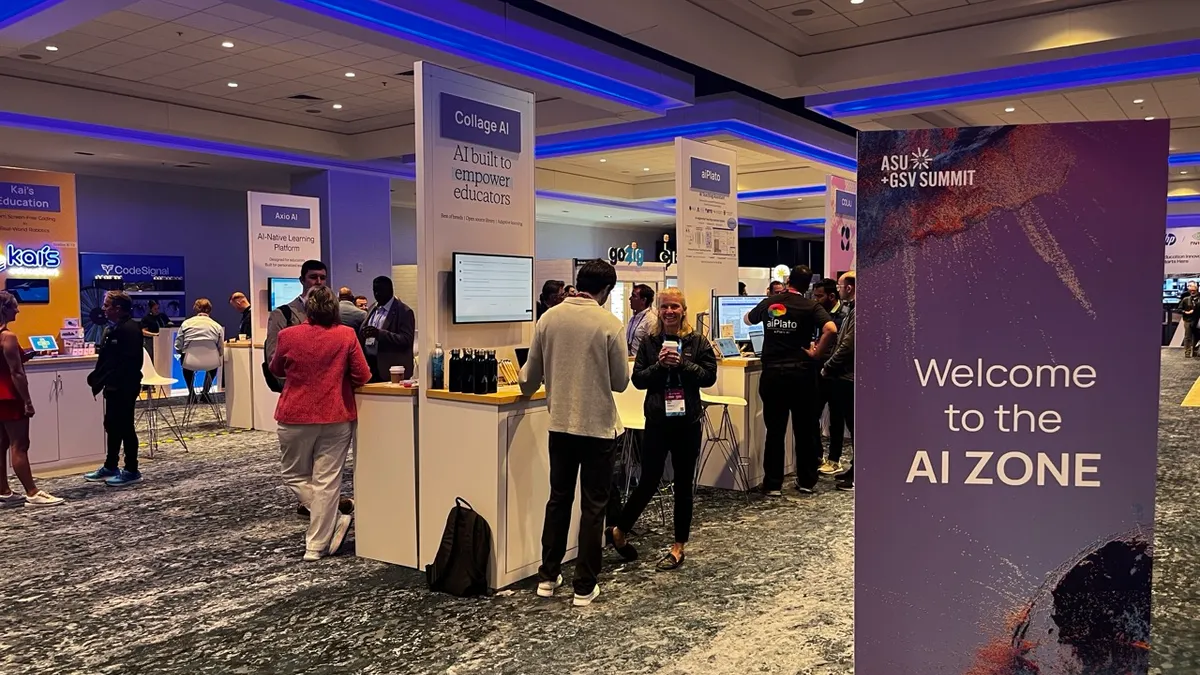
SAN DIEGO — Artificial intelligence is rapidly progressing and poised to reshape the workforce in the near future. The higher education sector is in a unique position, as both an employer of millions of workers and a system that prepares students for the labor force.
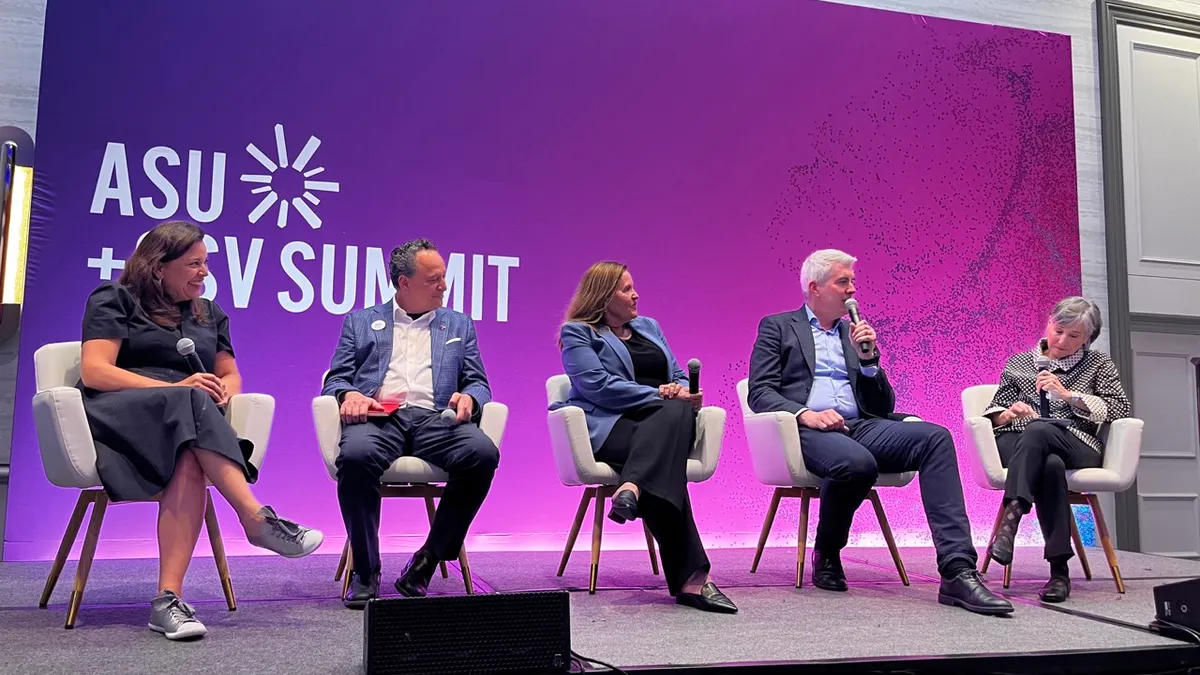
At the annual ASU+GSV Summit last week, four college leaders talked to Higher Ed Dive to weigh in on two questions: What about AI’s use in higher education are you most excited for? And what has you most concerned?
Editor’s note: Responses have been edited for length and clarity.
Bret Danilowicz, president of Radford University
What I'm most concerned about AI and its evolution is the speed at which faculty will need to redevelop their courses. Faculty traditionally redevelop their classes on a three- to five-year cycle. They're going to have to be updating yearly or semesterly. To keep current with this, we have to change faculty workloads because they can't redevelop the same number of classes at this speed. That would be my biggest concern, because nobody's really talking about it yet.
The greatest opportunity, I think, is for students for whom college is a challenge and they may just be making it across the border with Cs. Traditionally, those students may have had a challenge in getting hired.
If everybody develops AI skills — some of the ethics and some of the basics — that actually elevates the typical student into a place where they are much more employable than they would have been in the past.
From an access perspective, having students be employed and bring that to support their family or community can make a world of difference. That's that postgraduate success outcome that we're all talking about.
Lisa Marsh Ryerson, president of Southern New Hampshire University
A substantial risk could be giving up decision-making about learning to AI. If your strategy is just buying a bunch of licenses, I don't think that's the best way to go forward.
I think the strategy has to center on questions like, how do we improve outcomes for all of our learners, and what role will our people continue to play in that work?
That work is exciting to me. This is a real leadership moment in higher education.
I'm also excited for my own learning. My executive team and I are going through an AI bootcamp now. One can't even grapple with the questions of how and when to use AI unless we have our own experience and knowledge of the possibilities.
Harrison Keller, president of the University of North Texas
I'm excited about the potential of AI to personalize the learning experience. We could implement at scale the kinds of interventions and provide the kind of feedback that we've aspired to provide for many years.
Like other major employers, I'm concerned about our ability to upskill and reskill our own workforce rapidly to be able to take advantage of these new technologies. And that includes not only teaching and learning, but how we can leverage AI to improve our operations, to bolster our institutional research capabilities, and to help us be more effective and efficient.
Pradeep Khosla, chancellor of the University of California, San Diego
Most excitingly, it's going to help us significantly improve outcomes without making a significant investment. Every time you want to make significant improvements, you've got to invest a lot of money, right? But I think AI is one of those technologies where some level of investment is going to have a big, broad-based impact.
To balance that, people have to be thoughtful about deploying AI. Think of it as an amplifier. The largest amplification capacity for any human being is an AI agent. You must decide how you want to amplify yourself and what you want to use it for, instead of framing it as having taken over your thinking.