

Dive Brief:
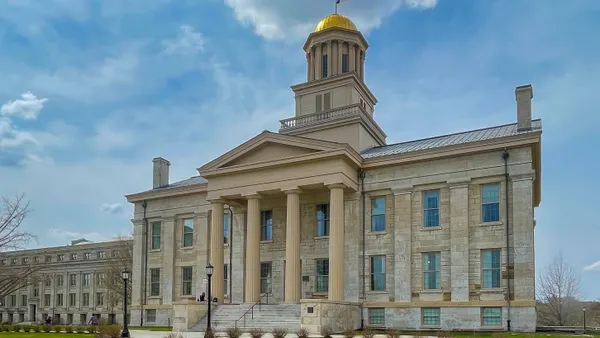
- Iowa’s public universities enjoyed healthy budgets in fiscal 2026, but institutional leaders are still bracing for some national higher education trends to hit home.
- A report headed for the Iowa Board of Regents logged a total of $9.5 billion in revenue across the state’s three public universities, up 1.4% from the prior year.
- At the same time, the state’s universities are “actively developing contingency strategies to address potential impacts from emerging fiscal headwinds,” including demographic shifts, inflation, federal policy changes and lower tax revenues in Iowa.
Dive Insight:
The report noted that “strong enrollment growth drove increases in tuition and fee revenue” at Iowa’s three state universities during fiscal 2026, which ended June 30. Those revenues came in half a percentage point over the regents’ budget.
As for enrollment, head count across the three institutions came to 71,872 in fall 2025, an increase of about 2% from the previous year.
This fall, undergraduate enrollment at Iowa’s public universities increased by 0.2%, or 98 students, according to a separate report also prepared for the regents’ Nov. 11 meeting. But overall enrollment fell 0.5%, or by 352 students, driven by a loss of graduate enrollment.
Like the system overall, the University of Iowa and Iowa State University largely saw their undergraduate populations hold steady. But those numbers mask losses in new first-year undergraduate enrollment this fall — down by 5.3% at UI and 4.7% at Iowa State. Meanwhile, new first-year undergrads increased by 10.3% at the smaller University of Northern Iowa.
In the fiscal report, the regents staff invoked the long anticipated enrollment cliff, with the numbers of traditional-aged college students estimated to begin declining after this year.
While Iowa is expected to fare better than many of its neighboring states when it comes to demographics, it won’t be left unaffected.
The number of high school graduates in Iowa could decline 9% between 2026 and 2041, according to the Western Interstate Commission for Higher Education’s latest estimates, cited in the regents’ enrollment report. That compares to a projected 29% decline in Illinois, 13% decline in Minnesota and 16% decline in Wisconsin.
But state colleges don’t recruit in a vacuum. Regents staff pointed out in their report that other states “from which the Regent universities receive many out-of-state students are expected to experience much larger drops in their high school graduate population.”
That could weigh on Iowa universities’ finances as colleges compete for a shrinking pool of students in the region — and declines in out-of-state students would have outsized impacts on Iowa universities’ budgets given the higher tuition prices those students pay.
“While enrollment and retention rates remain strong, institutions are closely monitoring key indicators — including applications, campus visits and housing deposits — to inform long-term enrollment management planning,” the fiscal report said.