

A recent board change at the Coalition for the Common Good could plunge the organization even deeper into an internal stalemate as its member universities battle over its structure and future.
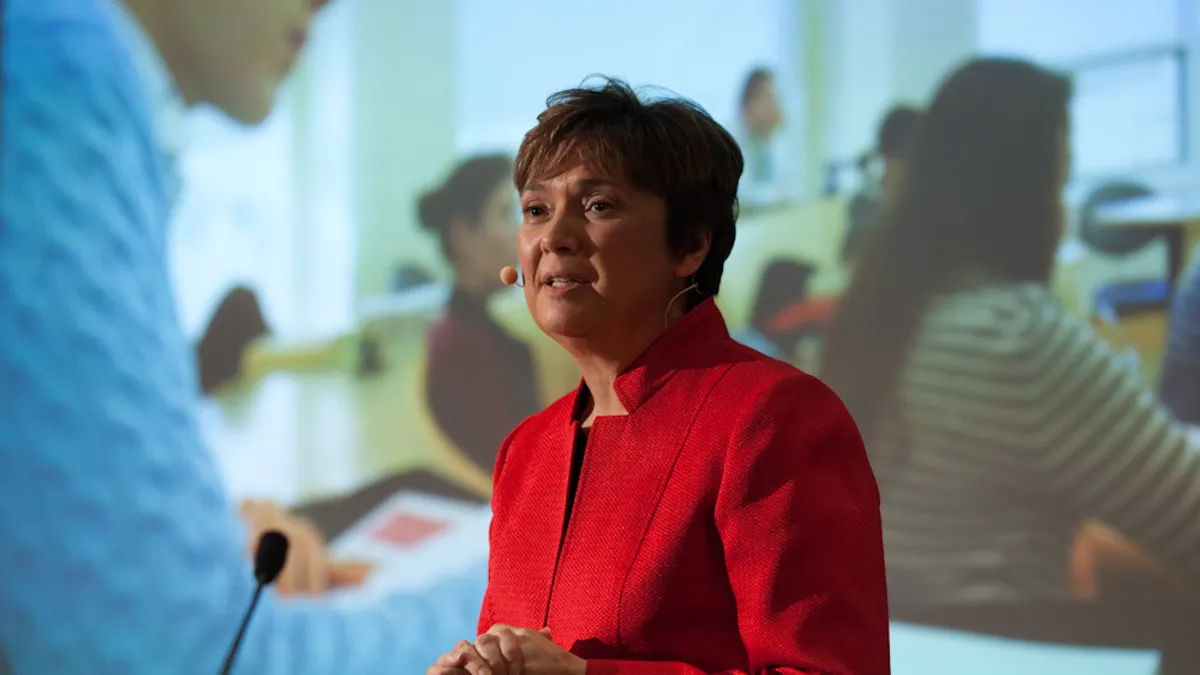
Lynn Pasquerella, best known as the president of the American Association of Colleges and Universities, has left her role as CCG’s only independent director. She joined CCG shortly after Ohio-based Antioch and Otterbein universities formed it in 2023. To date, the two universities are still the only members.
Her departure leaves the CCG board with eight members — four chosen by Antioch and four by Otterbein. That could make the six-vote supermajority necessary to confirm her replacement as the board’s independent member difficult given the tensions between the universities. Six-vote supermajorities are also needed for some action items of the CCG board.
Pasquerella’s term ended this fall, she confirmed to Higher Ed Dive. She initially resigned on May 20 citing increasing scheduling demands, but agreed to stay on to help with the transition through her term, which ended Sept. 30. Late last week, she wrote to CCG Board Chair Dan Gifford to confirm that her resignation was in effect and if it wasn't, to offer formal notice of her immediate resignation.
The coalition, originally the brainchild of former Antioch leaders, was meant to serve as an innovative network of like-minded institutions that could share resources and work together on programming. This year, however, it has become mired in a fierce governance and legal dispute.
Litigation began in August after CCG’s board voted to dissolve the Antioch Advisory Board of Governors, which oversees the university’s operations alongside a standing committee of CCG board members elected by the Antioch board. Pasquerella was among the board members to vote for the board's dissolution, Antioch President Lori Varlotta told Higher Ed Dive in a previous interview.
Antioch leaders argued that the CCG board’s vote violated the coalition’s bylaws, which mandate that major decisions about the university be first approved by the Antioch standing committee on the CCG board.
Just prior to learning of Pasquerella's resignation, Antioch Board Chair Steve Crandall published an open letter to her, asking for her help in resolving the dispute between Antioch and CCG.
“Your independent position on the CCG Board gives you an opportunity to encourage a fresh look at the choices ahead and help both universities move toward a resolution,” Crandall wrote.
But Pasquerella said in a Wednesday email that she was no longer in a position to influence the CCG board since her term has concluded.
"I continue to care deeply about Antioch and its educational mission," she said. "I sincerely hope the parties can find a constructive path forward that protects the university's interests, supports its students and employees, and allows Antioch to focus on its future."
Antioch leader in limbo
The governance spat has upended not only the coalition but Antioch’s operations.
Antioch’s board initiated the litigation in August, but an Ohio state court ruled that the body didn’t have standing to sue over breaches in the CCG bylaws. A member of the Antioch standing committee on the CCG board refiled the lawsuit in September.
Last month, the court approved a preliminary injunction against CCG, ruling that it lacked the authority to dissolve the university’s board without Antioch standing committee approval. It also said CCG’s board could not unilaterally fire Varlotta — something Comerford and CCG board leaders have attempted or threatened to do on multiple occasions.
The court further concluded that CCG could not intervene in Antioch’s accreditation, which the coalition attempted to do after moving to dissolve the university’s board.
However, the ruling did allow CCG to put Varlotta — who became Antioch president in fall 2025 — on paid administrative leave, since the coalition bylaws do not specifically prohibit this.
Varlotta’s status has thrown a cloud of uncertainty over Antioch, which Crandall addressed in his letter to Pasquerella.
Crandall wrote that Varlotta’s leadership was widely supported across Antioch stakeholder groups. “There is no support at either the Antioch Board or the Standing Committee for termination, as required by the Charter, the Bylaws and the Court’s order, so keeping Lori on paid administrative leave does nothing but waste limited Antioch resources,” he said last week.
The mechanics of just who within CCG has authority to put Antioch’s president on leave are also in dispute even after the court’s ruling.
Shortly after the decision, CCG said in a statement that it “affirms the role of the CCG President over staffing and operational decisions.” The coalition’s president, John Comerford, also leads Otterbein University and is at the center of a separate lawsuit Varlotta has filed against the CCG over allegations of discrimination and retribution.
In its own statement, Antioch called CCG’s view “entirely false.”
“The court did not say that the CCG President has authority to place the Antioch University President on paid administrative leave, though it did suggest the CCG Board could take that action,” the university said on Oct. 22.
Since then — on Monday — the CCG board passed a resolution ratifying Varlotta’s leave, according to a copy of the resolution provided by a spokesperson for the board.
Yet in its Oct. 22 statement, Antioch also pointed to Varlotta’s leadership role as being critical to Antioch’s relationship with its accreditor and suggested her leave could conflict with the court’s ruling on Antioch’s independence on accreditation matters.