Dive Brief:
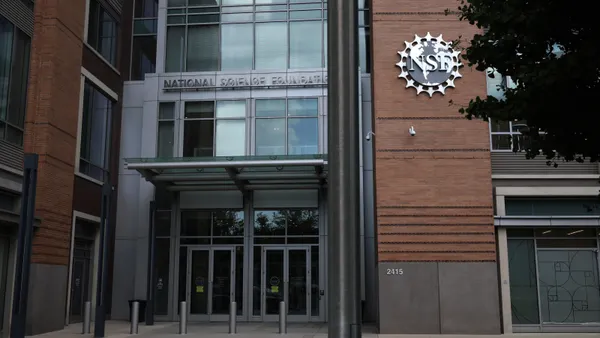
- A coalition of academic researchers, scientists, instructors, graduate students and university departments on Monday sued the National Science Foundation over its decision to shutter its Social, Behavioral, and Economic Sciences Directorate.
- In their lawsuit, the plaintiffs allege that NSF leadership violated the Administrative Procedure Act and the statute creating the agency by unilaterally announcing in April it would eliminate the directorate, known as SBE, in fiscal year 2027.
- The decision to end SBE and its hundreds of millions in research funding is reckless and illegal and would “devastate social, behavioral, and economic sciences in the United States,” the complaint said. The plaintiffs are asking the court to reverse NSF’s decision and block the closure. The agency did not immediately respond to questions on Monday.
Dive Insight:
Since April, NSF has “stopped funding opportunities for basic SBE research,” reassigned almost all of SBE's staff and cut ties with scientists who were working with the directorate, according to Monday’s lawsuit.
President Donald Trump also fired every member of SBE’s governing board, who plaintiffs said had been kept in the dark about the agency’s future since he retook office almost two years ago.
Their lawsuit argued that NSF breached the APA by failing to consider the outcome of doing away with SBE — namely, that the agency would be unable to fulfill its mandate to “initiate and support basic scientific research and programs” in the social sciences.
Each year, SBE distributes some $247 million in grants for research into the social, behavioral and economic sciences — nearly two-thirds of all federal grants in these fields, according to NSF.
“Without that funding, hundreds of promising research projects directed to the pressing problems of our time — from the use and effects of artificial intelligence to child development in the age of social media — will never proceed,” the lawsuit said. Thousands of people also will lose their jobs, it said.
The plaintiffs also said NSF has given no official rationale for why it decided to extinguish the directorate.
In response to question from The Atlantic, a White House spokesperson said in a May statement that the Trump administration “is committed to cementing America’s dominance in cutting-edge technologies of the future — innovation that is being driven by advancements in hard sciences, not in ideologically-driven ‘social sciences.’”
But the administration never said why it is labeling entire fields such as psychology and economics as “ideologically driven,” the plaintiffs said in their lawsuit Monday. And even if it were to explain, they argued, the rationale would directly conflict with the statutes that created NSF, “which repeatedly direct the Foundation to support the social sciences.”
All of this has occurred with a significant power vacuum at the top levels of NSF. The agency has been without a permanent leader for more than a year and a half, after its last director, Sethuraman Panchanathan, resigned in April 2025. It is also without a deputy director.
Both positions require a presidential appointment and Senate confirmation. Trump’s pick for NSF director, former U.S. Department of Health and Human Services Deputy Secretary Jim O'Neill, has not been given a confirmation hearing.
NSF Chief of Staff Brian Stone, a defendant in Monday’s lawsuit, is currently performing the duties of the agency’s director. The vast majority of NSF's significant cuts and the corresponding tumult occurred during Stone’s tenure. He is set to retire at the end of the year.
“NSF cannot shut down the government’s largest source of funding for an entire scientific sector without a Director and without consulting the body Congress created to make such Decisions,” Monday’s lawsuit said. “And it certainly cannot do so with no explanation.”
Alongside two named college instructors, the organizations suing NSF are the Federation of Associations in Behavioral and Brain Sciences, the Society of Experimental Social Psychology, and the Social & Affective Neuroscience Society. The plaintiffs are represented by the advocacy nonprofit Democracy Forward.