SAN DIEGO — Colleges are increasingly looking to recruit adult learners as a means of bolstering enrollment amid an anticipated decline in traditional-aged students. In turn, higher education officials are grappling with how to best serve students who have likely not been in a formal educational environment in years.
For some, the answer is artificial intelligence — a topic that continues to divide educators. Detractors warn AI could diminish the value of higher ed by eroding students’ critical thinking skills and leading to an environment where AI both writes and grades classwork. But supporters and ed tech companies tout rapidly advancing automation as a cost-effective solution to some of the sector's toughest challenges.
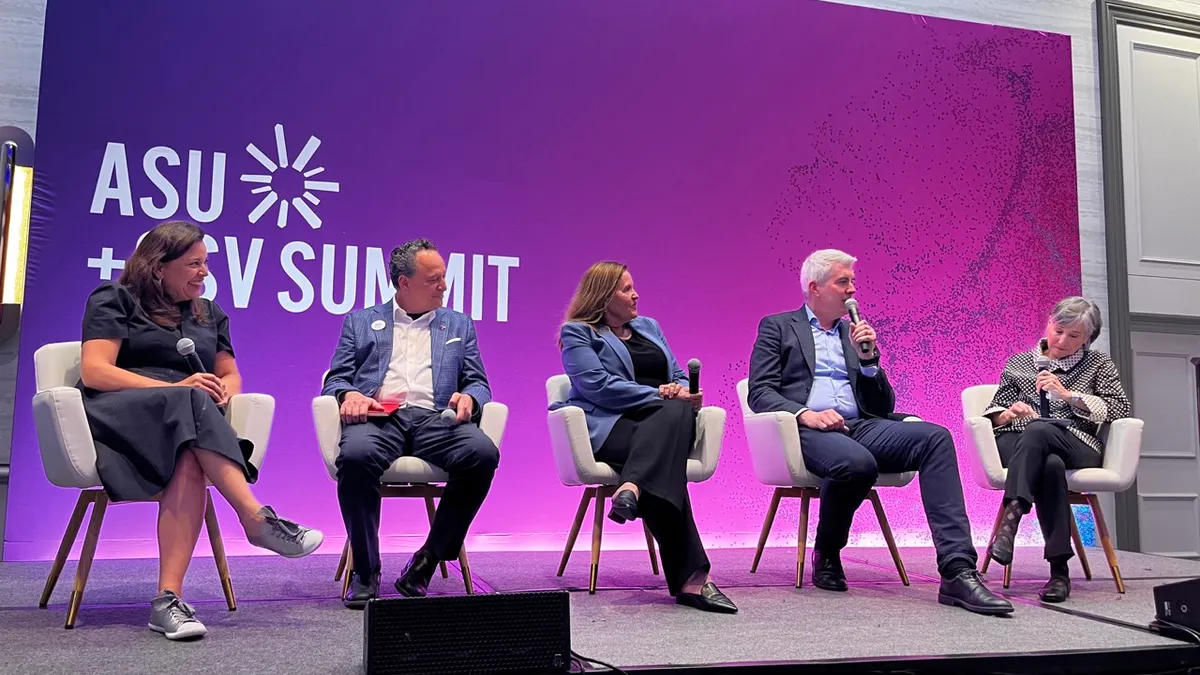
This week, leaders from two massive colleges that have long specialized in nontraditional students — Southern New Hampshire University and the University of Phoenix — spoke at the annual ASU+GSV Summit and shared insights from their experiences implementing AI.
"There is no silver bullet," John Woods, provost and chief academic officer at the University of Phoenix, told attendees of the education and technology conference on Monday. "You've got to lead with strategy."
Strategy-first implementation
Lisa Marsh Ryerson, president and CEO of Southern New Hampshire, emphasized that college officials should be guiding AI, not the other way around. That means that the primarily online nonprofit institution is not simply buying a bunch of product licenses for its over 189,000 students.
"AI is a help, of course, but we should not have it build our strategy," she said during Monday's panel.
Woods agreed.
"There's 40 companies out here who will hand you a business card and say they can put a tutor in every class," he said. "It's not quite that easy."
Before hitting the marketplace, college officials should have a clear vision of what they want from an AI tool, both in terms of institutional outcomes and what its adoption would mean for learners and instructors, according to Susan Winslow, CEO of Macmillan Learning, an ed tech company that offers AI tools.
From there, they can consider acquiring tools — and beefing up their engineering staff — to support those goals, Ryerson said.
Selecting an AI tool is "not a one-and-done" conversation, Winslow said, especially in light of the potential cybersecurity risks AI poses. Administrators should regularly check in on their AI usage to ensure it aligns with their strategic priorities.
Classroom support and tutoring tools
One of the most popularly advertised applications for AI is increased one-on-one instruction. Dozens of AI-focused companies have begun offering tutor chatbots in recent years, with sector heavyweights like Google and Khan Academy launching their own versions as well.
But simply telling students they can now access an instructional chatbot will likely fail to reach those who could benefit the most from the help, according to Woods.
More often than not, the students who use tutoring tools already earn strong grades — those looking "to keep their As or move their B to an A" — he told conference attendees.
Instead of introducing broadly available help, Woods recommended implementing AI tools that complement a course's curriculum.
At the University of Phoenix, a for-profit institution with over 82,000 students, students studying to be mental health counselors use AI chatbots to practice client conversations. Faculty then review those transcripts and provide feedback, he said. Education majors similarly use AI to practice conversations that may arise in parent-teacher conferences.
In both cases, human oversight is central to the process, and students are "not just using AI for AI's sake," Woods said.
The prospect of personalized education — such as offering a law student and a nursing student custom instruction in the same history class — is increasingly becoming attainable from a technology perspective, according to Woods.
But he added that most colleges are not set up to execute on that vision and would need a strong grasp on what each student needs and when they need it, he said.