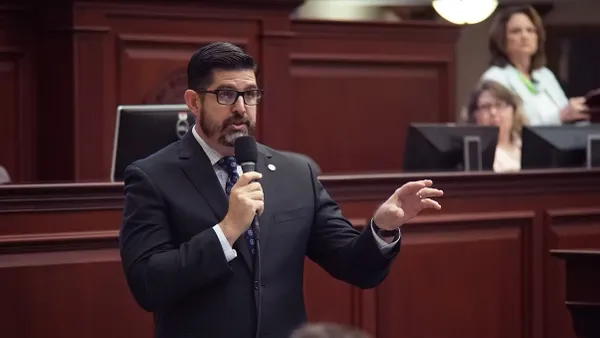


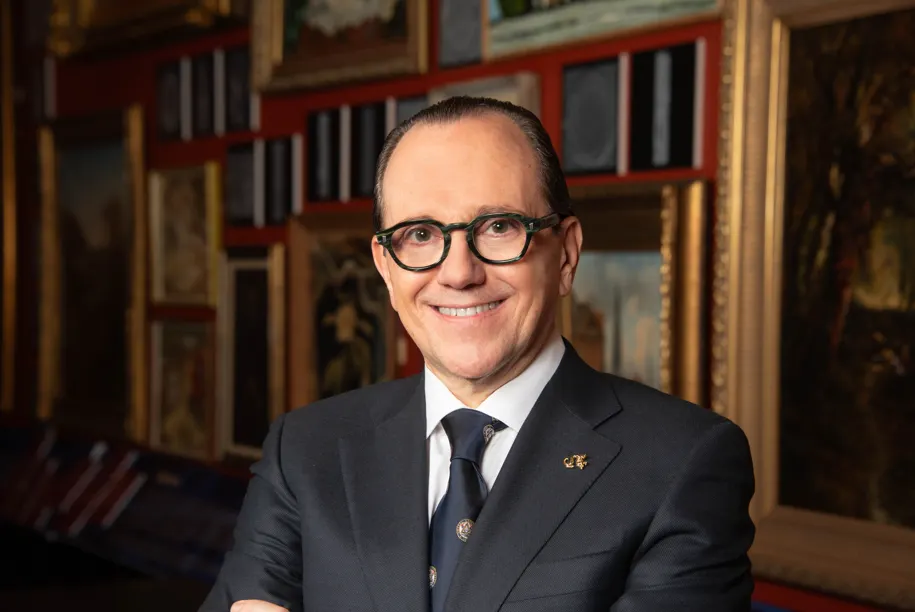
Drexel University President Antonio Merlo isn't just a first-generation college student. The Italian native’s parents didn’t go to high school either.
“To me, what is the value of education? To change the trajectory of your life for the better,” he says.
Merlo attended college in Milan before earning a doctorate in economics from New York University. He worked for years as a professor and water polo coach — having played the sport since the age 12 — before moving into administration at various universities, including dean roles at New York University and Rice University, in Houston.
When he joined Drexel in July, becoming its 16th president, he took over a university in transition and has since become perhaps its most enthusiastic cheerleader. Founded by a philanthropy-minded financier in 1891, the private Philadelphia institution today has roughly 21,000 students and is undergoing what it calls an “academic transformation.” That includes building core competencies into its entire curriculum and moving from a quarter-based academic calendar to the much more common semester model.
The new president says he can give fresh eyes to a transformation process developed and launched under his predecessor, John Fry, who served for nearly 15 years.
Drexel also aims to become a leader in experiential education, in part through its undergraduate co-op program, which provides students with work experience through partnerships with companies and organizations.
Higher Ed Dive spoke with Merlo in December to discuss leading a university undergoing such a transformation and navigating the choppy waters of 21st century higher education.
Editor’s note: The following interview has been edited for brevity and clarity.
HIGHER ED DIVE: What drew you to Drexel, and how is it different from other institutions you've worked with?
ANTONIO MERLO: There is something that is truly exciting and remarkable about Drexel, and that is, we are not trying to blend in and be a vanilla university that mimics a thousand others. What attracted me to Drexel is this clear sense of identity for experiential education. This is a university that focuses on the value proposition of a college degree. This is an institution that is willing to be agile and transform itself and be completely in tune with what the world needs tomorrow, not how we have done business for the past hundred years. I've not been in a university throughout my career that was so clear with its sense of identity.
What are your top two or three priorities for the year ahead?
MERLO: We want to be recognized as a student-focused and student-centered university that is a global leader in experiential education. My absolute top priority is to land that plane and ensure that our academic transformation fully actualizes itself and reaches every corner of this university.
Where are you in that process?
MERLO: I would say we are 95% done with academic transformation. We are running two parallel universities, one that runs on a quarter system, and one that now has all the new curricula in alignment with the semester system.
One thing that I wish I could take credit for but that I didn't do: The university really was amazing at realizing this is a once-in-a-lifetime opportunity to rethink everything we do. We are not just going to say, “Okay, how do we squeeze everything we do into a semester as opposed to a quarter?” but also, “How can we revamp every degree program we offer, every single one? How do we rethink what we want our students to learn? How do we want to position ourselves to be recognized in the landscape of higher education that makes us unique, that makes us distinctive?”
Drexel is talking about core competencies, and that, to me, is such a refreshing way of looking at things. We don't say, “Here are the 10 courses you must take.” We say, “Here are the skills that we want every single one of our students to have by the time they graduate.” And those competencies can be acquired in many different courses across the curriculum. You could be a business major, and you may take courses in engineering or in media design to build those core competencies.
We are embracing AI [artificial intelligence] and having an AI-infused curriculum in every single degree program we offer. We expect the graduates of the future to need to be AI-literate because this is what the jobs are going to require. This is a tool that is here and is going to change our lives, regardless of whether we put our heads in the sand or embrace it. We teach our students to understand it and use it so that they can bring this experience with them. Critical thinking, problem-solving — those are core competencies that AI is not going to displace.
Did you have to think about whether you wanted to take a leadership role where you're taking over a massive transformation project that was launched by someone else?
MERLO: Not only do I like it, I love it. Here is why: I consider myself an academic entrepreneur. You're absolutely right that this process started before me. But here is a university that was willing to look under the hood and say, “We need to change the way we do business.” So even though I'm coming in during the fourth quarter, we can still impact how much we're going to win by. Rule No. 1 for me is to come in and remind everybody why they started this process, by keeping them focused on the goal.
You need to remotivate people. It's like when you're running a marathon and you see the finish line in the last mile. Your legs stop going. I have the privilege of not being exhausted because I didn't have to run the first however many miles. But I have the opportunity to put my fingerprints on the final incarnation.
"Here is a university that was willing to look under the hood and say, 'We need to change the way we do business.'”

Antonio Merlo
President, Drexel University
One concrete example is the transition from quarter to semester. People forgot why. I come in, and they're all complaining, “Ah, it's so much work! We have to do this, we have to do that.” I provided a fresh eye from the outside, saying, “Let me tell you why transitioning from quarter to semester is going to be critically important.”
No. 1: It’s going to be hugely beneficial for our students. The quarter system is brutal. Students come in, you have two classes, you have an exam, you have another class, you have another exam, you have your final. A week later, you start another thing. It's very difficult to have everything sink in.
No. 2: By being synchronized with the rest of the world, it is going to open up opportunities that right now we don't have. Our law school and our medical schools are already on a semester system, but our undergraduate program is not. That means that, right now, we cannot take advantage of opportunities for our undergraduates to take classes and courses in our medical school and law school that would advance their careers.
No. 3: You have heard of a semester abroad. I've never heard of a quarter abroad. The opportunity is now to study abroad and to really use the global experience as part of experiential learning.
You’ve mentioned experiential learning a lot. What does that mean in practice at Drexel? How do you work it into the entire curriculum, into the DNA of the university?
MERLO: What you typically hear when you're visiting colleges is that, “We're going to give you a second-to-none education. Come here, and four years after, magically, you're going to get to use it all.” That's the standard model.
Here is what we tell you at Drexel. “We give you an education that is second-to-none — rigorous, on the frontier, no matter the field that you're interested in. But we get you to use it from day one.”
There is a huge pedagogical literature that shows the importance of learning by doing as a way to make that transition in your brain from a theoretical notion to “Now I understand.” I'm sure you've heard tons of schools tell you, “Our students get internships.” Our students can have up to three semesters of full-time work experience while they are with us.
No. 1, in the co-op they actually work full-time real jobs. This is not, “I go in and I photocopy, or I fetch coffee or I shadow somebody doing it.” It's a full entry-level job. We have over 1,500 partners that hire our students for a six-month stint.
Pillar No. 2 is research. We offer our students opportunities with professors in field work. That is experiential education. Sure, you may have labs as part of your class. But what if working on, let's say, a National Institutes of Health-funded project that tries to develop a new drug for a particular disease?
No. 3 is civic and community engagement. The city of Philadelphia is our campus. It's also our laboratory. It is the way in which we bring what we learn in the classroom into our community.
We are actually saying, “Actually, let's take this and learn what it does to our community. Let's bring this to West Philadelphia. Let's use civic and community engagement to understand how people experience what governments do, what nonprofits do, what corporations do.”
We saw that you guys had a bit of an enrollment drop during the fall. It was expected, correct?
MERLO: Yes, absolutely.
Can you explain what happened, what the future financial implications of it are, and if you think you'll rebound in terms of next year's first-year class?
MERLO: It was not unexpected because of everything we knew, both in terms of the demographic trends in the U.S. but also — let me put a spotlight on something that everybody felt — international enrollment. It's not just that fewer students from outside of the U.S. wanted to come, but even the students who would have wanted to come, somehow, because of all the visa situations, couldn't. Of course, you can never predict an exact number, but the point is, we were expecting it, and so because of that we prepared with that expectation.
A lot of universities are facing a dual whammy, which is that first-year enrollment is down and overall enrollment is down. That's not the case for us. Our first-year enrollment is down, but our overall enrollment is actually slightly up. That is because we had compensation from different sides, for example, the graduate student population.
The key point is, do I expect a rebound? Absolutely. And that is because now we're coming out with such a clear, strong, powerful message for the value proposition of a Drexel degree. And why am I optimistic and confident? Our applications are up.
Can you say by how much?
MERLO: We’re up [11% annually] in early decision/early action applications.
If everything goes as you hope and as projected, how do you see Drexel being different in another five years?
MERLO: If everything goes according to plan, when somebody hears the word Drexel they would say, “Oh yeah, a leader in experiential education.” If this sticks, this is going to be exactly our identifier. Our alumni, regardless of where they are in the world, are going to find this sense of engagement and belonging and feeling connected with the mission of this university.
I want to become a household brand name, where everybody would understand what Drexel is and what Drexel stands for. What we are doing right now is building the modern university for the modern world. The beauty of it is, it's a scalable model. We really need to put our arms around it. We have all the foundations.
This scaling up, does it involve acquisitions or online program expansion, or does it mean building out the campus that you have right now?
MERLO: Let me be very clear with you. A lot of people are living by the mantra, “Bigger is better.” My mantra is, “Better is better.” I want to be the best at what we do. By scaling up, I mean quality and ambition and achievement. I don't mean geographic expansions and acquisition. In fact, my goal is to make the Drexel campus feel even more vibrant than it is right now.
To me, having the resources for delivering the quality experience I want every single one of our Drexel students to have — that is student-focused and student-centered. That's where it all starts. How can I make that student experience even better than what it is today.