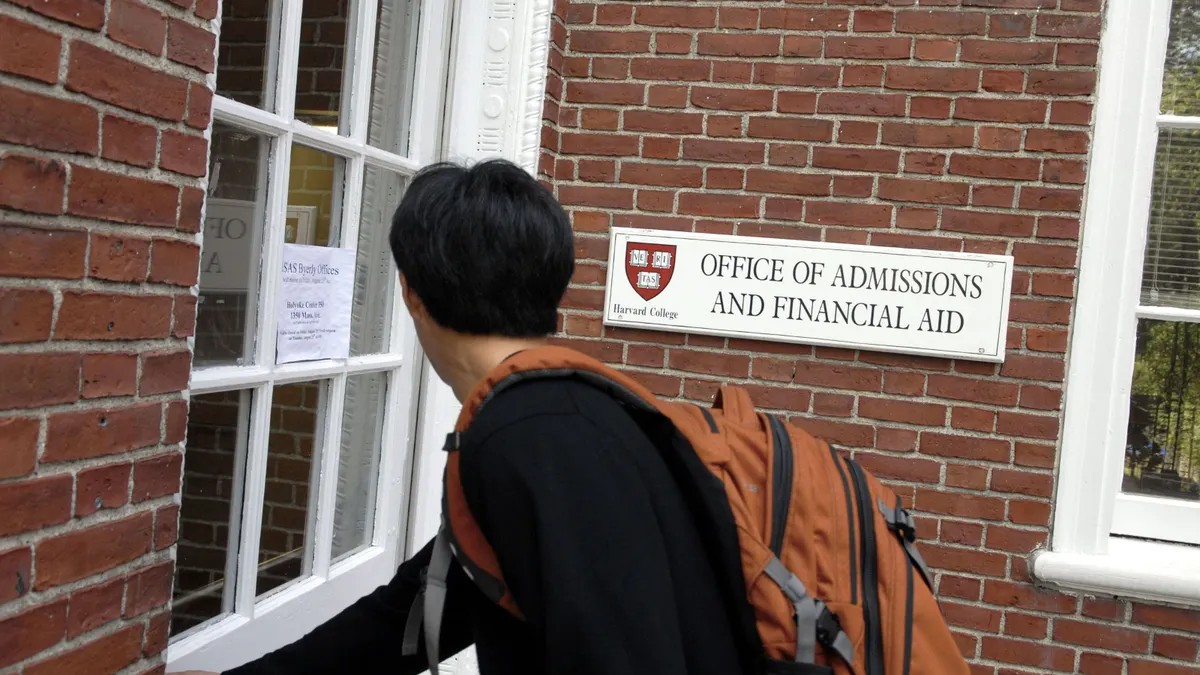
All eight Ivy League institutions have either moved away from COVID-era test-optional policies or plan to do so now that Columbia University has announced it will reinstate standardized testing requirements for undergraduate applicants in August 2027.
Other top-ranked institutions, including the Massachusetts Institute of Technology and Johns Hopkins University, already returned to requiring SAT or ACT scores following the pandemic.
The Trump administration, meanwhile, has taken a firm position in favor of standardized test requirements for college admissions.
In sweeping guidance released in February 2025 — which has since been struck down in court — the U.S. Department of Education’s then-Acting Assistant Secretary for Civil Rights Craig Trainor warned colleges against using proxies for race, writing that it would be unlawful, “for an educational institution to eliminate standardized testing to achieve a desired racial balance or to increase racial diversity.”
The Trump administration later proposed a compact to give institutions preferential treatment in funding if they adopted the federal government’s policy priorities, including requiring all undergraduate applicants to take a standardized test such as the SAT or ACT. None of the nine institutions initially offered the compact accepted.
For now, it has been mostly top-ranked universities — including some major public institutions — that are returning to SAT and ACT requirements. But it remains to be seen whether the Trump administration’s position will spur more colleges to follow the Ivy League’s lead.
“A lot of higher ed institutions tend to take their lead from the more selective institutions,” said Pamela Burdman, founder and executive director of the California-based Just Equations, a nonprofit focused on equity in mathematics education. “So the question is: Will the practices of the Ivy League seep down into the rest of higher ed?”
So far, however, the Trump administration’s stance and the move of the Ivy League institutions are hardly the death knell for test-optional policies nationwide.
While there is no question the coronavirus pandemic drove the rapid growth of the test-optional movement nixing SAT or ACT requirements, the impact of those changes remains strong. According to FairTest, an organization that advocates for limiting standardized testing in college admissions, more than 2,000 bachelor’s-degree granting institutions are test optional or test free.
“The truth is over 90% of schools are still test optional. A variety of schools have just double downed again,” said Harry Feder, executive director of FairTest.
What does the data say?
Feder said high school grades are far more indicative of how students will perform in college than the SAT or ACT.
A 2014 study of colleges that don’t require standardized testing scores found almost no difference between the graduation rates of applicants who submitted scores and those who didn’t. Meanwhile, it found strong GPAs in high school were linked to high GPAs in college.
Feder also contended that standardized tests have “all sorts of class and race discriminatory properties” that make them exclusionary.
There have been persistent findings of racial disparities, for instance, in standardized testing performance, with a 2020 Brookings Institution report showing that Asian and White students consistently outperform their Black and Latino peers on the SAT's math section.
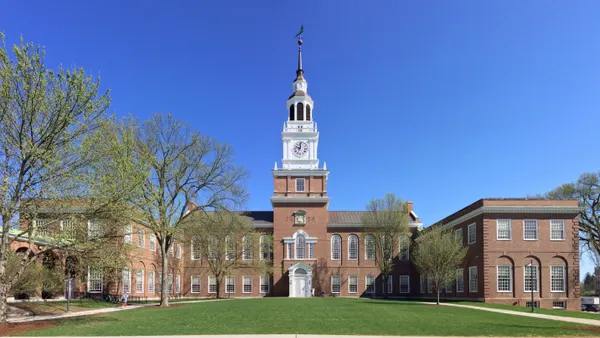
But a January 2025 working paper studying Dartmouth College applicants, co-authored by Dartmouth economics professor Bruce Sacerdote, found that standardized test requirements often help high-achieving students from disadvantaged backgrounds.
“There’s not really an association between being test optional and having a more diverse pool, at least in a lot of places,” Sacerdote said. “It’s not like there’s some cutoff score that everybody’s got to hit and then you’re in or you’re out. It’s much more about: Are you succeeding in the context of your environment?”
Brown University economics professor John Friedman agrees.
Friedman helped lead a May 2025 study on standardized test scores and academic performance at “Ivy-Plus” colleges, which included the eight Ivy League institutions plus MIT, Stanford University, Duke University and the University of Chicago.
“Test scores at Ivy-Plus institutions are way more predictive of academic preparation than high school grades. High school grades are, in fact, not that predictive at all of academic preparation,” he said, adding that too many students are getting 4.0 GPAs or close to that.
He called the decision by Ivy League schools to revert to standardized test requirements a positive development.
“My sense is this is the right policy to go to, and it really comes out of the work I did as a researcher,” said Friedman.
MIT Dean of Admissions and Student Financial Services Stuart Schmill referenced the university’s own internal research when it reinstated its standardized testing requirement in 2022.
“Our research has shown that, in most cases, we cannot reliably predict students will do well at MIT unless we consider standardized test results alongside grades, coursework, and other factors,” he said at the time.
Similarly, Friedman’s and Sacerdote’s research played a role in the decisions to reinstate the requirements at Brown and Dartmouth, respectively. But they also are quick to acknowledge that test scores are merely one factor in admissions.
Meanwhile, Feder expressed concern that the U.S. Supreme Court’s 2023 ruling striking down race-conscious admissions, coupled with a return to standardized test requirements, has harmed diversity.
An analysis by Class Action, a nonprofit organization, showed that Black and Hispanic enrollment at Ivy-Plus institutions dropped in the aftermath of the court’s decision in Students for Fair Admissions v. Harvard.
“It’s very clear that as a result of that decision, the percentage of Black and brown kids at the elite institutions being admitted has decreased. Going away from test optional contributes to that,” Feder said.
But Friedman and Sacerdote counter that part of the issue is that some students from disadvantaged backgrounds err by not submitting standardized test scores, failing to realize that the scores they attained may be more of an asset than they think.
Which colleges are staying test-optional?
There is no universal answer to whether schools should use test scores or not, said Friedman. “The answer depends on what one finds when universities go do the work on their data,” he said.
It was data that took the University of Vermont in a different direction, according to its vice president for enrollment management, Jay Jacobs. UVM made its test-optional policy permanent for undergraduate admissions in 2025.
According to Jacobs, the university studied fall and first-year cumulative GPA for its students with standardized test scores on record versus those without. What the admissions team found, he said, was little difference between the groups.
“The admissions team and the faculty student affairs committee started to ask questions,” said Jacobs. “Are these differences big enough to warrant the test requirement, given what we know about the tests and who performs well on them from a socioeconomic perspective, from a racial and ethnic diversity perspective, from a gender diversity perspective?”
Officials also decided it was important for UVM to be accessible, given its status as a public flagship and land-grant institution. “That drove us to think about whether this would work,” Jacobs said.
He added that during UVM’s test-optional admission pilot program, which started in the 2020-21 academic year, both retention and graduation rates increased. “In fact, we’re sitting this year on the second straight year of the highest one-year retention rate in university history and our highest graduation rates in university history.”
Many other colleges from various parts of the country, including the University of Michigan, Syracuse University and Texas Tech University, have stood by their test-optional policies as well.
Uproar in the Golden State
The University of California system implemented a test-free admissions policy in 2020. But could that be changing?
More than 2,300 University of California faculty members have signed an open letter urging the system to reinstate the SAT/ACT mathematics requirement for STEM majors, starting with the 2027 admissions cycle. The letter alleged students are coming to college badly underprepared in math and that objective benchmarks are needed.
In July, UC’s board chair said a standardized testing review would be a “major focus” of the board and that she expects the academic senate to make a recommendation on the system’s testing policy by the end of the academic year.
Burdman, the founder of Just Equations, said math underpreparedness is a national trend but questions the remedy some professors are proposing.
“I’m skeptical that returning to standardized tests is going to be the solution to the problem they’ve identified, particularly for a public university that has an obligation to serve the broad diversity of the state’s population, whether it’s geography, income, ethnicity or race,” Burdman said.
The UC faculty letter stated, “The SAT/ACT mathematics requirement is not an obstacle to equity; rather, it is a prerequisite for it.”
But Burdman countered that multiple ways of addressing math readiness don’t involve using standardized tests.
Feder agreed and went a step further. “It’s a manufactured crisis,” Feder said. “You’re getting rid of a lot of potential doctors in a lot of communities if you start sifting them out by SAT scores. This isn’t MIT or Harvard.”
But Sacerdote called periodic standardized test assessments “part of life” for potential doctors. He suggested that reinstating these requirements may provide applicants with a better understanding of how to study for the MCAT exam and other tests down the road.
No one-size-fits-all solution
Many experts agree there is no one-size-fits-all approach when it comes to standardized test requirements versus test-optional policies.
Sacerdote and Friedman both pointed to a working paper by City University of New York researchers that concluded that high school grades were more helpful in predicting academic success in college than standardized test scores at a large, urban public university system.
“In cases like CUNY, if the test scores are not helpful as part of assessing students’ academic preparation, then I don’t see any reason to require test scores there,” Friedman said.
Sacerdote added, “It’s definitely not for me to say just because we found this at Dartmouth, every institution should step up and do it the same way we do it.”
Jacobs voiced a similar sentiment for the test-optional camp.
“We’re not sitting on a high horse at the University of Vermont,” Jacobs said. “It was the right thing to do for our university per our vigorous data analysis.”