

Dive Brief:
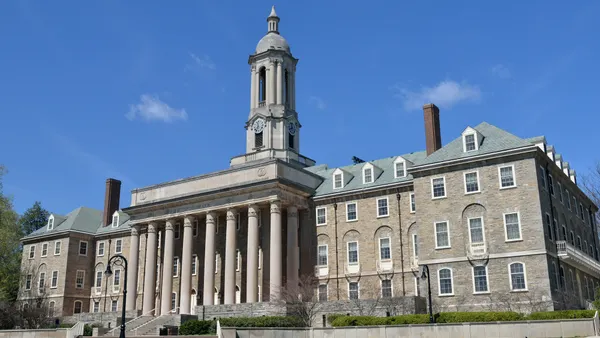
- Pennsylvania State University is facing a $124 million budget gap for fiscal 2027 amid a drop in fall enrollment and spikes in employee health insurance costs, the public institution said Monday.
- To weather the shortfall, Penn State leaders plan to tighten capital spending, slash the president’s strategic funds, centralize surpluses from individual units, and reduce budgets across the university by an average of 1.3% without cutting personnel.
- The budget woes follow declining enrollment in key areas for the fall semester, with year-over-year drops in international, graduate and out-of-state students, according to a separate announcement.
Dive Insight:
Just over 70% of Penn State’s budget hole is due to falling tuition and fee revenue.
Behind the revenue miss is a fall headcount that is 3,058 students short of the comparable 2025 number. Breaking that down, Penn State said Monday that it enrolled 742 fewer graduate students, 922 fewer international students and 2,384 fewer out-of-state students across its campuses. All three of those groups can have an outsized impact on tuition revenue at a college.
About half of the enrollment decline came at seven regional campuses that are set to close — and had been expected. In explaining the declines, the university also pointed to nationwide trends, including widespread decreases in graduate enrollment and international students.
At the same time, Penn State logged its largest-ever undergraduate class of 43,010 students and a record class of 9,907 first-time, full-time students.
“Even with these challenges, Penn State's market position is strong,” said Matt Melvin, Penn State vice president for enrollment management, in a statement.
Health insurance costs made up the remainder of the university’s fiscal 2027 shortfall in its $2.2 billion education and general budget. By August, healthcare claims had grown 15.7% year over year, the university said Monday. Budgetwise, that led to a $37 million jump above projections.
On an FAQ page about its budget, Penn State said it had no plans for broad cuts to its programs or student services, or for changes in its hiring processes, as it looks to tighten spending. The institution also said it would hold tuition and fee prices steady despite the revenue dip.
The university does, however, already have plans to nix some 47 undergraduate programs after a multiyear review of its offerings. Collectively, those programs enroll about 1.1% of Penn State’s undergraduates. The institution listed another 50 programs as “strategic growth opportunities.”
Penn State’s plan to close seven of its 19 regional Commonwealth campuses is primarily an effort to shore up the institution’s budget. Keeping those locations open would cost the university $40 million annually in financial support and overhead expenses and require a $200 million investment in facilities, according to a 2025 report recommending the closures.