Dive Brief:
- The U.S. Department of Justice on Thursday filed lawsuits against four states — Arizona, New Mexico, Oregon and Washington — over their laws allowing certain undocumented students to pay in-state tuition rates and receive state financial aid.
- Under the Trump administration, the agency has pursued a widespread legal campaign against these policies, arguing that they illegally provide benefits to undocumented students that are not offered to all U.S. citizens.
- In total, the DOJ has now sued 21 states over similar tuition policies and succeeded in knocking down five. The remaining cases are ongoing.
Dive Insight:
While varying from state to state, the contested policies commonly deem undocumented students eligible for in-state tuition rates if they have lived in the state for a portion of their high school career and graduated locally, among other requirements. Some also grant undocumented students eligibility for state-funded scholarships and financial aid.
Stanley Woodward Jr., the DOJ’s associate attorney general, signaled in a Thursday statement that the agency intends to continue suing over similar state policies until none are left.
Out-of-state tuition is often double or triple in-state tuition. The University of Oregon, for example, lists in-state tuition and fees at $17,475 for the 2026-27 academic year. For out-of-state students, that sticker price is $47,466.
Each state's flagship university lists out-of-state tuition as roughly 3x higher than in-state tuition
All four of the states sued this week have Democratic governors, and all but Arizona have Democrat-controlled legislatures.
New Mexico, Oregon and Washington have allowed certain undocumented students to pay in-state tuition for at least a decade.
In contrast, Arizona's policy is one of the newest in the country, adopted in 2022 via a state ballot measure. Under Proposition 308, all students regardless of their citizenship status qualify for in-state tuition and state financial aid if they:
- Attended high school while physically in Arizona for at least two years.
- Graduated high school or obtained an equivalency diploma while in the state.
The Trump administration began attacking such policies in court last year, citing a federal immigration statute that prohibits undocumented students from receiving postsecondary education benefits based on state residency “unless a citizen or national of the United States” is also eligible regardless of residency.
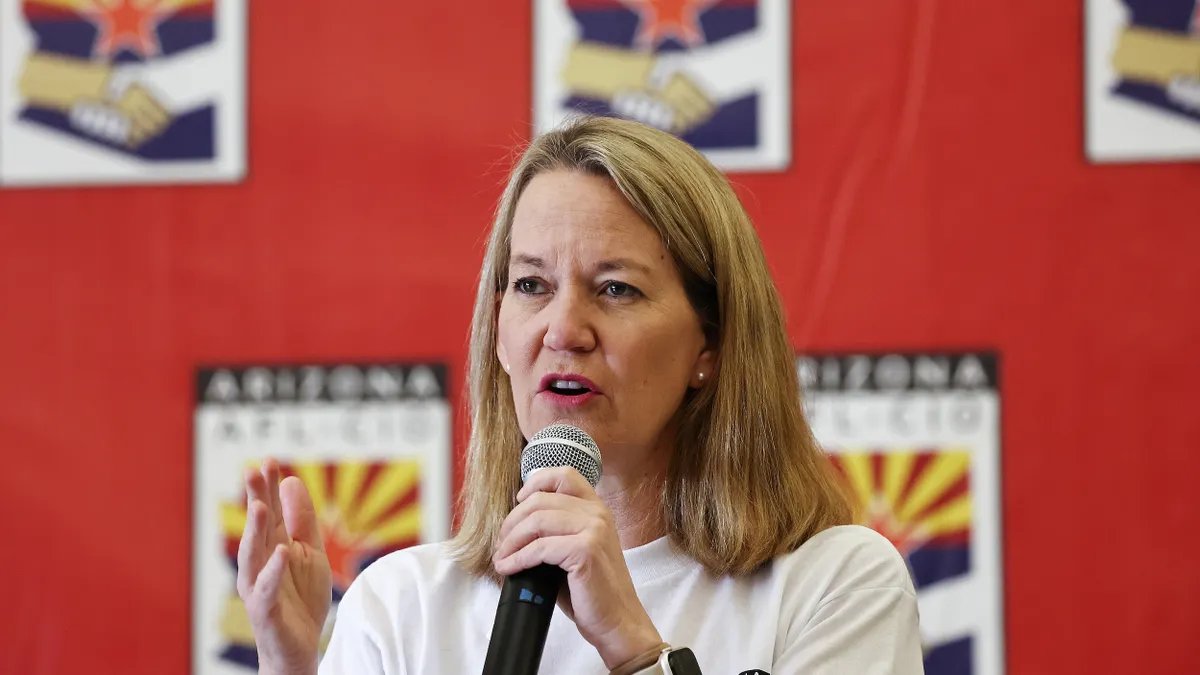
Arizona Attorney General Kris Mayes said Friday the lawsuit is fundamentally “about state’s rights” and that she would fight the Trump administration's allegations. She also noted that she anticipated the case back in 2025, when she issued a legal opinion arguing that her state's law complies with federal law.
“Proposition 308 confers no eligibility for a postsecondary education benefit on the basis of residence,” Mayes said last August.
“Some Arizona residents will not be eligible for in-state tuition,” she added, while some people eligible for in-state rates will not be state residents.
Oregon Gov. Tina Kotek and Washington Gov. Bob Ferguson both said they would defend their respective states' tuition laws.
“Washington state won’t be bullied into changing how we provide opportunities for young people in our state,” Ferguson said on social media Thursday. “We’ll see them in court, and we expect to win.”
In a statement Friday, Kotek questioned the Trump administration's priorities.
"Rather than focus on affordability and reduce costs for Oregon families, the federal administration seems determined to attack state laws that have been successful for a decade," she said.
New Mexico Gov. Michelle Lujan Grisham was unavailable to comment on the lawsuit on Friday, according to her office. A New Mexico Education Department official did not immediately respond to a request for comment.
The DOJ’s latest flurry of lawsuits this week spurred outrage from educational access groups and student advocates.
Thomas Saenz, president and general counsel of the Mexican American Legal Defense and Educational Fund, said on Friday that the cases demonstrate "the Trump administration’s misuse of the court system to continue a concerted campaign of hostility toward all immigrants."
MALDEF, a Latino civil rights nonprofit, has sought to intervene on behalf of students in four of the DOJ's lawsuits.
Miriam Feldblum, president and CEO of the Presidents' Alliance on Higher Education and Immigration, called the DOJ's tuition lawsuits "misguided" and said a loss of these policies would deprive states of a more educated workforce.
"Undermining these state-level policies creates uncertainty for institutions, disrupts their educational missions, and weakens states’ ability to meet their workforce and economic needs," she said in a Friday statement.
The DOJ has so far filed lawsuits against 17 other states over their in-state tuition policies for undocumented students:
- California.
- Connecticut.
- Colorado.
- Illinois.
- Kansas.
- Kentucky.
- Maryland.
- Massachusetts.
- Minnesota.
- Nebraska.
- New Jersey.
- New York.
- Oklahoma.
- Rhode Island.
- Texas.
- Vermont.
- Virginia.
Florida lawmakers revoked the state's in-state tuition policy for undocumented students last year, prior to the DOJ's legal campaign