

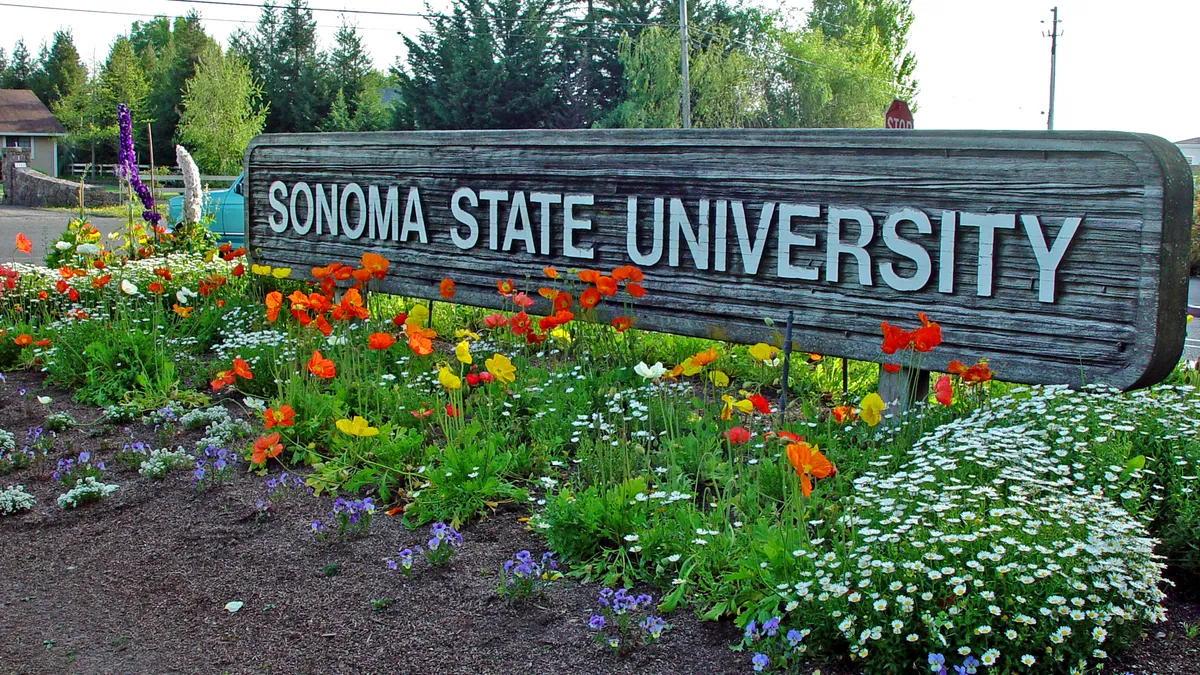
In January 2025, Sonoma State University announced broad cuts to jobs and academic programs, and said it would eliminate its NCAA athletics program. The cost-cutting came in response to what the public California institution’s then-president called the “sobering news” of a $24 million budget hole.
The announcement rocked the campus, sparking protests and a lawsuit over the elimination of athletics and discontinued academic programs that is still playing out in state court.
Since then, the university has gotten help from the state in the form of a one-time $45 million funding boost to help stabilize its finances. This spring, Sonoma State President Michael Spagna, who started in January, told the campus the university has moved on from retrenchment and is in "strategic investment” mode.
The university announced last month that it was relaunching NCAA athletics with 10 men’s and women’s sports beginning in the 2027-28 academic year.
Even before that big announcement, the university has been quietly revamping some of the programs it previously planned to axe. Leading that effort is Stacey Bosick, Sonoma State’s interim provost and chief academic officer. According to Bosick, seven of 19 previously suspended programs are coming back in some form.
Higher Ed Dive sat down with Bosick to talk about how the university went about saving programs that had previously been slated to end.
Editor’s note: This interview has been edited for clarity and brevity.
HIGHER ED DIVE: In April, Sonoma State’s president said the university is “out of cutting mode.” Can you explain how you got there?
STACEY BOSICK: We at Sonoma State have been cutting for years. While we had this momentous big cut that reverberated throughout the academic programs and hit athletics last year, we've actually been cutting prior to that. Those cuts included cutting administrative positions — which is where the campus went first — cutting management positions, streamlining where we could, and thinking about what are the nonessentials.
The cuts that occurred back in [January 2025] occurred under a different leadership and were a last-ditch effort following those prior cuts. It was really truly an open look at all of the programs, even the programs that appeared to be the most viable. Today, we have the fortunate position to ask, “Where do we go from here?”
And when you stepped in as provost, you reconsidered some of those suspended programs? How did that process start?
That's when the creative juices get going on our campus.
Those programs were technically suspended. In my role at the time, it was my job to put those through for discontinuation. But in speaking with faculty, in speaking with leadership, in hearing some of the concerns about the cuts from students and from our communities, I held on to those.
Rather than moving forward with formal discontinuation, we just kept those in a holding pattern. We didn't take students into the programs, but we continued to teach the courses to ensure we were meeting the needs of the current students.
We started having conversations with faculty about where there might be a way to bring a program back — is there a way to do it in a cost-effective way that doesn't undermine the budget?
There is a lot of saying no. You look at the data and see how it's going to play out in a really positive way, and sometimes it's not. Sometimes the math just isn't there. And so there were lots of difficult conversations: “All right, you want to have a program that has X number of units. Can you do it in fewer?”
One was your physics program, right? We’ve seen quite a few physics programs close in retrenchments at other colleges and universities. How did you revive that one?
Physics was low-enrolled — but an outstanding program. Students are working with faculty on campus literally launching satellites into space. It is a hands-on, exciting, thrilling program. It is no joke. I used to have this misconception that those experiences might not be available at smaller campuses, that those are R1-type experiences. Actually, there's more of it available here for students. We continue to be able to attract top faculty, who frankly could have been at any university in the U.S. or abroad, who are creative, and are at a university like this because they like teaching and want to work with students.
The problem was that there weren't enough students in some of those classes. Those are really tough classes, and not all of our students are math-ready coming into college. So we are doing our best to get them math-ready. We see that as our obligation and promise to students.
When I started talking more with the physicists and their dean, it became clear that they had some really great ideas about how to make their program more efficient. How often do we need to offer this course? Do we need to offer it every semester, or could we offer it once every four semesters?
We need to have a very clear pathway for students and very clear course rotations. Unfortunately, what that means is that we had to lose some of our best lecturers who really contribute to students' lives.
The flip side of that is that students here are exposed to our tenure-track faculty who have this deep research experience, who are going after grants and have these rich experiences to offer to students. It's imperfect. There's no perfect pathway through cuts, but I'm a lot more excited about having a breadth of deep experiences for students — and for our faculty to be able to live out their dream of working with students in these rich ways — than to cut programs.
What are some of the other programs that you have kept and revamped?
Geology was slated to be cut. What we did there is an unorthodox move where we moved it into our College of Humanities, Social Sciences, and the Arts. Geology would normally be found in the sciences, right? But we moved it over there so that they could team up with environmental science.
They trimmed their curriculum extensively. Now students come in and take courses that fit two pathways: environmental science and geology. Then, there's a sort of branching off point where students — having been exposed to careers and opportunities in environmental science and in geology — have a much wider perspective. When they go into the workforce, they're going to understand the pivots that are possible in those fields and how these fields overlap. They have a rich understanding of the environment and the way human interaction is shaping the environment.
Was this marriage easy between these programs? No. I tend to be an optimist and celebratory, and I'm excited about what we're doing here. There are challenges. But these folks did the hard work and had many difficult meetings. What's helped is our ongoing partnership with the California Department of Water Resources. I had extensive conversations about what they actually need out of our students. What they told me is, “We've got some trouble ahead because geology is being dropped in places, and so we're going to have a shortage of licensed geologists.”
Geology is a case where employers had a need that wasn't being met. What about cases where employers don't necessarily see the value of a program, but you are producing students that, in the long run, could very much meet their needs? I'm really thinking of the liberal arts, where you're trying to develop critical thinkers.
That's where the conversations need to happen. It's not unlike a marriage, where you make assumptions about what is going on in the other person's world if you don't talk to one another.
I don't want our faculty to feel as though they need to become master salespeople. I want them to thrive and do the beautiful work that they do, and to bring that wonderful diversity of experience and disciplines to campus. I'm a trained sociologist, a former sociology professor of 10 years and taught criminology courses. I don't want to sell that. I want to convince students because they see how happy I am, and how I think about the world in a different way.
But we do have a job to meet up with the community on careers. What I find is that normally when we get into the weeds and actually have those conversations about what do you need, what do we offer — we do get there.
Was history also one of the programs that was revived? Again, we see a lot of history programs shuttering, and I think a lot of history programs feel like they're under siege.
One of the trends that we're seeing in higher ed is shuttering programs that aren't the largest on campus. I think that's a fundamental mistake. There are plenty of ways to run small programs. You don't need every program on your campus to be business.
With history specifically, we're already thinking about doing a blended program with our BA and our MA. What that means is that instead of offering a course at the undergraduate level and separately at the graduate level, we can offer more split courses where the faculty member is actually using both bodies of students to enlighten and enrich the other.
Many of our graduate students who are going into history ultimately are doing so to better their careers, or to go into teaching at community colleges or in high schools. Having the opportunity to work with undergraduates in their course enables them to see what that would be like. At the same time, the experiences of the undergraduates are enriched by having graduates in their classroom who have more experience ripping apart literature, questioning history and being critical about whose history is being written.
What it allows us to do from a technical standpoint is reduce the cost of the program by having, again, clear course rotations, clear scheduling and a straightforward pathway through the program. Our faculty are teaming across the curriculum, so that our undergraduates in ethnic studies and in political science also have a clear trajectory into that master’s in history in a streamlined way.