

Dive Brief:
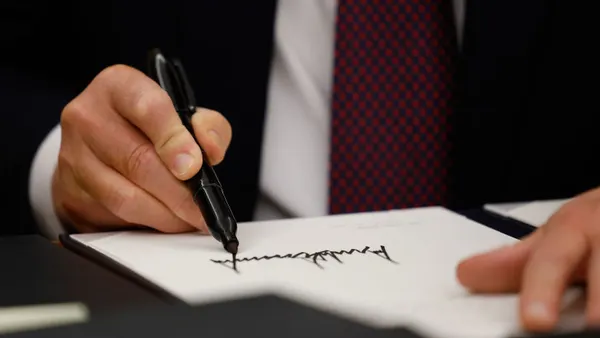
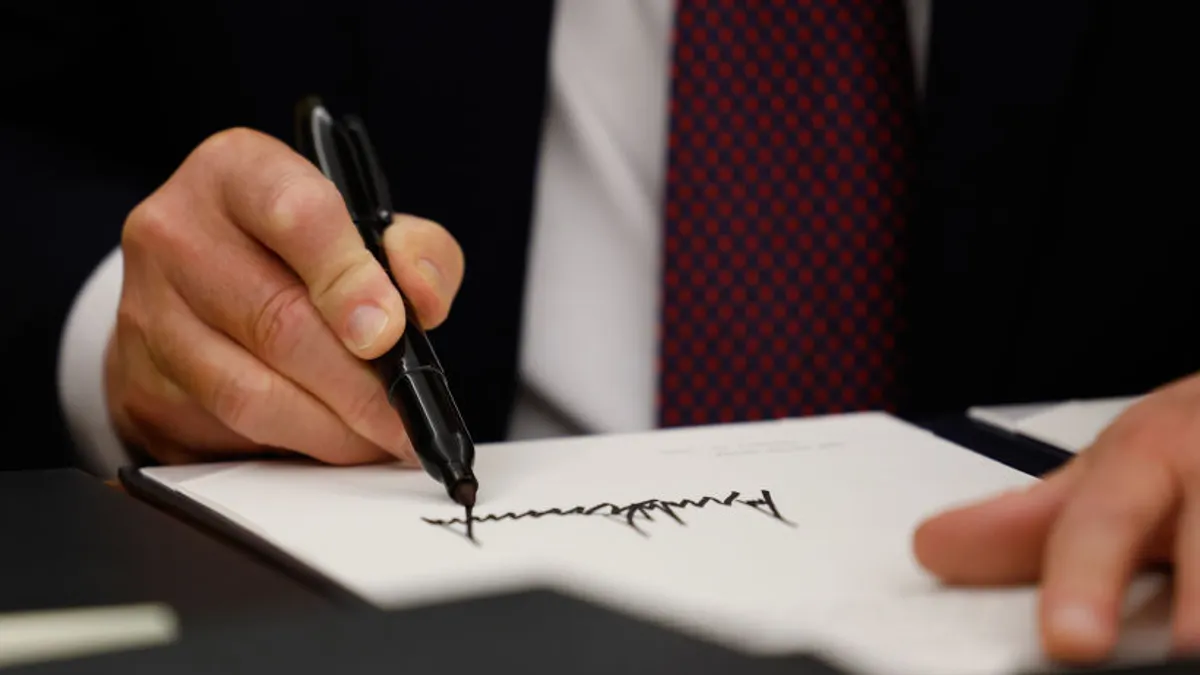
- A federal judge on Wednesday declined to block President Donald Trump’s March executive order that threatens to strip federal contracts from colleges and other organizations over their diversity, equity and inclusion efforts.
- The order prohibits contractors from engaging in “disparate treatment based on race or ethnicity” in recruitment, employment and other areas. Higher education groups sued in April to stop the order’s implementation.
- In his opinion, U.S. District Judge Adam Abelson concluded the plaintiffs failed to show they would likely win their case and denied their request for a preliminary injunction request. He also outlined limits in the executive order’s scope, writing that it only applies to conduct that is “already prohibited by federal law.”
Dive Insight:
In their lawsuit, plaintiffs argued that Trump’s March order was overly broad and vague and violated their First and Fifth Amendment rights.
“The Administration views discussion of race and ethnicity as unlawful, and the very concepts of diversity, equity, and inclusion as discriminatory. But that is flat wrong,” they argued in their original complaint. “The Contractors Order sanctions legal, and laudable, expression on race or ethnicity, and in doing so, violates the free speech, free association, and due process rights of Plaintiffs and their members.”
The plaintiffs include the National Association of Diversity Officers in Higher Education, the American Association of University Professors, and United Academics of Maryland-University of Maryland, College Park.
Abelson, a Biden appointee, disagreed with the groups’ constitutional arguments.
He pointed to the order’s “operative phrase” that banned “disparate treatment based on race or ethnicity,” terminology that the judge noted was synonymous with intentional discrimination. That language “has a settled antidiscrimination-law meaning that materially narrows the provision’s reach,” Abelson wrote.
Democracy Forward, the advocacy nonprofit representing the plaintiffs, said the ruling provides “clarity” for federal contractors and “defangs” Trump’s order.
In a news release Wednesday, the group pointed to language from Abelson explaining that the order “only prohibits contractors from engaging in conduct that is already prohibited by federal law: intentional discrimination on the basis of race or ethnicity.”
In an emailed statement Thursday, NADOHE President and CEO Emelyn dela Peña said, “The ruling was a clear win for NADOHE and our members, both substantively and in terms of the ruling’s practical impact, despite the court denying our request for a preliminary injunction.”
She added, “As a result of this ruling, leaders of colleges and universities no longer need to second-guess whether their lawful activities to support inclusive and diverse campus communities violate the executive order.”
In his opinion, Abelson cited in part precedent from an appeals court ruling against some of the same plaintiffs suing over earlier Trump executive orders targeting DEI.
One of those orders directed federal agencies to cancel “equity-related” grants and contracts to “to the maximum extent allowed by law,” while another required federal funding recipients to certify that they do not engage in activities “that violate any applicable Federal anti-discrimination laws.”
After a lower court initially blocked the orders, the 4th U.S. Circuit Court of Appeals concluded that the certification requirement only required recipients to affirm that their DEI programs don’t violate antidiscrimination law.
Moreover, the groups could still challenge specific enforcement actions stemming from that order that they believe misinterpret antidiscrimination law, a majority for the appeals panel wrote.