Dive Brief:
- The U.S. Department of Justice and the office of Kansas' attorney general on Wednesday asked a federal judge to strike down a state law allowing certain undocumented college students to pay in-state tuition rates.
- The joint motion came just hours after the DOJ sued Kansas over the decades-old law, marking the 10th lawsuit the federal agency has filed over such state policies.
- A judge would need to sign off on the motion to invalidate the law. If approved, Kansas would be the fifth state to side with the Trump administration in court to successfully strike down its own in-state tuition laws.
Dive Insight:
Since 2004, undocumented students in Kansas have been eligible to pay in-state tuition rates at public colleges if they:
- Attended an accredited Kansas high school for at least three years.
- Graduated from high school or earned a GED in Kansas.
- Signed an affidavit stating that they will apply to obtain lawful immigration status as soon as possible.
Over 5,100 undocumented students used the policy to enroll at Kansas colleges from 2010 to 2021, according to a former member of the Kansas Board of Regents.
The price difference between in-state and out-of-state tuition is often dramatic and can determine whether many students attend college or not. The University of Kansas lists its baseline in-state tuition as roughly $11,300 for the 2025-26 academic year. The sticker price for out-of-state students was nearly triple that, at about $30,200.
Under the Trump administration, the DOJ has methodically challenged in-state tuition policies for undocumented students in court. The agency on Wednesday argued that Kansas’ law violates a federal statute prohibiting states from giving undocumented students access to higher education benefits based on state residency if they aren't also available to out-of-state U.S. citizens.
“Kansas’s unconstitutional and un-American laws should never have been passed in the first place and are prohibited by federal law,” Brett Shumate, assistant attorney general of the DOJ’s civil division, said in a statement.
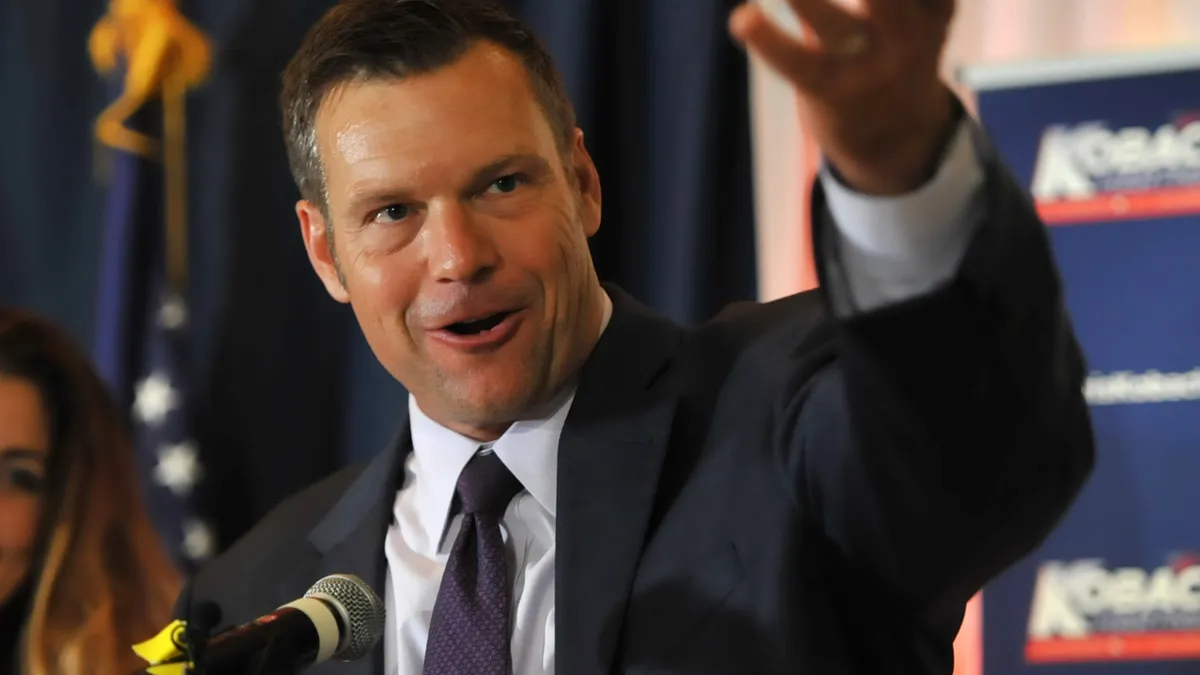
The American Civil Liberties Union of Kansas blasted the joint move by the Trump administration and Kansas Attorney General Kris Kobach.
“Kobach is so determined to collude with the Trump-Vance administration that he will misuse our courts to attack the laws of the very state he serves," Micah Kubic, executive director of ACLU Kansas, said in a statement Wednesday. "He does not, in fact, get to single-handedly decide who is a Kansan."
Kobach's office did not immediately respond to questions Wednesday.
The law has divided Republicans in Kansas. Still, the Republican-controlled Legislature narrowly passed a bill earlier this year that sought to repeal the law. They received vocal support from Kobach, a Republican.
But Democratic Gov. Laura Kelly vetoed the bill in April, saying it targeted Kansas residents who were brought to the U.S. as children.
“America’s immigration system is broken, but this is not the way to fix it," she said in her veto. "To punish these kids for decisions their parents made years ago is not only cruel, but also not in the best interest of the state. Kansas needs these young people to be educated and trained so they can enter our workforce and contribute to our state’s economy."
The DOJ has so far filed lawsuits against nine other states over their in-state tuition policies for undocumented students: California, Illinois, Kentucky, Minnesota, Nebraska, New Jersey, Oklahoma, Texas and Virginia.
Shumate on Wednesday touted his agency's wins "on this exact issue in Texas, Oklahoma, Kentucky, and Nebraska." In each case, the lawsuits did not go to trial. Instead, the states' attorneys general quickly sided with the DOJ and moved to have their laws struck down.
Officials from other states, including Minnesota, have fought back. A federal judge in March dismissed the Trump administration's lawsuit against Minnesota, ruling the state's laws offer the same benefits to both citizens and undocumented residents. The DOJ has since appealed that decision